
Cannabis for Parkinson’s: 2026 Research Update
Cannabis Parkinson's research update for 2026: evidence, risks, product considerations, and safe questions to ask your clinician.

Interest in cannabis Parkinson’s support has grown because people living with Parkinson’s disease often deal with more than tremor. Sleep disruption, muscle stiffness, pain, anxiety, appetite changes, and medication side effects can all affect daily quality of life. That does not mean cannabis is a proven treatment for Parkinson’s, and it definitely does not mean anyone should replace prescribed therapy with CBD or THC. It means the research question is worth taking seriously, especially for adults who want a balanced, safety-first view before speaking with a clinician.
Parkinson’s disease is a progressive neurological condition involving movement symptoms and non-motor symptoms. The National Institute of Neurological Disorders and Stroke explains that symptoms can include tremor, slowness, rigidity, sleep issues, mood changes, and cognitive changes. Cannabis products interact with the body’s endocannabinoid system, which is why researchers are examining whether cannabinoids might influence pain, sleep, inflammation, mood, or movement-related symptoms. The short version for 2026: early data is interesting, patient reports are common, but high-quality clinical evidence remains limited.
📺 Video Guide
Cannabis Parkinson’s Research: What the Evidence Says
The most honest answer is that cannabis and Parkinson’s research is still early. Some observational reports suggest people may notice improvements in sleep, pain, anxiety, tremor, stiffness, or general comfort. However, observational reports cannot prove cause and effect. People choose their own products, doses vary, THC and CBD ratios are inconsistent, and placebo effects can be strong in symptom-based conditions.
A search of PubMed cannabis and Parkinson’s studies shows a growing but still uneven evidence base. Reviews in the NCBI literature archive often conclude that cannabinoids deserve further study, especially for non-motor symptoms, but they stop short of recommending cannabis as a standard Parkinson’s therapy. The Michael J. Fox Foundation also takes a cautious position: some people report benefits, but controlled trials are small and results are mixed.
The gap between patient experience and clinical proof matters. A person may genuinely feel better after using a cannabis product, while the medical community still lacks enough evidence to predict who will benefit, which product works best, and what risks apply to older adults or people using multiple medications.
✓ Key Research Takeaways
- ✓ Evidence is strongest as a conversation starter, not as a replacement therapy.
- ✓ Non-motor symptoms such as pain and sleep are often the most practical research targets.
- ✓ Product consistency, dose, age, and medication interactions change the risk profile.
Motor Symptoms: Tremor, Rigidity, and Dyskinesia
Many people first search for cannabis because they have seen dramatic videos of tremor reduction. Those stories are compelling, but they are not the same as controlled evidence. Parkinson’s motor symptoms are complex, and they may fluctuate throughout the day depending on levodopa timing, sleep, stress, food intake, and disease stage. A visible improvement after cannabis may be meaningful for that individual, but it does not tell us whether the same product will help another person.
The Parkinson’s Foundation notes that evidence for marijuana in Parkinson’s remains inconclusive and that side effects can include dizziness, confusion, hallucinations, and balance problems. That is especially important because falls are already a major risk for many people with Parkinson’s. High-THC products may worsen balance, attention, or mood in sensitive users.
Dyskinesia, or involuntary movement related to long-term dopaminergic therapy, is another area of interest. Some cannabinoid trials have looked at dyskinesia, but results have not been strong enough to make cannabis a reliable recommendation. For now, motor symptom management should stay anchored in neurologist-directed care, medication optimization, physical therapy, and evidence-based movement support.
Non-Motor Symptoms May Be the More Realistic Target
The more realistic cannabis Parkinson’s discussion often focuses on non-motor symptoms. Pain, sleep disruption, anxiety, appetite, and general relaxation may affect quality of life as much as tremor. These are also areas where adults commonly explore CBD oils, balanced CBD:THC products, or carefully dosed evening options.
The CDC’s cannabis health effects overview warns that cannabis can affect memory, coordination, reaction time, and mental health. For someone with Parkinson’s, those effects matter because the baseline condition may already involve movement, sleep, and cognitive challenges. Meanwhile, the FDA’s cannabis and CBD page reminds consumers that many cannabis-derived products are not evaluated like approved medicines.
If a clinician agrees that a patient may explore cannabis, non-motor goals should be specific. Instead of asking, “Does cannabis help Parkinson’s?” ask: “Can this product help my sleep without increasing fall risk?” or “Could CBD affect my current medicines?” Specific goals make it easier to assess whether a product is helping or simply adding another variable.
💡 Pro Tip
Track one symptom at a time for two weeks: sleep quality, pain score, anxiety, appetite, or evening stiffness. A simple log is more useful than vague memory.
CBD, THC, and Product Choice
CBD and THC are not interchangeable. THC is intoxicating and may influence mood, perception, appetite, sleep, and coordination. CBD is non-intoxicating, but it can still interact with liver enzymes and medications. The DEA cannabis fact sheet and the World Health Organization CBD Q&A both highlight why cannabinoid type and product quality matter.
For cautious adults, CBD-forward products are often the first discussion point because they avoid intoxication. Puff ‘n Pass readers comparing oils can review our internal guide to CBD capsules vs softgels and our CBD drug interactions guide before speaking with a professional. Product pages such as CBD Oil 10 10ml or CBD Oil 20 Full Spectrum 10ml can help shoppers understand format and strength, but they should not be treated as disease-specific recommendations.
THC products require more caution in Parkinson’s because intoxication may amplify dizziness, confusion, anxiety, hallucinations, or impaired balance. People with a history of psychosis, severe anxiety, memory problems, heart rhythm concerns, or frequent falls need careful medical advice before using THC.
Safety Checklist Before Trying Cannabis
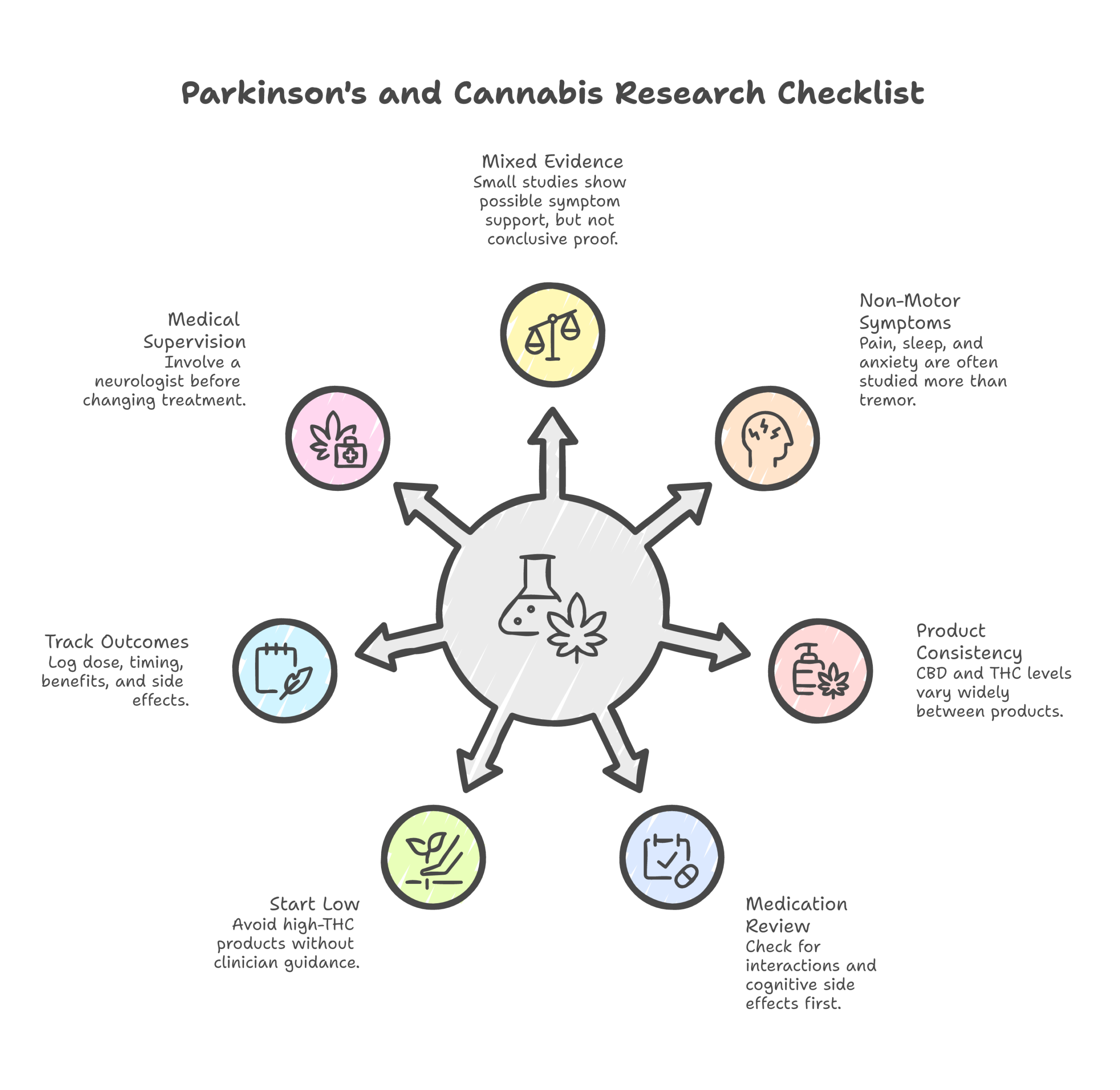
A safety-first checklist is essential because Parkinson’s often affects older adults who may take several medicines. The ClinicalTrials.gov cannabis and Parkinson’s listings show ongoing research interest, but trial activity does not equal established treatment. Until stronger evidence exists, the smartest approach is conservative and documented.
First, review all medicines with a neurologist or pharmacist. This includes levodopa combinations, dopamine agonists, sleep medications, antidepressants, blood thinners, blood pressure medication, and anti-anxiety medication. Second, choose a product with transparent labeling and, ideally, third-party testing. Our guide on how to read cannabis lab reports explains why certificates of analysis matter. Third, avoid driving or risky activity after use, especially when trying a new product.
Fourth, start with the lowest practical dose and do not combine cannabis with alcohol. Fifth, track side effects such as dizziness, confusion, sleepiness, mood changes, hallucinations, stomach upset, or worsening balance. Sixth, stop and seek medical advice if symptoms worsen. For broader wellness context, our articles on cannabis for seniors and cannabis for chronic pain may help frame safer conversations.
📝 Important Note
Do not change Parkinson’s medication timing or dose because a cannabis product seems helpful. Any change to Parkinson’s therapy should go through the treating neurologist.
Questions to Ask Your Doctor
The best cannabis Parkinson’s conversation is practical, not ideological. Bring a product label, ingredient list, cannabinoid ratio, intended dose, and symptom goal. Ask whether CBD or THC may interact with current medication. Ask whether the product could worsen fall risk, hallucinations, low blood pressure, daytime sleepiness, or cognition. Ask what symptoms should trigger stopping immediately.
It is also worth asking whether there are better-supported options for the same symptom. Sleep therapy, medication adjustment, exercise, physiotherapy, nutrition, hydration, mental health support, and pain management may be more appropriate than cannabis for many people. Cannabis should fit into a wider care plan, not become the whole plan.
For adults who are cleared to explore products, the safest mindset is “small, slow, and measured.” A carefully selected CBD-forward product, a written symptom goal, and a clinician-approved plan are more responsible than chasing strong effects. In Parkinson’s care, consistency beats intensity.
Bottom Line for 2026
Cannabis for Parkinson’s is not a miracle cure, and it is not ready to be treated as a standard medical therapy. The strongest 2026 position is cautious interest. Researchers continue to study cannabinoids because the biology is plausible and patient reports are common. At the same time, the evidence is too mixed to promise reliable benefits for tremor, rigidity, dyskinesia, or disease progression.
Where cannabis may have the most practical role is symptom support for selected adults, especially around sleep, pain, anxiety, or relaxation, when reviewed by a clinician. Quality, dose, cannabinoid ratio, medication interactions, and fall risk matter more than hype. If you or a loved one is considering cannabis, start with education, ask specific medical questions, and choose transparent products from a trusted source.
⚠️ Disclaimer
This article is for informational purposes only and does not constitute medical advice. The information provided about medical cannabis in Greece is current as of May 2026 but may change. Always consult with qualified healthcare professionals for medical advice and treatment options. Decisions about medical cannabis should be made in consultation with authorized healthcare providers who understand your specific medical history and conditions. For our full disclaimer, visit cannastoreams.gr/disclaimer.
Frequently Asked Questions
Can cannabis treat Parkinson’s disease?
No. Cannabis is not an established treatment for Parkinson’s disease progression. Some adults explore it for symptom support, but evidence remains limited and medical supervision is important.
Is CBD safer than THC for Parkinson’s?
CBD is non-intoxicating, while THC can impair balance, thinking, and mood. CBD can still interact with medications, so safer does not mean risk-free.
What symptoms are people usually targeting?
Most practical discussions focus on sleep, pain, anxiety, appetite, relaxation, or general comfort. Evidence for motor symptoms like tremor is less reliable.
Can cannabis interact with Parkinson’s medication?
Yes, interactions and additive side effects are possible, especially with sedatives, mood medication, blood pressure drugs, and complex Parkinson’s regimens. Ask a doctor or pharmacist first.
What is the safest way to explore cannabis?
Discuss it with a clinician, choose transparent products, start low, avoid combining with alcohol, and track benefits and side effects carefully.
