Planning a trip and wondering what happens to your cannabis travel tips routine when you cross state lines or international borders? You are not alone. Millions of travelers face this question every year, and the answers are rarely straightforward. Cannabis laws vary wildly between countries, states, and even cities, and what is perfectly legal at home could land you in serious trouble at your destination.
This guide breaks down what you actually need to know before you pack your bags: where cannabis is legal for travelers, how to handle airports and border crossings, and practical alternatives when carrying your own supply is not an option.
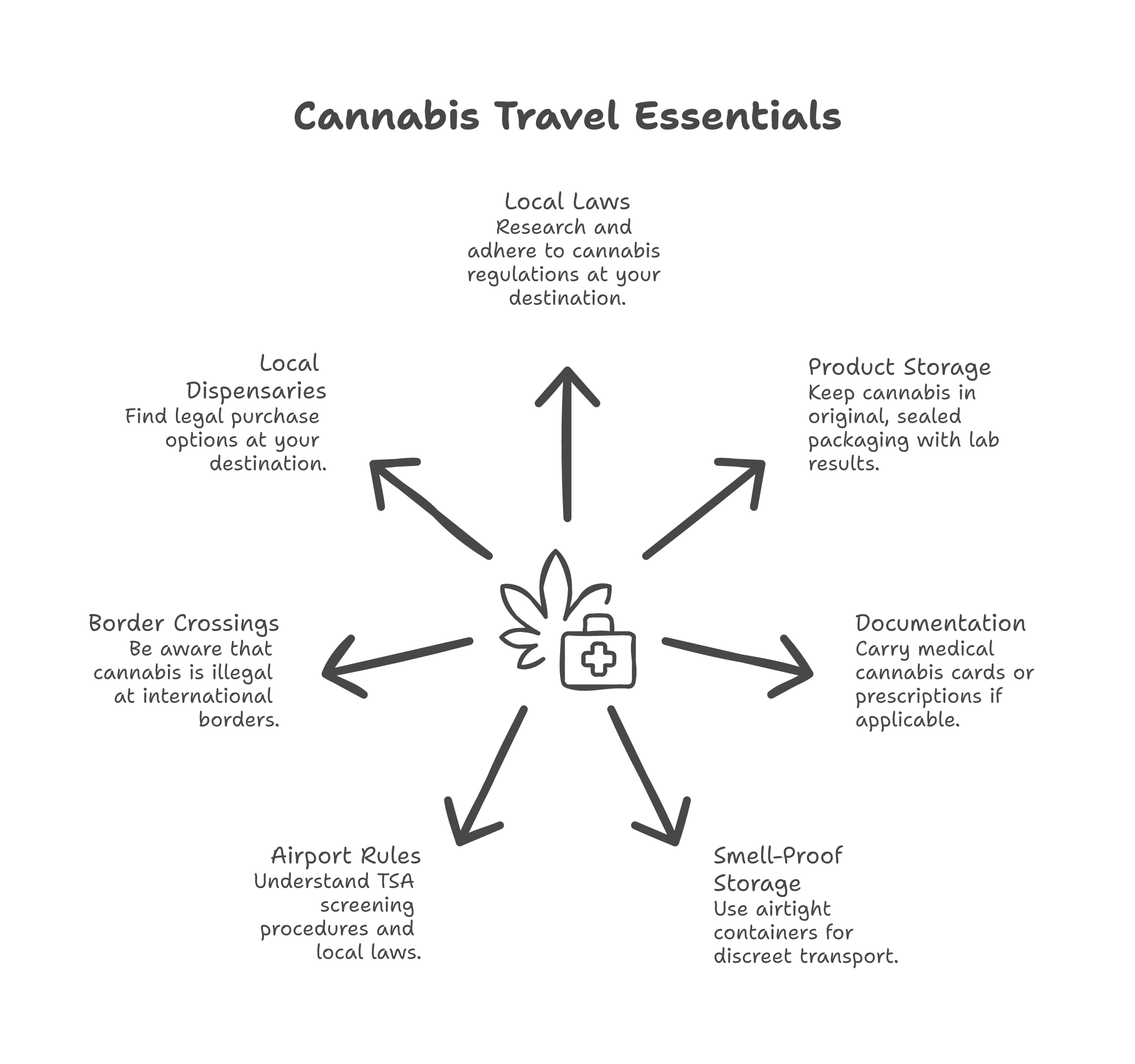
Know the law before you go
This sounds obvious, but most cannabis travel problems start with assumptions. Just because recreational cannabis is legal in your home state or country does not mean your destination shares the same rules. The United Nations Office on Drugs and Crime classifies cannabis as a controlled substance under international treaties, and most countries still follow those guidelines.
In Europe, the situation is a patchwork. The European Monitoring Centre for Drugs and Drug Addiction (EMCDDA) tracks cannabis policies across EU member states, and the differences are striking. The Netherlands tolerates small amounts in licensed coffeeshops. Spain allows private consumption in cannabis clubs. Greece permits CBD products with THC below 0.2%, but recreational cannabis remains illegal. Germany legalized personal possession up to 25 grams in April 2024, while neighboring France maintains strict prohibition.
In the United States, 24 states plus Washington D.C. have legalized recreational cannabis as of 2026, according to the National Conference of State Legislatures. But here is the catch: cannabis remains a Schedule I substance under federal law, and airports, highways, and border crossings fall under federal jurisdiction.
📝 Important Note
Laws change quickly. Thailand legalized cannabis in 2022 and partially reversed course by 2024. Always check government sources within 48 hours of your departure date, not a blog post from six months ago.
Flying with cannabis: what TSA actually does
The Transportation Security Administration (TSA) states clearly on their website that their screening procedures focus on security threats, not drugs. Their officers are not specifically looking for cannabis. However, if they find it during a routine check, they are required to report it to local law enforcement.
What happens next depends entirely on where you are. At LAX or Denver International, local police will generally let you go since state law permits possession. At Dallas/Fort Worth or Atlanta, you could face criminal charges because those states still prohibit cannabis.
For international flights, the calculation changes completely. Bringing cannabis across national borders violates federal law in the U.S. and international smuggling laws in most other countries. The U.S. Customs and Border Protection actively screens for controlled substances, and penalties can include arrest, fines, and being banned from future entry.
Domestic travel between legal states
Driving between two legal states in the U.S. might seem safe, but the route matters. If you drive from Colorado to California, you pass through Utah and Nevada. Utah has strict cannabis laws for recreational use. Getting pulled over with cannabis in your car in a prohibition state creates a problem regardless of where you bought it.
The same applies in Europe. Driving from the Netherlands through Belgium to France with cannabis products purchased legally in Amsterdam puts you at risk in both Belgium and France, where possession penalties range from fines to imprisonment.
If you choose to transport cannabis between legal jurisdictions, keep products in sealed, original packaging in the trunk of your vehicle. Keep quantities within the legal possession limit of your destination, not your origin. And never consume while driving, as impaired driving laws apply everywhere.
✓ Smart Travel Practices
- ✓ Research cannabis laws at every stop along your route, not just the destination
- ✓ Keep products in original sealed packaging with visible labels
- ✓ Store everything in the trunk, away from the driver’s reach
- ✓ Carry documentation: receipts, medical cards, or prescriptions
- ✓ Stay within the possession limit of your destination state or country
Medical cannabis and travel documentation
Medical cannabis patients have slightly more options, but the protections are limited. In the U.S., some states offer reciprocity for out-of-state medical cards. According to NORML’s state-by-state guide, states like Arkansas, Missouri, and New Hampshire accept visiting patient cards. Others, like New York, require you to register as a temporary patient.
In Europe, the International Narcotics Control Board (INCB) provides guidelines for traveling with controlled medications. You will need a medical certificate translated into the local language, your original prescription, and products in pharmaceutical packaging. Some countries require advance notice to their health ministry.
Greece’s medical cannabis program allows patients with qualifying conditions to access cannabis-based medicines, but the program is relatively new and does not extend reciprocity to foreign visitors. If you are traveling to Greece with medical cannabis, consult the Greek National Organization for Medicines (EOF) for current requirements.
CBD products: the gray area
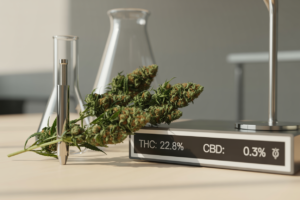
CBD complicates travel in its own way. In the U.S., the FDA permits hemp-derived CBD products containing less than 0.3% THC under the 2018 Farm Bill. TSA allows these products in both carry-on and checked bags. But the packaging matters: if your CBD oil does not clearly show THC content, an officer may flag it for testing.
In the EU, CBD regulations vary by country. The EU Court of Justice ruled in 2020 (the Kanavape case) that CBD is not a narcotic, but individual member states still set their own THC thresholds. Austria permits 0.3% THC. Italy allows 0.6%. France attempted to ban CBD flower entirely before courts struck down the restriction.
Asian countries are far less forgiving. Japan, South Korea, Singapore, and the Philippines maintain zero-tolerance policies for all cannabis derivatives, including CBD. Getting caught with a CBD oil that contains any detectable THC in these countries can result in years of imprisonment. The U.S. State Department publishes country-specific travel advisories that include drug law summaries worth reading before departure.
💡 Pro Tip
When traveling with legal CBD products, bring the Certificate of Analysis (COA) from the manufacturer. This lab report shows exact cannabinoid content and can help you prove compliance with local THC limits if questioned.
Cannabis-friendly destinations in 2026
If you want to incorporate cannabis into your travel experience, the smarter approach is to buy locally rather than transport. Several destinations welcome cannabis tourism with legal frameworks designed for visitors.
Canada legalized recreational cannabis nationally in 2018, making it one of the easiest countries for cannabis travelers. Licensed dispensaries operate in every province, and Health Canada publishes clear possession and purchase limits for adults.
Uruguay was the first country to legalize cannabis nationally in 2013. Foreign visitors cannot purchase from pharmacies (that system requires residency), but cannabis clubs are accessible with membership.
Thailand decriminalized cannabis in 2022, though the government has since moved to re-regulate recreational use. Dispensaries still operate in Bangkok, Chiang Mai, and tourist areas, but check Thailand’s FDA for current rules before you go.
The Netherlands still operates its coffeeshop model in Amsterdam and other cities, though recent years have seen discussions about restricting tourist access in some municipalities.
U.S. legal states like Colorado, California, Oregon, and Illinois have mature dispensary networks with products available to anyone 21+. Some states even offer cannabis consumption lounges where you can use products on-site.
Practical packing and storage tips
When traveling within legal jurisdictions where transporting cannabis is permitted, how you pack matters for both legality and product quality.
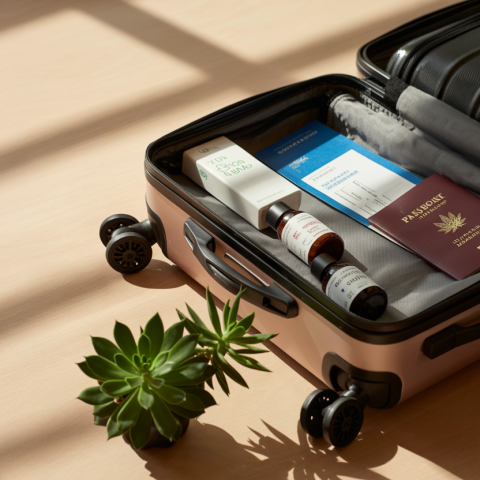
Keep original packaging. Dispensary packaging includes strain name, THC/CBD percentages, batch numbers, and the dispensary’s license information. This documentation proves you purchased legally and helps with any law enforcement interactions.
Use smell-proof containers. Airtight containers prevent odor from attracting attention during transit. They also protect flower from drying out or getting crushed. Many cannabis storage solutions are designed specifically for travel, with humidity control packs built in.
Separate products. If you are carrying flower, edibles, and tinctures, keep each in its own sealed container. Edibles should stay in original child-resistant packaging. Liquids like tinctures and oils must follow TSA’s 3-1-1 rule for carry-on luggage (3.4 ounces or less per container).
Temperature control. Edibles containing chocolate or butter can melt. Cartridges and vape pens should not be checked in luggage due to lithium battery regulations and should stay in your carry-on according to FAA guidelines.
What to do if you get caught
Despite your best preparations, things can go wrong. If law enforcement discovers cannabis in your possession while traveling, your response matters.
Stay calm and cooperative. Do not attempt to hide or dispose of products once an officer has initiated contact. In the U.S., you have the right to remain silent and the right to an attorney. Exercise both. Politely decline to answer questions about where you bought the cannabis or where you were taking it, and ask for legal representation.
Abroad, the situation is more complicated. The U.S. Embassy can provide a list of local attorneys and notify your family, but they cannot get you out of jail or override local laws. Some countries impose mandatory minimum sentences for drug offenses that apply to tourists and citizens equally.
For travelers from Greece, the Greek Ministry of Foreign Affairs provides consular assistance for citizens detained abroad. Register your trip with them before departure.
Cruise ships, trains, and buses
Cruise ships operate under maritime law and the flag state of the vessel. Nearly all major cruise lines, including Royal Caribbean, Carnival, and Norwegian, prohibit cannabis regardless of departure port or itinerary. Ships departing from legal states like California still enforce their own zero-tolerance policies, and cabin searches do happen.
Amtrak and Greyhound in the U.S. both prohibit cannabis on their vehicles and in their stations, citing federal law. European rail operators like Deutsche Bahn follow national laws, which means cannabis possession on a train is governed by whichever country you are currently passing through.
Rideshare drivers (Uber, Lyft) can refuse passengers with visible cannabis or strong odor. Both companies allow drivers to cancel rides and report passengers. If you need to transport recently purchased cannabis, keep it sealed and stored discreetly.
Hotel and accommodation policies
Even in legal states and countries, most hotels prohibit smoking cannabis on their premises. This applies to both flower and vape pens in many cases. Some hotels charge cleaning fees of $250 or more if staff detect cannabis odor in your room.
Cannabis-friendly accommodations are growing. Platforms like Bud and Breakfast list properties that welcome cannabis use, primarily in Colorado, California, and Oregon. Some Airbnb hosts in legal areas explicitly allow cannabis use in their listing rules. Always confirm before booking and look for written permission in the listing description.
Edibles and vaporizers are often the most accommodation-friendly options since they produce minimal odor. Cannabis-infused beverages are another discreet choice that works well in both hotel rooms and vacation rentals.
Frequently Asked Questions
Can I fly with cannabis between two legal U.S. states?
Technically, flying with cannabis is a federal offense regardless of state laws, since airports and airspace fall under federal jurisdiction. However, TSA does not actively search for cannabis and focuses on security threats. Some airports in legal states, like LAX, have policies allowing passengers to carry state-legal amounts through checkpoints. The risk is low on domestic flights between legal states, but it is not zero.
Is it safe to travel internationally with CBD oil?
It depends on the destination. Most Western European countries and Canada allow CBD products with low THC content. However, countries in Asia and the Middle East often treat all cannabis-derived products as illegal narcotics. Always check your destination’s specific CBD regulations and carry a Certificate of Analysis showing THC content.
Will my medical cannabis card protect me in another state?
Only if that state offers reciprocity. About a dozen U.S. states accept out-of-state medical cards, including Arkansas, Missouri, and Oklahoma. Others require you to register as a temporary patient. Check NORML’s state-by-state guide for current reciprocity information before traveling.
What happens if a drug dog alerts on me at the airport?
Most airport K-9 units are trained for explosives detection, not narcotics. However, some airports use narcotics-trained dogs, particularly at international terminals and customs areas. If a dog alerts, officers will search your belongings. What happens next depends on local law: in legal states, small amounts may be confiscated or ignored; in prohibition states, you could face criminal charges.
Can I bring cannabis on a cruise ship departing from a legal state?
No. All major cruise lines prohibit cannabis regardless of departure port. Ships operate under maritime law and their flag state regulations, and cannabis remains illegal under both U.S. federal law and international maritime conventions. Bringing cannabis aboard can result in confiscation, fines, and being removed from the ship at the next port.
⚠️ Disclaimer
This article is for informational purposes only and does not constitute legal advice. Cannabis laws vary by jurisdiction and change frequently. The information provided is current as of March 2026 but may not reflect the latest legislative changes. Always verify local laws at your specific origin, transit, and destination points before traveling with any cannabis products. For legal advice, consult a qualified attorney familiar with cannabis law in the relevant jurisdictions. For our full disclaimer, visit cannastoreams.gr/disclaimer.