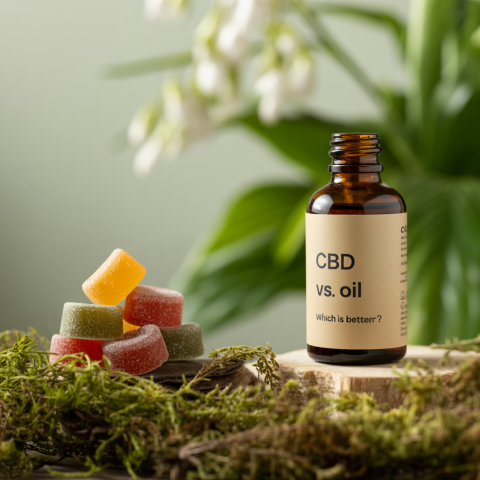
If you have been looking into CBD products recently, chances are you ran into the same fork in the road everyone hits: gummies or oil? Both deliver cannabidiol into your body, but the way they do it, how fast they work, and who they suit best could not be more different. This guide walks through every factor that actually matters so you can pick the format that fits your life.
📺 Video Guide
What Are CBD Gummies?
CBD gummies are chewable edibles infused with a pre-measured dose of cannabidiol. They look and taste like regular candy, which is a big part of their appeal. Most brands offer doses ranging from 5 mg to 50 mg per gummy, and flavors run the full spectrum from sour watermelon to mango and mixed berry.
When you eat a gummy, it passes through your digestive system before the CBD enters your bloodstream. This process, called first-pass metabolism, means your liver breaks down a portion of the CBD before it circulates. The trade-off is a slower onset but a longer-lasting effect, typically 4 to 6 hours.
Gummies have grown into the largest CBD product category in the United States, according to Grand View Research. Part of that comes down to simplicity: you do not need to measure anything or deal with an earthy aftertaste.
What Is CBD Oil?
CBD oil, sometimes called a tincture, is a liquid extract of cannabidiol suspended in a carrier oil like MCT, hemp seed, or olive oil. You take it by placing drops under your tongue (sublingual administration), holding for 30 to 60 seconds, then swallowing.
The sublingual route bypasses your digestive system. Thin blood vessels under the tongue absorb CBD directly into the bloodstream, which is why effects tend to kick in within 15 to 30 minutes. A 2020 review in Molecules found that sublingual bioavailability ranges from 20% to 35%, roughly double what oral ingestion provides.
Oil also gives you precise control over dosing. Most bottles come with a graduated dropper, so you can dial your intake up or down by a single milligram. That flexibility is why many experienced CBD users prefer tinctures, particularly when they are fine-tuning their CBD oil strength for a specific purpose.
CBD Gummies vs Oil: Head-to-Head Comparison
Let’s break this down by the factors that matter most when choosing between the two formats.
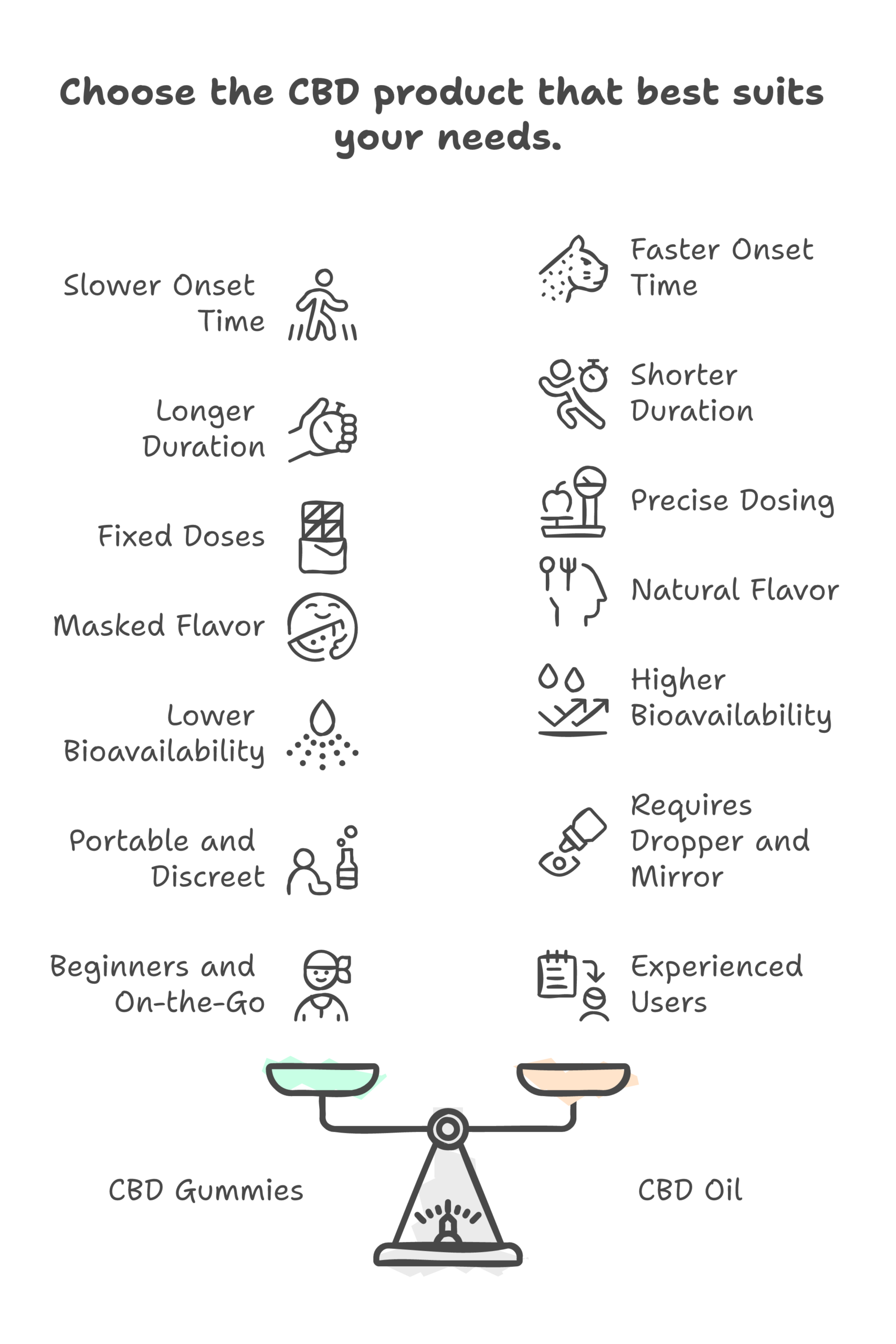
Onset time. Oil wins here. Sublingual absorption gets CBD into your system in 15 to 30 minutes. Gummies need 30 to 90 minutes because they travel through your stomach and liver first. If you want fast-acting relief for sudden discomfort, oil is the better pick.
Duration of effects. Gummies win on staying power. Because digestion releases CBD slowly, the effects typically last 4 to 6 hours. Oil usually lasts 2 to 4 hours. For sustained support through a workday or a full night’s sleep, gummies have the edge.
Bioavailability. This measures how much CBD actually reaches your bloodstream. Oil taken sublingually absorbs roughly 20% to 35% of the dose, based on research published by the World Health Organization. Gummies score lower, around 6% to 15%, because first-pass metabolism chews through a significant portion. In practical terms, a 25 mg gummy may deliver less active CBD than a 25 mg dose of oil.
Dosing precision. Oil lets you adjust by the drop, which matters when you are calculating your ideal CBD dose. Gummies come in fixed increments, so if 12.5 mg is your sweet spot, you are stuck splitting a gummy in half and hoping for accuracy.
Taste and convenience. Gummies taste like candy. Oil tastes like, well, hemp. Some people do not mind the earthy flavor; others find it genuinely unpleasant. Gummies are also easier to carry around. No dropper, no measuring, no mirror. Pop one and move on.
Shelf life and storage. Both products last about 12 to 18 months when stored properly. Gummies should be kept in a cool, dry place to prevent melting. Oil bottles need protection from light and heat. According to the FDA, proper storage is one of the simplest ways to preserve CBD potency.
✓ When to Choose Gummies
- ✓ You are new to CBD and want a simple starting point
- ✓ You dislike the natural taste of hemp extracts
- ✓ You need something portable for travel or work
- ✓ You want longer-lasting effects (sleep support, all-day calm)
✓ When to Choose Oil
- ✓ You want faster relief (15-30 minutes vs 60+ minutes)
- ✓ You need precise control over your dosage
- ✓ You prefer higher bioavailability per milligram
- ✓ You are already experienced with CBD and know your ideal dose
Bioavailability: Why It Matters More Than You Think
Bioavailability is the percentage of a substance that reaches your bloodstream unchanged. It is arguably the most overlooked factor in the CBD gummies vs oil debate.
When you swallow a gummy, your digestive enzymes and liver metabolize a chunk of the CBD before it ever circulates. Research from the National Institutes of Health estimates oral bioavailability at just 6% to 15%. So from a 25 mg gummy, you might absorb 1.5 to 3.75 mg of active CBD.
Sublingual oil performs better. By absorbing through the mucous membranes under your tongue, it skips the liver’s first-pass effect. The same 25 mg dose could deliver 5 to 8.75 mg of usable CBD. That is a meaningful difference, especially if you are managing a specific condition and watching your budget.
Some manufacturers address this gap by adding nanoemulsion technology to their gummies, which breaks CBD particles into smaller sizes for better absorption. A 2022 study published in Pharmaceutics found that nano-CBD formulations can increase oral bioavailability by up to four times compared to standard gummies.
💡 Pro Tip
If you go with gummies, take them with a meal containing healthy fats. Research from the University of Minnesota showed that eating CBD with fatty foods can increase absorption by up to 5 times compared to taking it on an empty stomach.
Full Spectrum, Broad Spectrum, or Isolate?
Both gummies and oil come in three extract types, and the one you choose matters at least as much as the format itself.
Full spectrum contains all the cannabinoids, terpenes, and flavonoids found in the hemp plant, including trace amounts of THC (under 0.3%). The idea behind full spectrum is the “entourage effect,” where these compounds work together for stronger results. A study in the British Journal of Pharmacology provided early evidence supporting this theory.
Broad spectrum removes the THC while keeping other beneficial compounds. If you are concerned about drug testing or live somewhere with strict THC regulations, broad spectrum is a solid middle ground. We have a detailed breakdown of full spectrum vs broad spectrum vs isolate CBD if you want to go deeper.
CBD isolate is pure cannabidiol with nothing else. It is flavorless and THC-free, which makes it popular in gummies. The downside: you miss out on the entourage effect entirely.
CBD Gummies vs Oil for Specific Conditions
For anxiety. Both formats work, but timing is the differentiator. If you deal with situational anxiety (a work presentation, a flight), oil gives you faster relief. For general, ongoing anxiety, gummies provide steady support throughout the day. A 2019 study in The Permanente Journal found that 79.2% of participants reported reduced anxiety scores within the first month of CBD use. Our guide on CBD for anxiety covers the research in more detail.
For sleep. Gummies are the preferred choice here. Their longer duration of action (4-6 hours) aligns better with a full sleep cycle. Many sleep-focused gummies also include melatonin or CBN for added effect. Taking a gummy 30 to 60 minutes before bed gives it time to kick in right when you need it.
For pain. Oil may have an advantage for acute pain because of faster onset and higher bioavailability. If you are dealing with chronic pain, though, the sustained release from gummies can provide more consistent relief. The CDC notes that cannabinoids have shown modest evidence for chronic pain management, though more research is needed.
For daily wellness. This comes down to personal preference. If you just want a daily wellness supplement and do not need rapid effects, gummies fit easily into a morning routine. Think of them like a vitamin. Oil works better if you want to adjust your dose depending on how you feel that day.
Quality Markers to Look for in Both Formats
Not all CBD products are equal. Whether you go with CBD gummies or CBD oil, here is what to check before buying:
Third-party lab testing. Reputable brands publish Certificates of Analysis (COAs) from independent labs. These confirm the CBD content and screen for contaminants like heavy metals, pesticides, and residual solvents. The FDA has warned that some products contain significantly less CBD than advertised.
Hemp source. Hemp grown in the U.S. or EU falls under stricter agricultural regulations. Look for brands that disclose where their hemp is farmed.
Extraction method. CO2 extraction is considered the gold standard. It produces clean extracts without harsh chemical solvents. Ethanol extraction is also acceptable but may leave trace amounts of solvent.
Ingredient transparency. For gummies, check for added sugars, artificial colors, and gelatin vs. pectin (for vegans). For oil, check the carrier oil type and whether any additives are included. Simpler ingredient lists are usually better.
📝 Important Note
CBD is not regulated by the FDA as a dietary supplement. This means quality varies wildly between brands. Always buy from companies that provide accessible, up-to-date third-party lab results. If a brand does not publish COAs, move on.
Cost Comparison: Getting the Most CBD for Your Money
Price is worth considering, especially since bioavailability affects your effective cost per milligram.
A standard bottle of CBD oil (1000 mg, 30 ml) typically costs $40 to $80. That gives you roughly 33 mg per dropper, and at 20-35% bioavailability, you absorb 6.6 to 11.5 mg of active CBD per serving.
A jar of 30 gummies at 25 mg each (750 mg total) runs $25 to $50. At 6-15% bioavailability, each gummy delivers 1.5 to 3.75 mg of active CBD.
When you do the math, oil tends to deliver more usable CBD per dollar. But that calculation ignores the convenience factor. If you would not consistently take oil because of the taste or the hassle, gummies that you actually use are worth more than oil sitting in a drawer.
If you are shopping for broad spectrum CBD oil, compare the cost per milligram across brands rather than looking at the sticker price alone.
Can You Use Both Together?
Yes, and many people do. A common approach is to use oil for fast relief when symptoms flare up and gummies as a daily baseline. For example, you might take a 25 mg gummy every morning for general wellness, then use a few drops of oil if you feel anxious before a meeting or have trouble falling asleep.
The key is tracking your total daily intake. The European Food Safety Authority has not established an official upper limit for CBD, but most clinical studies use daily doses between 20 mg and 300 mg depending on the condition. Start low and work up gradually, checking how you respond at each level. Our CBD edibles dosing guide walks through the process step by step.
Side Effects and Safety
CBD is generally well tolerated. The World Health Organization’s 2018 critical review stated that CBD has a good safety profile, with no evidence of recreational use or public health problems.
That said, some people experience mild side effects including dry mouth, drowsiness, reduced appetite, or digestive discomfort. Gummies may cause more digestive issues than oil simply because of the added sugars and other ingredients.
CBD can also interact with certain medications, particularly those metabolized by the cytochrome P450 enzyme system. If you take prescription medications, especially blood thinners, anti-seizure drugs, or immunosuppressants, talk to your doctor before starting CBD in any form.
Frequently Asked Questions
Are CBD gummies as effective as CBD oil?
Both deliver CBD into your body, but oil has higher bioavailability (20-35% vs 6-15%). This means you absorb more CBD per milligram from oil. However, gummies last longer once they kick in, so “effectiveness” depends on what you are trying to achieve.
How long do CBD gummies take to work compared to oil?
CBD oil taken sublingually works in about 15 to 30 minutes. Gummies typically need 30 to 90 minutes because they pass through your digestive system first. Individual metabolism, body weight, and whether you have eaten recently all affect timing.
Can I take CBD gummies and oil at the same time?
Yes. Many people use oil for quick relief and gummies for sustained daily support. Just keep track of your total daily CBD intake and start with lower doses of each until you know how the combination affects you.
Which is better for beginners: gummies or oil?
Gummies are usually the easier starting point. Pre-measured doses eliminate guesswork, the taste is pleasant, and there is no learning curve. Once you understand how CBD works for you, switching to oil for more control is straightforward.
Do CBD gummies have sugar?
Most CBD gummies contain sugar or sweeteners to mask the natural hemp flavor. Sugar content ranges from 2 to 5 grams per gummy depending on the brand. Sugar-free options exist but often use sugar alcohols or artificial sweeteners instead.
⚠️ Disclaimer
This article is for informational purposes only and does not constitute medical advice. The information provided is current as of March 2026 but may change. Always consult with qualified healthcare professionals before starting any CBD regimen, especially if you take prescription medications. For our full disclaimer, visit cannastoreams.gr/disclaimer.