CBD in Greece 2026: Legal Consumer Guide
CBD in Greece 2026 guide: what changed, what is legal, flower restrictions, oil checks, labels, THC rules, and safety basics.

CBD in Greece 2026 is no longer a simple “can I buy CBD?” question. Greek consumers now need to separate dried hemp flower, CBD oil, cosmetics, topicals, prescription medical cannabis, and general wellness products before deciding what is sensible to buy. The practical change in 2026 is that flower became the risky format, while properly documented non-flower products remain the safer path for adults who want CBD without confusion.
This guide keeps the answer consumer-focused. If you want the deeper background, read our CBD legality Greece 2026 consumer guide and the specific CBD flower ban Greece guide. Here we focus on what changed, what remains available, what labels and lab reports should show, and which warning signs should make you walk away.
CBD in Greece 2026: What Changed
The main change is format risk. Current reporting and market guidance describe a 2026 Greek restriction on retail sale, distribution, supply, and consumer use of dried hemp or CBD flower, even when sellers frame the product as low-THC hemp. That does not automatically mean every CBD product disappeared from the legal market. It means consumers should stop treating flower, oil, cosmetics, and medical cannabis as if they were one category.
The distinction matters because EU hemp rules are often misunderstood. The European Commission hemp guidance discusses a 0.3% THC threshold for eligible industrial hemp varieties under agricultural rules. That threshold is important for cultivation, but it is not a universal retail permission slip for any hemp product on a shop shelf.
The EUDA cannabis laws FAQ makes the bigger point: medical cannabis products, commercial cannabis-derived products, cosmetics, foods, supplements, and wellness products can fall under different national and EU rules. So a product being hemp-derived is only the beginning of the question, not the end.
✓ Key Benefits
- ✓ Clearer distinction between flower, oil, cosmetics, and medicines
- ✓ More pressure on sellers to provide batch documentation
- ✓ Better consumer focus on labels, THC statements, and realistic claims
- ✓ Less reliance on appearance or aroma as a sign of quality
What Is Still Legal to Check, Buy, or Discuss
For most adults, the practical legal route is to look at non-flower formats and verify the product category. CBD oils, topicals, cosmetics, and some other formats may still be sold when they comply with Greek and EU product rules. The safest consumer mindset is simple: do not ask “is CBD legal?” Ask “what product category is this, what documentation proves it, and what claims is the seller making?”
CBD oil is the format many shoppers are moving toward because the bottle can show ingredients, total CBD, approximate serving size, batch number, best-before date, and a certificate of analysis. Our recent guide on why consumers are switching to CBD oil in Greece explains that shift in more detail, especially for people who previously bought flower.
Food and supplement claims deserve extra care. In the EU, cannabinoid extracts may run into novel food questions, and the European Commission novel foods framework is separate from agriculture or cosmetics rules. A bottle, gummy, edible, oil, or topical can be treated differently depending on ingredients, route of use, and marketing claims.
The Consumer Checklist for CBD in Greece 2026
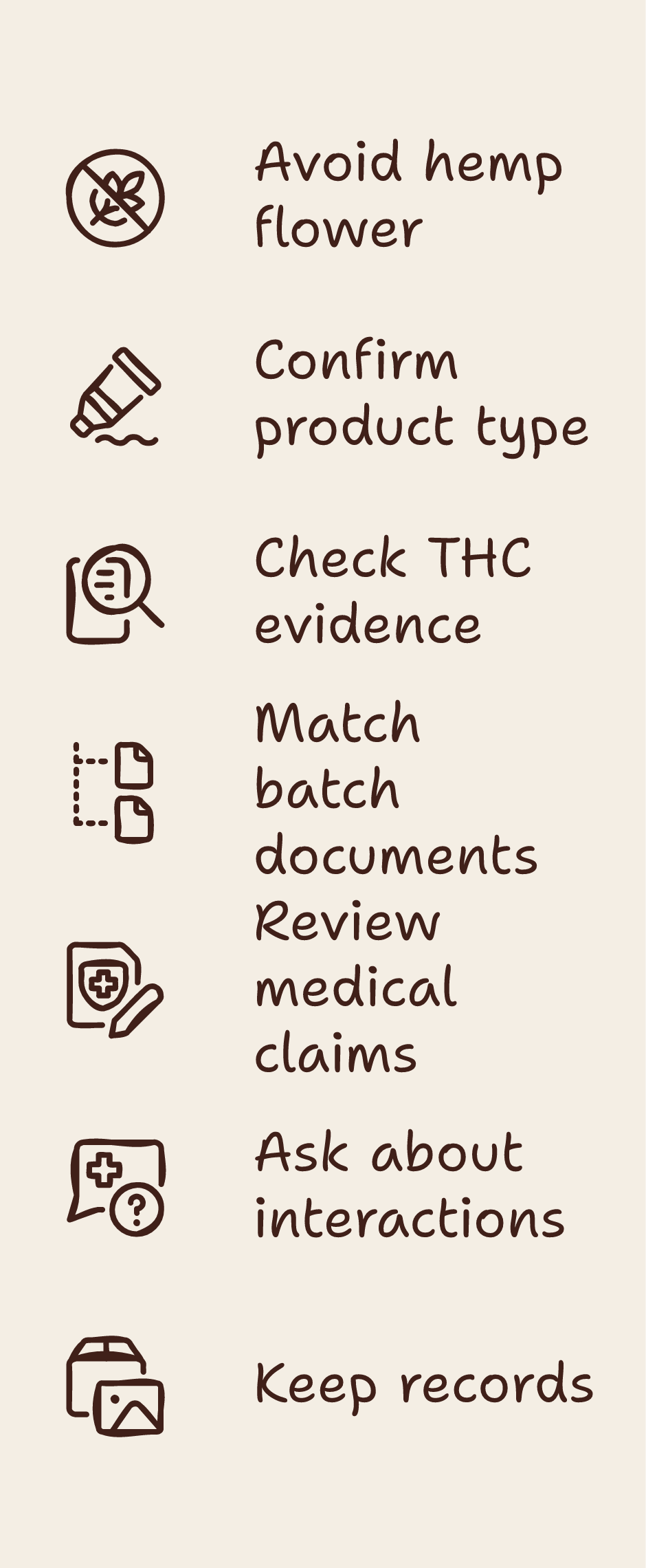
Start with the physical format. Dried flower should raise an immediate red flag for ordinary retail consumers in Greece after the 2026 rule change. Oils, cosmetics, topicals, and pharmacy medicines need a different review. If the product is smokeable, loose, or sold mainly by strain aroma, it is in the highest-risk zone.
Second, ask for batch evidence. A serious CBD seller should be able to explain CBD amount, THC statement, ingredient list, batch number, production or best-before date, and certificate of analysis. If the certificate does not match the bottle, or the seller sends a generic lab report from another batch, treat that as a failed check. Good documentation is boring, precise, and easy to match.
Third, review the claims. A wellness shop should not promise that CBD cures anxiety, treats cancer, replaces medication, solves insomnia, or guarantees pain relief. The FDA consumer update on CBD is US-focused, but its safety warnings are useful everywhere: CBD quality varies, medical claims need scrutiny, and consumers should understand interaction and liver-related concerns before casual use.
💡 Pro Tip
Keep a photo of the label, batch number, and certificate of analysis after purchase. If regulations or product questions come up later, those details matter more than a receipt alone.
Why the 0.3% THC Number Is Often Misused
The 0.3% THC threshold appears often in CBD marketing, but consumers should be careful with what it actually means. Under EU agricultural policy, the threshold relates to eligible industrial hemp varieties and certain market rules. The EU regulation setting THC limits for hemp seed foods also shows that food limits may be expressed in mg/kg rather than crop percentage. These are technical rules, not a simple green light for every product.
That is why a seller saying “it is under 0.3% THC” should not end the conversation. You still need to know whether the product is flower, oil, cosmetic, food, supplement, or prescription medicine. You also need to know whether Greek rules allow that product category for retail sale, whether the label is accurate, and whether the lab report checks the exact batch you are buying.
This point is especially important for travelers and workers subject to testing. A legal agricultural hemp threshold does not guarantee that a consumer product is legal to carry, sensible to use before driving, or safe for drug testing. Responsible buyers avoid intoxicating effects, keep documentation, and choose conservative formats when clarity matters.
Medical Cannabis Is a Separate System
Medical cannabis in Greece should not be confused with a consumer CBD oil shelf. It is a regulated healthcare pathway involving prescription products, pharmacy dispensing, and medical supervision. The European Medicines Agency page for Sativex shows how cannabinoid medicines can be evaluated as medicines for specific uses, while Greece’s medical cannabis system remains separate from general retail wellness products.
For patients, the key point is that medical cannabis is not a workaround for casual access. It belongs in a clinician-led discussion, especially for serious pain, spasticity, chemotherapy-related nausea, appetite loss, or other qualifying situations. For ordinary consumers browsing CBD products, do not borrow medical language unless the product is actually a medicine sold through the proper channel.
The EUDA cannabis policy overview also shows why European cannabis policy is not one uniform market. Countries take different routes on medical access, commercial products, penalties, and low-THC goods. Greek consumers need Greek-specific checks, not generic “Europe allows CBD” slogans.
📝 Important Note
If a product uses medical language but is sold like an ordinary wellness item, slow down. Treatment claims belong to authorized medicines and qualified healthcare advice, not casual retail copy.
Health and Safety Checks Before Using CBD
CBD is often marketed as gentle, but “non-intoxicating” does not mean risk-free. The FDA’s statement on CBD regulatory gaps highlights concerns around liver injury, drug interactions, reproductive effects, and long-term daily exposure. The CDC cannabis health effects page also reminds consumers that cannabis products can affect attention, coordination, and mental state, depending on product and person.
Interactions are the biggest practical issue for many adults. If you take blood thinners, seizure medication, sedatives, sleep medication, antidepressants, heart medication, or several prescriptions, speak with a qualified clinician before trying CBD. Our CBD drug interactions guide gives you a sensible starting list of questions.
Research on CBD absorption also supports conservative expectations. A PubMed-indexed pharmacokinetic paper found that product route, formulation, and swallowing patterns can affect blood levels, while a broader cannabinoid pharmacokinetics review shows large variation between oral, inhaled, and other routes. The plain-English takeaway: start low, change one variable at a time, and do not assume another person’s serving will fit you.
How to Read a CBD Oil Label in Greece
A CBD oil label should answer several questions without drama. How much CBD is in the bottle? How much is in one suggested serving? Is it full-spectrum, broad-spectrum, or isolate? What carrier oil is used? Are flavorings or additives listed? Is there a batch number and best-before date? If the label is vague, the product is asking you to trust marketing instead of evidence.
The certificate of analysis should then confirm cannabinoid content and, ideally, safety screening for contaminants. It should be recent enough to be meaningful and specific enough to match the bottle. If the report says one batch but the bottle says another, that is not a paperwork detail; it is the central quality check failing.
Product choice should match the routine. For shoppers comparing available options, a simple oil such as CBD Oil 10ml or a gentler format like CBD Drops Olive Oil 10ml can be easier to evaluate than loose products because serving size, ingredients, and packaging details are clearer. Availability can change, so always verify the current label before buying.
Red Flags That Should Stop the Purchase
The first red flag is a seller who treats the 2026 flower restriction as unimportant. If they wave away format questions, change the subject, or say “everyone sells it,” that is not a compliance strategy. The second red flag is a missing or mismatched lab report. Without batch evidence, you are guessing on CBD content, THC statement, and quality.
The third red flag is aggressive medical language. The WHO cannabidiol Q&A discusses CBD as a compound with a different profile from THC, but that does not give a shop permission to promise treatment outcomes. Evidence, authorization, dosage, and patient context all matter.
The fourth red flag is pressure. Good CBD shopping is slow, documented, and calm. If someone pushes you to buy because a product is “legal everywhere,” “stronger than normal,” or “basically medical,” leave it. The best sellers make the boring facts easy: product type, batch number, certificate, ingredients, and realistic use guidance.
⚠️ Disclaimer
This article is for informational purposes only and does not constitute medical advice. The information provided about medical cannabis and CBD in Greece is current as of August 2026 but may change. Always consult qualified healthcare professionals for medical advice and treatment options. For our full disclaimer, visit cannastoreams.gr/disclaimer.
A Responsible Way to Buy
The responsible path is simple. Avoid dried flower as an ordinary retail consumer. Choose a clearly identified product category. Ask for batch-level documentation. Read the label. Check whether the seller makes realistic claims. Start with a conservative serving if you decide to use CBD, and avoid combining it with alcohol, sedatives, or new supplements until you understand your response.
For many Greek consumers, this means oils and topicals will feel more practical than flower. They are easier to store, easier to document, easier to use discreetly, and easier to compare. They also fit the direction of the market: less smokeable ambiguity, more transparent product education.
The bottom line for CBD in Greece 2026 is not panic. It is discipline. Treat CBD like a regulated wellness category, not a loophole. The better your documents, labels, and expectations, the safer and cleaner your buying decision becomes.
Frequently Asked Questions
Is CBD in Greece 2026 legal?
Some non-flower CBD formats may be lawfully available when they comply with Greek and EU product rules. Dried hemp or CBD flower is the high-risk format after the 2026 retail restriction.
Does the 0.3% THC rule make a product legal?
No. The 0.3% figure is mainly tied to industrial hemp rules. Retail legality depends on product category, Greek rules, labeling, THC evidence, and marketing claims.
What should I ask a CBD shop before buying?
Ask for the exact product category, batch number, certificate of analysis, CBD amount, THC statement, ingredients, best-before date, and whether the product makes any medical claims.
Is medical cannabis the same as CBD wellness products?
No. Medical cannabis belongs to a regulated healthcare pathway with prescription and pharmacy controls. CBD wellness products are a separate retail category and should not make treatment claims.
Can CBD interact with medication?
Yes. CBD can interact with some medicines and may increase sedation when combined with alcohol or calming drugs. Speak with a clinician if you take prescriptions.
