Your body already makes its own cannabis-like chemicals. That might sound strange, but it’s true. The endocannabinoid system (ECS) is a cell-signaling network that exists in every human body, whether or not you’ve ever touched a cannabis plant. It was discovered in the early 1990s by researchers studying how THC interacts with the body, and what they found changed how we think about human biology.
If you’ve ever wondered why cannabis affects pain, mood, sleep, and appetite all at once, the endocannabinoid system is your answer. This guide breaks down the ECS in plain language — what it does, how it works, and why it matters for your health.
📺 Video Guide
What is the endocannabinoid system?
The endocannabinoid system is a biological network that helps your body maintain balance, or homeostasis. Think of it as an internal thermostat. When something gets too high or too low — body temperature, inflammation levels, stress hormones — the ECS kicks in to bring things back to baseline.
The system was identified by Dr. Raphael Mechoulam and his team at the Hebrew University of Jerusalem. While isolating THC in the 1960s, Mechoulam set off decades of research that eventually led to the discovery of the ECS in 1992. The name “endocannabinoid” literally means “cannabinoids made inside the body” — endo meaning internal.
What makes the ECS interesting is its scope. It’s not tucked away in one organ. It operates across your brain, gut, immune system, skin, bones, and reproductive organs. According to a 2018 review published in Cannabis and Cannabinoid Research, the ECS is involved in nearly every physiological process researchers have examined.
The three building blocks of the ECS
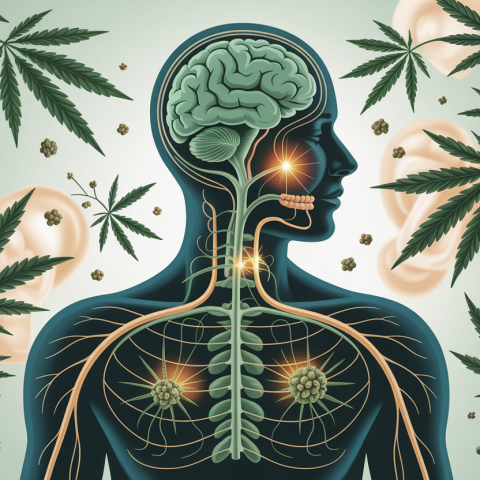
The endocannabinoid system has three components: endocannabinoids (the chemical messengers), receptors (the locks those messengers fit into), and enzymes (the cleanup crew that breaks everything down afterward).
Endocannabinoids are molecules your body produces on demand. The two main ones are anandamide (AEA) and 2-arachidonoylglycerol (2-AG). Anandamide gets its name from the Sanskrit word “ananda,” meaning bliss. It’s associated with the runner’s high people feel after intense exercise. 2-AG is more abundant and plays a wider role in immune function and pain management.
Unlike hormones that are stored in glands, endocannabinoids are made from fat-based molecules in cell membranes right when they’re needed. Once they do their job, enzymes break them down so they don’t overshoot.
Receptors sit on the surface of cells throughout your body. CB1 receptors are concentrated in the brain and central nervous system. They influence memory, mood, motor control, and pain perception. CB2 receptors are found mainly in immune cells and peripheral tissues. They manage inflammation and immune responses. Research from the World Health Organization confirms that cannabinoid receptors are among the most widespread receptor types in the mammalian brain.
Enzymes handle the breakdown. FAAH (fatty acid amide hydrolase) breaks down anandamide, and MAGL (monoacylglycerol lipase) takes care of 2-AG. This cleanup prevents the system from staying activated longer than necessary.
💡 Quick reference
CB1 receptors = brain and nervous system (mood, pain, memory). CB2 receptors = immune system and peripheral tissues (inflammation, immune response). Both are activated by your body’s own endocannabinoids and by plant-based cannabinoids like THC and CBD.
What does the endocannabinoid system actually do?
The short answer: it keeps things stable. The longer answer involves a surprisingly wide list of functions.
Pain regulation. When you stub your toe, your nervous system fires pain signals. The ECS can dial those signals down by releasing endocannabinoids at the site of injury. A 2020 study in the Journal of Pain Research found that endocannabinoid levels increase in spinal fluid following acute pain, suggesting the body ramps up production when it needs pain relief. This is why cannabis is being studied for chronic pain.
Mood and stress. Anandamide acts on the same CB1 receptors that THC targets. When anandamide levels are healthy, most people report better mood and lower anxiety. A study published in Translational Psychiatry found that people with certain genetic variations that slow anandamide breakdown reported lower anxiety levels. That gene variation essentially gives them more of their own natural “bliss molecule” circulating at any given time.
Sleep. The endocannabinoid system helps regulate your sleep-wake cycle. Anandamide promotes sleepiness, while 2-AG levels fluctuate throughout the day in patterns that mirror circadian rhythms. Research from the National Institutes of Health has shown that disrupting endocannabinoid signaling leads to fragmented sleep and daytime fatigue.
Immune function. CB2 receptors on immune cells help calibrate the inflammatory response. Too little inflammation and you can’t fight infections. Too much and you get autoimmune problems. The ECS helps find the middle ground. A 2020 review in Frontiers in Immunology described the ECS as a “gatekeeper” of immune function.
Appetite and digestion. This is one of the most well-known effects. CB1 receptors in the hypothalamus regulate hunger signals, which is why THC — which activates CB1 — famously causes “the munchies.” But the ECS also manages gut motility and digestive enzyme secretion through receptors in the digestive tract.
✓ Functions regulated by the ECS
- ✓ Pain perception and inflammation
- ✓ Mood, anxiety, and stress response
- ✓ Sleep-wake cycles
- ✓ Appetite and metabolism
- ✓ Immune system calibration
- ✓ Motor control and coordination
- ✓ Memory formation and learning
- ✓ Reproductive health
How cannabis interacts with the endocannabinoid system
Cannabis works because the plant produces chemicals (phytocannabinoids) that are structurally similar to the endocannabinoids your body already makes. It’s like having a spare set of keys that fit the same locks.
THC is the most direct match. It binds to CB1 receptors in the brain almost the same way anandamide does, which is why it produces euphoria, pain relief, and appetite stimulation. The difference is that THC is much more potent and lasts longer than anandamide, because FAAH — the enzyme that breaks down anandamide — doesn’t process THC as efficiently.
CBD takes a different approach. Rather than binding directly to CB1 or CB2 receptors, CBD appears to work indirectly. According to a 2020 review in Pharmacological Research, CBD may inhibit FAAH, which slows the breakdown of anandamide. The result is more of your own endocannabinoids circulating for longer periods. This may explain why CBD has anti-anxiety effects without producing a high.
Other cannabinoids like CBG, CBN, and CBDV also interact with the ECS, though often through different pathways. Terpenes — the aromatic compounds in cannabis — can modulate how cannabinoids bind to receptors, which is part of the “entourage effect” theory.
Clinical endocannabinoid deficiency: when the system falls short
In 2001, neurologist Dr. Ethan Russo proposed a theory called Clinical Endocannabinoid Deficiency (CECD). The idea is straightforward: if your body doesn’t produce enough endocannabinoids, the systems they regulate start to malfunction.
Russo’s 2008 paper in Neuroendocrinology Letters linked CECD to conditions that share common traits: migraines, irritable bowel syndrome (IBS), and fibromyalgia. All three involve heightened pain sensitivity, and all three have proven difficult to treat with conventional medicine. Patients with these conditions often report that cannabis helps where other treatments have failed.
A 2016 review found growing evidence supporting CECD, including studies showing that migraine patients have below-average anandamide levels in their cerebrospinal fluid. The theory isn’t proven beyond doubt, but it’s generating real research.
If CECD turns out to be valid, it could explain why some people respond so well to cannabis products while others barely notice the effects. People with naturally lower endocannabinoid tone may benefit more from external cannabinoid supplementation.
📝 Worth noting
CECD is still a hypothesis, not an established diagnosis. No doctor will put “endocannabinoid deficiency” on your chart. But the research is accumulating, and it provides a useful framework for understanding why cannabinoid therapies work for some people.
How to support your endocannabinoid system naturally
You don’t need cannabis to keep your ECS healthy, though it can certainly help. Several lifestyle factors influence endocannabinoid production and receptor sensitivity.
Exercise. Moderate aerobic exercise increases anandamide levels. That post-run feeling of calm isn’t just endorphins — it’s partly your endocannabinoid system doing its thing. A 2019 study in Drug and Alcohol Dependence confirmed that 30 minutes of moderate running significantly raised circulating anandamide levels in participants.
Diet. Omega-3 fatty acids are precursors to endocannabinoids. Fatty fish, walnuts, flaxseed, and hemp seeds provide the building blocks your body needs to make anandamide and 2-AG. A diet heavy in processed food and low in omega-3s may impair ECS function over time.
Stress management. Chronic stress depletes endocannabinoid stores. Meditation, adequate sleep, and time in nature all help restore balance. Combining cannabis with meditation is something many people have found effective, though the mechanisms aren’t fully mapped out yet.
Other plant compounds. Several non-cannabis plants produce compounds that interact with the ECS. Echinacea contains cannabimimetics that bind to CB2 receptors. Black pepper has beta-caryophyllene, a terpene that also activates CB2. Chocolate contains small amounts of anandamide and compounds that slow its breakdown, which might partially explain why chocolate feels comforting.
The entourage effect and why it matters
When researchers talk about the endocannabinoid system and cannabis, the “entourage effect” comes up often. The idea, first proposed by Mechoulam and Ben-Shabat in 1998, suggests that cannabinoids work better together than in isolation.
A 2020 paper in Frontiers in Pharmacology reviewed evidence for the entourage effect and found that whole-plant cannabis extracts often produced stronger effects than isolated cannabinoids at the same dose. This is why full-spectrum CBD oils tend to outperform pure CBD isolates for many users.
The practical takeaway is that the endocannabinoid system seems to respond best to a range of inputs rather than a single compound. Terpenes like myrcene, limonene, and linalool each interact with different aspects of the ECS, and their combined effect with cannabinoids appears to be greater than the sum of its parts.
Why most people haven’t heard of the ECS
Here’s something that bothers a lot of researchers: the endocannabinoid system is one of the largest receptor systems in the human body, and most medical schools barely mention it. A 2013 survey found that only 13% of U.S. medical schools included ECS education in their curricula.
The reason is political as much as scientific. Cannabis prohibition made ECS research difficult to fund and publish for decades. The DEA’s classification of cannabis as Schedule I restricted researchers to studying its harms rather than its biology. As legalization has spread, research has accelerated, but medical education hasn’t kept pace.
This matters because doctors who don’t understand the ECS can’t advise patients about cannabinoid-based treatments. If your doctor seems uncertain about CBD or medical cannabis, it may not be skepticism — it may be a gap in their training.
⚠️ Medical disclaimer
This article is for informational purposes only and does not constitute medical advice. The information provided about medical cannabis in Greece is current as of January 2025 but may change. Always consult with qualified healthcare professionals for medical advice and treatment options. Decisions about medical cannabis should be made in consultation with authorized healthcare providers who understand your specific medical history and conditions. For our full disclaimer, visit cannastoreams.gr/disclaimer.
Frequently asked questions
What is the endocannabinoid system in simple terms?
The endocannabinoid system is your body’s internal balancing network. It uses chemical messengers called endocannabinoids to regulate pain, mood, sleep, appetite, and immune function. It works like a thermostat, adjusting things when they get too high or too low.
Does everyone have an endocannabinoid system?
Yes. All mammals have an endocannabinoid system, including humans, dogs, and cats. It’s present from birth and operates regardless of whether you’ve ever used cannabis.
How does CBD affect the endocannabinoid system?
CBD doesn’t bind directly to CB1 or CB2 receptors the way THC does. Instead, it appears to slow the breakdown of anandamide (your body’s natural bliss molecule) by inhibiting the FAAH enzyme. This means more of your own endocannabinoids stay active longer.
Can you boost your endocannabinoid system without cannabis?
Yes. Regular exercise, eating omega-3 rich foods, managing stress, and getting quality sleep all support ECS function. Certain foods like dark chocolate and black pepper contain compounds that interact with cannabinoid receptors.
What is clinical endocannabinoid deficiency?
Clinical endocannabinoid deficiency (CECD) is a theory suggesting that some people produce insufficient endocannabinoids, potentially contributing to conditions like migraines, IBS, and fibromyalgia. It’s still being researched and isn’t an official medical diagnosis yet.