
Cooking with Cannabis: Beginner’s Kitchen Guide
Learn to cook with cannabis at home. This beginner's guide covers decarboxylation, dosing, cannabutter recipes, and safe kitchen techniques for 2026.

Cooking with cannabis at home is easier than most people think, but there are a few things you need to get right or you’ll waste your supply and end up with something that either does nothing or hits too hard. This guide walks through the entire process, from turning raw flower into an active ingredient to making your first batch of cannabutter and using it in real recipes. If you’ve never cooked with cannabis before, start here.
The basics come down to science: raw cannabis contains THCA and CBDA, which are the acidic precursors to THC and CBD. Eating raw cannabis won’t get you high because those compounds need heat to convert into their active forms. That conversion process is called decarboxylation, and it’s the single most important step in cooking with cannabis.
What Is Decarboxylation and Why It Matters
Decarboxylation is a chemical reaction that removes a carboxyl group from cannabinoids when exposed to heat. According to research published in the Journal of Molecular Structure, THCA converts to THC at temperatures between 105°C and 120°C (220°F to 250°F). Go too low and the conversion is incomplete. Go too high and you start breaking down the very compounds you’re trying to activate.
Here’s the practical method: Preheat your oven to 110°C (230°F). Break your cannabis into small, even pieces and spread them on a parchment-lined baking sheet. Bake for 30 to 40 minutes, shaking the tray once halfway through. The flower should turn from green to a light golden brown. That color change tells you the decarboxylation is working.
One common mistake is skipping this step entirely and dropping raw flower into butter. That gives you butter that tastes like grass and does almost nothing. The other mistake is cranking the oven to 175°C (350°F) to “speed things up,” which degrades THC into CBN, a cannabinoid that makes you sleepy rather than producing the effects you were looking for.
💡 Pro Tip
Use an oven thermometer. Most home ovens are off by 5 to 15 degrees, and that variance matters when you’re working with cannabinoids. A $10 thermometer can save you from ruining an expensive batch.
Choosing the Right Fat for Infusion
Cannabinoids are fat-soluble, which means they bind to fats and oils rather than water. This is why you can’t just brew cannabis in hot water and expect results. You need a fat base, and the three most common options are butter, coconut oil, and olive oil.
Butter is the classic choice for baking. It has a saturated fat content of about 63%, which gives cannabinoids plenty to bind to. The flavor works well in cookies, brownies, and most baked goods. The downside is that butter contains milk solids and water, which means it burns at lower temperatures and has a shorter shelf life.
Coconut oil has the highest saturated fat content of any cooking oil at roughly 82%, making it the most efficient carrier for cannabinoids. A study in the American Journal of Clinical Nutrition noted that medium-chain triglycerides in coconut oil are absorbed more quickly by the body, which can lead to faster onset of effects. It’s also vegan-friendly and works in both sweet and savory recipes.
Olive oil is better suited for savory dishes like pasta sauces, salad dressings, and dips. Its fat content is lower (about 14% saturated, 73% monounsaturated), so it’s slightly less efficient at binding cannabinoids, but it tastes better in dishes where butter or coconut oil would feel out of place.
How to Make Cannabutter Step by Step
Cannabutter is the foundation of cannabis cooking. Once you have a good batch, you can substitute it for regular butter in nearly any recipe. Here’s the method that works consistently.
Ingredients: 1 cup (225g) unsalted butter, 1 cup (240ml) water, 7 to 10 grams of decarboxylated cannabis. The water prevents the butter from burning and separates out during cooling.
Step 1: Melt the butter in a saucepan on low heat. Add the water and stir until combined.
Step 2: Add the decarboxylated cannabis. Stir gently and reduce heat to the lowest possible setting. You want the mixture to stay between 70°C and 80°C (158°F to 176°F). It should barely simmer with an occasional small bubble, never a rolling boil.
Step 3: Let it infuse for 2 to 3 hours, stirring every 20 minutes. According to Leafly’s dosing guide, longer infusion times beyond 3 hours don’t significantly increase potency, and they can add more chlorophyll, making the butter taste bitter.
Step 4: Set a cheesecloth over a glass jar or bowl. Pour the mixture through slowly, letting gravity do the work. Don’t squeeze the cheesecloth, as that pushes through plant material that tastes harsh and adds no extra potency.
Step 5: Refrigerate the strained liquid for at least 4 hours. The butter solidifies on top, and the water layer sits underneath. Lift the butter disc off, pat it dry, and discard the water. Your cannabutter is ready.
✓ Why This Method Works
- ✓ Water prevents burning and allows lower, steadier temperatures
- ✓ Low heat preserves cannabinoids and terpenes
- ✓ Cheesecloth straining removes all plant material for smoother taste
- ✓ Refrigeration cleanly separates butter from water and impurities
Dosing: How to Calculate and Control Potency
Dosing is where most beginners run into trouble. Edibles take 45 minutes to 2 hours to kick in, and the effects last 4 to 8 hours. Eating too much is uncomfortable and can cause anxiety and paranoia. The FDA and most state cannabis regulators recommend starting at 5mg of THC per serving.
Here’s a rough calculation. If your cannabis tests at 20% THC, one gram contains about 200mg of THC. Decarboxylation isn’t 100% efficient, so assume roughly 85% conversion, giving you about 170mg per gram. If you use 7 grams in a batch of cannabutter, that’s roughly 1,190mg of THC in the entire batch.
Divide that by the number of servings your recipe makes. If you bake 24 cookies with that butter, each cookie contains about 50mg of THC, which is a very strong dose. For beginners, you’d want to either use less cannabis in the butter or use a smaller amount of cannabutter mixed with regular butter in the recipe.
A safer approach for your first time: use 3 to 4 grams of flower per cup of butter. That puts each cookie in the 20 to 25mg range, and you can eat half a cookie for a 10mg dose. You can always eat more, but you can’t eat less once it’s in your system. Research from Colorado’s Department of Public Health found that most negative emergency room visits from edibles involved doses above 50mg by inexperienced users.
📝 Important Note
Edibles affect everyone differently. Body weight, metabolism, tolerance, and whether you’ve eaten recently all change how you react. Start with 5mg, wait at least 90 minutes before considering more, and keep a journal of your experiences to dial in your ideal dose over time.
Cooking Temperature Matters More Than You Think
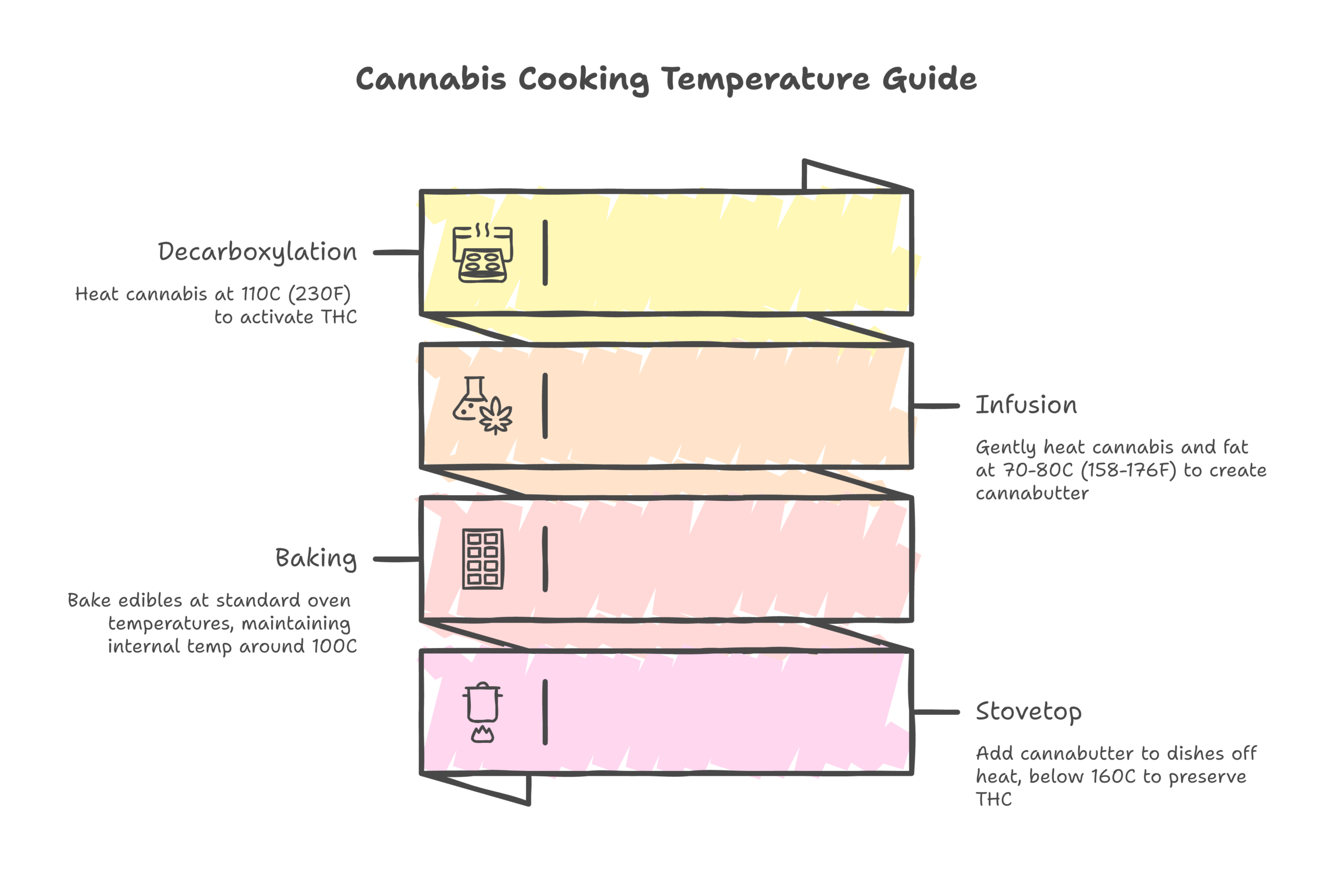
Once you have your infused butter or oil, temperature during cooking is still a factor. THC begins to degrade noticeably above 157°C (315°F), and terpenes, which contribute to flavor and the entourage effect, break down at even lower temperatures. Research published in Scientific Reports showed significant cannabinoid loss at sustained high temperatures.
For baking, this creates an interesting situation. Most cookie and brownie recipes call for oven temperatures of 175°C to 190°C (350°F to 375°F). The good news is that the internal temperature of the dough stays well below the oven temperature for most of the baking time. The moisture in the batter keeps the internal temperature around 100°C (212°F) until the very end when the surface starts browning. So baking at standard temperatures works, but pulling items out slightly early helps preserve potency.
Stovetop cooking is riskier. Sautéing with cannabutter in a hot pan can easily push temperatures past 200°C. If you’re making a sauce, add the cannabutter at the very end, off heat, and stir it in. For dishes like mac and cheese or mashed potatoes, stir the cannabutter in after the dish is done cooking and the temperature has dropped below 160°C.
🎬 Watch: How to Make Cannabutter
This step-by-step video walks through decarboxylation and cannabutter preparation, covering everything discussed in this guide.
Simple Recipes to Start With
Don’t try something complicated your first time. These three recipes are forgiving and give you room to experiment with dosing.
Cannabis Chocolate Brownies: Use any boxed brownie mix and substitute cannabutter for the butter or oil called for. If the recipe asks for 1/3 cup oil, use 1/3 cup of your infused coconut oil. Bake at the recommended temperature, but check 3 minutes early. Cut into equal portions so each piece has a consistent dose.
Infused Pasta Sauce: Make your regular tomato sauce or pesto. Once it’s done and off the burner, stir in 1 to 2 tablespoons of cannabutter per serving. The residual heat melts the butter without degrading the cannabinoids. This works well because you can control the dose per plate.
Cannabis Honey: Warm honey to about 60°C (140°F) and stir in cannabis-infused coconut oil at a 1:1 ratio. The lecithin naturally present in honey helps emulsify the oil. Use it in tea, on toast, or as a sweetener. A teaspoon is roughly one dose if you’ve done your math right. Store it in a sealed jar at room temperature.
Common Mistakes That Ruin Cannabis Edibles
Not grinding evenly. Chunk-sized pieces decarboxylate unevenly. Some bits overdo it while others barely convert. A hand grinder gives you consistent particle size without turning it into powder, which can pass through cheesecloth.
Boiling the butter. Boiling means your mixture hit 100°C at the water surface, and fats can get even hotter. This degrades cannabinoids faster than a gentle simmer. If you see rapid bubbling, turn the heat down immediately.
Uneven mixing. If you don’t stir your cannabutter thoroughly into batter or dough, some portions get almost nothing while others are loaded. Professional edible makers use sunflower lecithin as an emulsifier to distribute cannabinoids evenly through the mixture. You can buy it as a powder and add a teaspoon per cup of infused fat.
Guessing the dose. Without knowing your flower’s THC percentage, you’re shooting in the dark. If you buy from a dispensary that provides lab results, use those numbers. If you’re working with unknown material, start very small and titrate up over multiple sessions.
Testing on a full crowd. Don’t make your first batch for a party. Make a small test batch, try one serving yourself, wait the full 2 hours, and note the effects. Then adjust your ratios before scaling up. It’s the difference between a good time and a bad one.
Storage and Shelf Life
Cannabis-infused products are perishable, and proper storage matters both for safety and potency. According to Harvard Health, cannabinoids degrade when exposed to light, heat, and oxygen over time.
Cannabutter keeps in the refrigerator for up to two months in an airtight container. For longer storage, portion it into ice cube trays, freeze, then transfer the cubes to a freezer bag. Each cube is roughly 1 tablespoon, making it easy to dose recipes later. Frozen cannabutter stays good for up to six months.
Infused coconut oil lasts slightly longer due to its natural antimicrobial properties, as noted by the World Health Organization’s food safety guidelines. Keep it in a dark glass jar in the fridge, and it stays usable for about three months.
Finished edibles like cookies and brownies follow the same rules as their non-infused versions. If a regular brownie goes stale in 5 days at room temperature, so will your cannabis brownie. Refrigerate or freeze finished products, and always label them clearly to prevent accidental consumption by children or pets.
💡 Pro Tip
Label every container with the date, the amount of cannabis used, and the estimated mg per serving. When you come back to it weeks later, you won’t have to guess whether it’s the strong batch or the mild one.
Kitchen Safety and Legal Considerations
Decarboxylation produces a strong smell. If discretion is a concern, wrap your cannabis tightly in aluminum foil before baking. This contains most of the odor and also helps with even heating. A mason jar with the lid loosely placed in a water bath is another low-smell method used by more experienced cooks.
Keep all cannabis products, both raw and finished, stored away from children and pets. The CDC reports that accidental cannabis ingestion in children has increased alongside legalization, with edibles being the most common source. Use child-proof containers and store them somewhere that isn’t the regular snack shelf.
Legal status varies widely. In Greece, medical cannabis is legal under specific conditions, but recreational use and home preparation of THC edibles falls into a grey area depending on the source material. In the United States, federal law still classifies cannabis as Schedule I, though individual states have their own frameworks. Always check your local regulations before cooking with cannabis at home.
Going Beyond Butter: Other Infusion Methods
Once you’re comfortable with basic cannabutter, there are a few other infusion techniques worth trying.
Slow cooker method: Combine butter, water, and decarbed cannabis in a slow cooker on the “low” setting for 4 to 6 hours. This is more hands-off than the stovetop method and maintains more consistent temperatures. The low setting on most slow cookers holds at about 85°C (185°F), which is close to ideal.
Sous vide infusion: Seal decarbed cannabis and your fat of choice in a vacuum bag and submerge it in a water bath at 73°C (163°F) for 4 hours. This method gives you the most precise temperature control and almost no smell. It also requires the least babysitting since the temperature stays locked in.
Tinctures: If you’d rather skip fat-based infusions, you can make cannabis tinctures using high-proof alcohol. Submerge decarbed cannabis in ethanol (like Everclear) for several weeks, shaking daily. Strain and use the liquid under your tongue or add it to drinks. Tinctures allow more precise dosing with a dropper and take effect faster than fat-based edibles.
Frequently Asked Questions
Can I use any type of cannabis for cooking?
Yes, you can use flower, trim, shake, or even stems, though potency varies. Flower gives the most consistent results because you know the THC percentage. Trim and shake are weaker per gram but work fine if you adjust the quantity. Stems contain minimal cannabinoids and aren’t worth the effort.
How long do cannabis edibles take to kick in?
Typically 45 minutes to 2 hours, depending on your metabolism and whether you’ve eaten recently. An empty stomach speeds absorption, while a fatty meal before or during consumption can delay onset but may intensify effects. The peak usually hits 2 to 3 hours after eating.
What should I do if I eat too much?
Find a calm, comfortable space and remind yourself it will pass. Drink water, eat a light snack, and try to rest. Some people find that chewing black peppercorns or smelling black pepper helps reduce anxiety, likely due to the terpene beta-caryophyllene. The uncomfortable feeling typically fades within 4 to 6 hours. Seek medical attention if symptoms feel severe.
Can I cook with CBD-only flower?
Absolutely. CBD flower still needs decarboxylation (CBDA converts to CBD at similar temperatures), and the cooking process is identical. The difference is that CBD edibles won’t produce a high. They’re commonly used for relaxation and general wellness. If you’re in a region where THC is restricted, CBD flower is often the legal alternative for cooking.
Does the type of strain affect how edibles feel?
With edibles, the indica vs. sativa distinction matters less than it does with smoking. When your liver processes THC, it converts it to 11-hydroxy-THC regardless of the strain. The cannabinoid and terpene profile still has some influence, but the differences are subtler with edibles compared to inhalation.
⚠️ Disclaimer
This article is for informational purposes only and does not constitute medical or legal advice. Cannabis laws vary by jurisdiction, and the legality of home preparation of cannabis edibles depends on your local regulations. Information in this article is current as of March 2026. Always consult with qualified healthcare professionals before using cannabis, especially if you take prescription medications. For our full disclaimer, visit cannastoreams.gr/disclaimer.
