
CBD for Arthritis: What the Research Actually Shows
Topical and oral CBD may help reduce arthritis pain and inflammation. Here is what clinical trials, patient surveys, and the latest research say about using CBD for joint relief.

If you’ve got arthritis, you’ve probably heard someone suggest CBD. Maybe a friend swears by it, or you spotted a topical cream at your local wellness shop. The hype is real, but so is the confusion. Does CBD actually work for arthritis pain, or is it wishful thinking dressed up in a fancy dropper bottle? Here’s what the research says so far, what real patients report, and how to figure out if it’s worth trying.
📺 Video Guide
What CBD Actually Does in Your Body
CBD, short for cannabidiol, is one of over 100 cannabinoids found in the cannabis plant. Unlike THC, it won’t get you high. What it does is interact with your endocannabinoid system (ECS), a network of receptors that regulate pain, inflammation, mood, and immune response throughout your body.
Your ECS has two main receptor types: CB1 (mostly in the brain and nervous system) and CB2 (concentrated in immune cells and peripheral tissues). CBD doesn’t bind directly to these receptors the way THC does. Instead, it influences them indirectly, modulating how they respond to your body’s own endocannabinoids. According to research published in the Journal of Cannabis Research, CBD also inhibits the enzyme FAAH, which breaks down anandamide, your body’s natural pain-relieving compound.
For arthritis specifically, the CB2 receptors matter most. They sit in joint tissues and immune cells, the exact places where arthritis causes problems. When CBD activates CB2 pathways, it can dampen the inflammatory signals that make joints swell, ache, and stiffen.
What the Research Shows (and Doesn’t)
Let’s be honest about where things stand. The animal studies look promising. Multiple studies, including a widely cited 2017 paper in the journal Pain, found that CBD reduced joint inflammation and pain-related behaviors in rats with osteoarthritis. The rats showed less nerve damage in their joints and less inflammation after topical CBD application.
Human studies are catching up, though they’re still small. A 2022 trial with 18 participants found that topical CBD (6.2 mg applied twice daily for two weeks) reduced thumb arthritis pain significantly compared to placebo. Another 2024 study with 15 patients reported less hand arthritis pain, better grip strength, and reduced morning stiffness after using CBD gel three times daily for four weeks. The catch? The benefits faded once people stopped using it, according to Medical News Today’s analysis of recent trials.
But here’s the flip side. A randomized controlled trial gave participants 45 mg of CBD-rich oil daily for 60 days and found no significant improvement in knee osteoarthritis pain compared to placebo when measured with the WOMAC scale. Another 2023 trial using 600 mg of isolated CBD daily also came up empty.
The pattern? Topical CBD applied directly to affected joints seems more consistently helpful than oral CBD in pill or oil form. This makes intuitive sense: you’re putting the compound exactly where it’s needed rather than waiting for it to survive digestion and reach the joint through your bloodstream.
💡 Pro Tip
The Arthritis Foundation surveyed over 2,600 patients and found that 94% used CBD specifically for pain, with 83% reporting improvement. That’s not clinical proof, but it’s a strong signal worth paying attention to.
Types of Arthritis and How CBD May Help Each
Osteoarthritis (OA) is the “wear and tear” type. Cartilage breaks down, bones rub together, and the surrounding tissue gets inflamed. CBD’s anti-inflammatory properties target this inflammation directly. The animal studies showing reduced joint swelling and nerve protection were conducted on OA models, and most of the positive human topical studies focused on OA patients.
Rheumatoid arthritis (RA) is an autoimmune condition where your immune system attacks joint tissue. CBD’s interaction with CB2 receptors on immune cells could theoretically modulate this overactive immune response. A 2021 review in Frontiers in Pharmacology noted CBD’s immunomodulatory effects but stressed that RA-specific clinical trials are still needed.
Psoriatic arthritis combines joint inflammation with skin symptoms. CBD’s dual action on both skin inflammation and joint pain makes it an interesting candidate, though research remains preliminary. If you’re dealing with joint pain alongside other health concerns, a multi-pronged approach often works best.
CBD Products That Work for Arthritis
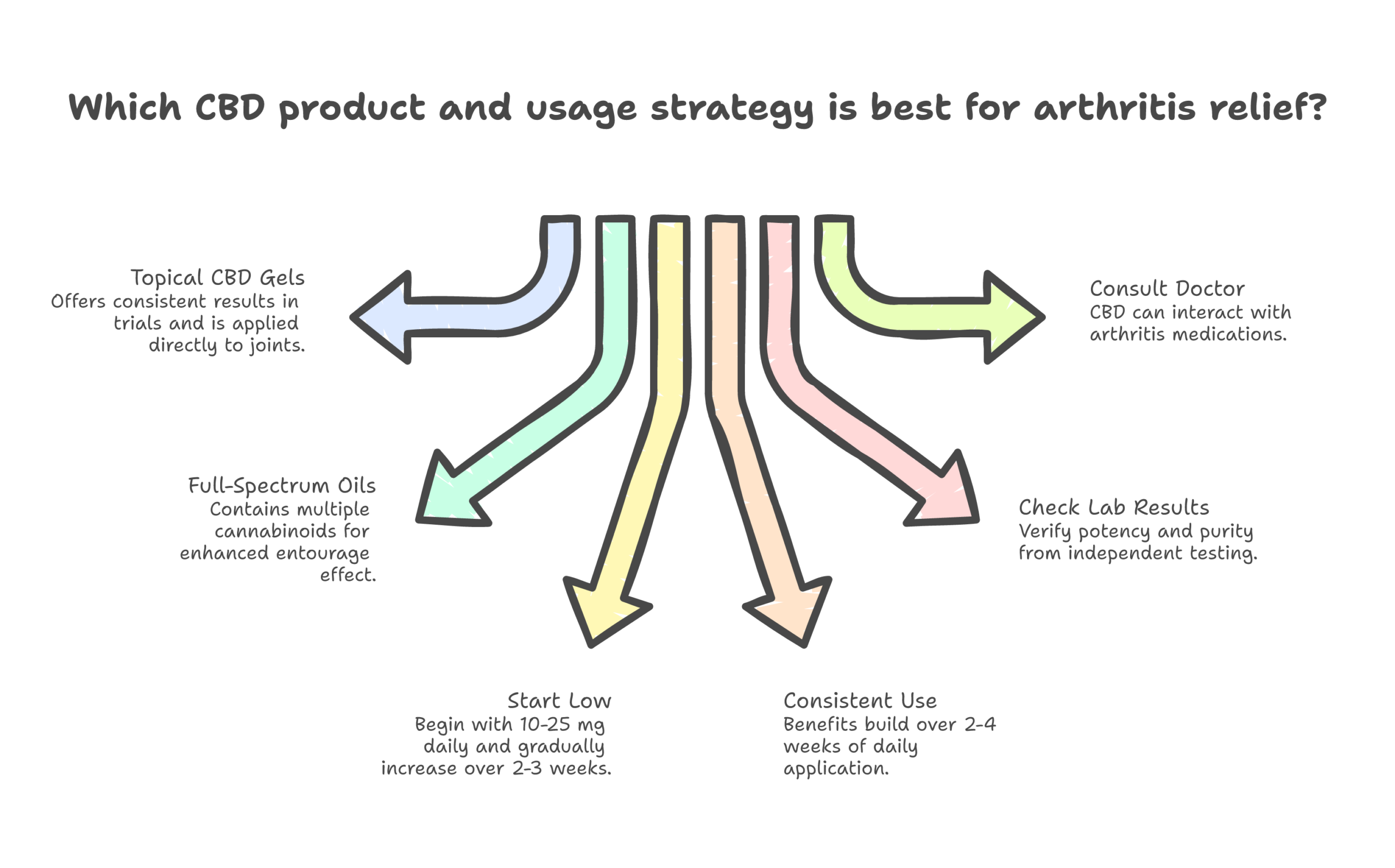
Topical creams and gels are the frontrunner for arthritis relief. You apply them directly to the affected joint, bypassing the digestive system entirely. Look for products with at least 250 mg of CBD per container, and apply two to three times daily for best results. These work well for hands, knees, and other accessible joints.
CBD oils and tinctures taken under the tongue offer more systemic relief. They absorb through the mucous membranes under your tongue, reaching your bloodstream in about 15-30 minutes. If you’re dealing with widespread joint pain or arthritis-related sleep issues, sublingual oils give broader coverage. Choosing the right CBD oil strength matters, so start low and work your way up.
Full-spectrum products contain CBD alongside other cannabinoids, terpenes, and flavonoids from the cannabis plant. There’s growing evidence for an “entourage effect” where these compounds work better together than CBD alone. A comparison of full spectrum, broad spectrum, and isolate CBD can help you decide which type suits your needs. The FDA hasn’t approved CBD for arthritis treatment, but acknowledges that research is ongoing.
If you want to try a broad spectrum CBD oil, these products strip out THC while keeping other beneficial cannabinoids intact. For something stronger, a higher concentration option may be worth considering.
✓ Key Benefits of CBD for Arthritis
- ✓ Anti-inflammatory action targets joint swelling directly
- ✓ Non-addictive alternative to opioid pain medications
- ✓ Topical application delivers CBD where it’s needed most
- ✓ May improve sleep quality disrupted by nighttime joint pain
- ✓ Minimal side effects reported in clinical trials
Dosing CBD for Arthritis Pain
There’s no official dosing guideline for CBD and arthritis because regulatory bodies haven’t approved it for this purpose yet. That said, the research and clinical experience we do have points to some useful ranges.
For topicals, the successful studies used applications two to three times daily. Apply a generous amount to the affected joint and massage it in thoroughly. Give it at least two weeks of consistent use before deciding if it’s working. The 2024 hand arthritis study used gel applied three times daily for four weeks before measuring outcomes.
For oral CBD, the Arthritis Foundation recommends starting low (5-10 mg twice daily) and gradually increasing every two to three days until you notice relief. Most arthritis patients in surveys report using between 25-75 mg daily, though some use more. Keep a simple log of your dose, time, and pain levels so you can track what actually helps.
Timing matters too. If morning stiffness is your worst symptom, take your dose right when you wake up. If pain peaks in the evening or disrupts your sleep, an evening dose makes more sense.
📝 Important Note
CBD can interact with certain medications commonly used by arthritis patients, including blood thinners (warfarin), some anti-inflammatories, and corticosteroids. According to Harvard Health, CBD inhibits the cytochrome P450 enzyme system, which metabolizes many prescription drugs. Always talk to your doctor before adding CBD, especially if you take multiple medications.
What to Look for in a CBD Product
Third-party lab testing is non-negotiable. The CBD market is still loosely regulated, and studies have found that many products contain less CBD than advertised or include contaminants. Look for a Certificate of Analysis (COA) from an independent lab. If a company won’t share their lab results, that’s a red flag. Knowing how to read cannabis lab results helps you verify what you’re actually getting.
Hemp source matters. CBD derived from organically grown hemp reduces your exposure to pesticides and heavy metals. The USDA’s hemp program provides a regulatory framework, but sourcing from countries with weaker standards increases contamination risk.
Extraction method affects quality. CO2 extraction is the gold standard because it preserves cannabinoids without leaving solvent residues. Cheaper ethanol or hydrocarbon extraction can work, but CO2-extracted products tend to be cleaner and more consistent.
Additional ingredients in topicals can complement CBD. Look for menthol, camphor, or arnica alongside CBD in creams for arthritis. These provide additional pain relief through different pathways, which can make the overall product more effective for joint pain.
CBD vs. Traditional Arthritis Treatments
CBD isn’t meant to replace your prescribed arthritis medication. Think of it as a potential complement to your existing treatment plan. NSAIDs like ibuprofen are effective for many people, but long-term use carries risks for your stomach, kidneys, and cardiovascular system. The CDC reports that over 58 million Americans have arthritis, and many cycle through multiple treatments looking for adequate relief.
From the Arthritis Foundation survey, CBD users reported reducing their use of NSAIDs and opioids after incorporating CBD into their routine. That’s potentially meaningful. The Yale School of Medicine published research in 2025 suggesting cannabinoids offer new pathways for safe and effective pain management, which could change how we think about chronic pain treatment more broadly.
Physical therapy, exercise, and weight management remain the cornerstone of arthritis care. CBD might make it easier to stay active by reducing pain enough to get through your exercises. Several patients in online forums describe using topical CBD before physical therapy sessions to make the stretching and strengthening less painful.
Side Effects and Safety Profile
The safety data on CBD is actually pretty reassuring. The World Health Organization concluded that CBD is generally well-tolerated with a good safety profile. Most clinical trials report only mild side effects.
The most commonly reported side effects include fatigue, changes in appetite, and mild digestive discomfort. These tend to occur with oral CBD rather than topicals. High doses (above 300 mg daily) are more likely to cause drowsiness, which is why starting low and increasing gradually makes sense.
Topical CBD has an especially mild side effect profile because very little enters your bloodstream. The most you might experience is minor skin irritation at the application site, and even that is uncommon. If you’re nervous about trying CBD, topicals are probably the safest entry point. Products like CBD recovery topicals designed for athletes use similar formulations that work well for arthritis joints too.
Practical Tips for Getting Started
Talk to your rheumatologist first. Even though CBD is available without a prescription in most places, your doctor needs to know about it because of potential drug interactions. Most rheumatologists are at least familiar with CBD by now and can advise you on how it fits with your current treatment.
Pick one product type and stick with it for at least a month. If you try a cream for three days, switch to oil, then try gummies, you’ll have no idea what’s actually working. Based on the research, topicals for localized joint pain or sublingual oil for widespread symptoms are your best starting points.
Track your results. Arthritis pain fluctuates naturally, so you need data over time. Use a simple 1-10 pain scale each morning and evening. After three to four weeks, you’ll have enough data points to see whether CBD is making a real difference or if you’re just experiencing normal fluctuation.
Be realistic about expectations. CBD isn’t going to rebuild worn cartilage or cure autoimmune arthritis. What it might do is take the edge off your pain, reduce swelling enough to improve mobility, and help you sleep better. For many arthritis patients, those quality-of-life improvements are worth pursuing. Understanding how different CBD delivery methods like tinctures work can help you find what fits your lifestyle.
Frequently Asked Questions
How long does it take for CBD to work on arthritis pain?
Topical CBD may provide some relief within 15-45 minutes of application, but the full anti-inflammatory benefits typically build over one to two weeks of consistent use. Oral CBD takes 30-60 minutes per dose but also requires consistent daily use over two to four weeks for cumulative effects on joint inflammation.
Can I use CBD alongside my prescription arthritis medication?
Many people do, but you must consult your doctor first. CBD interacts with the CYP450 enzyme system that metabolizes many common drugs, including methotrexate, prednisone, and blood thinners. Your doctor may need to adjust dosages or monitor blood levels more closely.
Is topical or oral CBD better for arthritis?
Current research suggests topical CBD may be more effective for localized joint pain because it delivers cannabinoids directly to the affected area. Oral CBD offers more systemic effects, which can help with widespread pain, anxiety, and sleep disruption. Some people use both: a topical for their worst joints and oral CBD for overall wellness.
Will CBD show up on a drug test?
Pure CBD isolate should not trigger a positive drug test. However, full-spectrum CBD products contain trace amounts of THC (up to 0.3%), which can accumulate with regular use and potentially cause a positive result. If drug testing is a concern, choose broad-spectrum or CBD isolate products.
How much CBD should I use for arthritis?
Start with 10-25 mg of oral CBD daily and increase gradually. For topicals, apply a generous amount to affected joints two to three times daily. The Arthritis Foundation suggests starting low and building up over weeks. Most patients who report relief use between 25-75 mg daily, but individual responses vary widely.
⚠️ Disclaimer
This article is for informational purposes only and does not constitute medical advice. The information provided about CBD and cannabis products is current as of March 2026 but may change as new research emerges. Always consult with qualified healthcare professionals before starting any new supplement, especially if you take prescription medications. CBD is not approved by the FDA for the treatment of arthritis. For our full disclaimer, visit cannastoreams.gr/disclaimer.
