
CBD Gummies vs CBD Oil: Which Fits Your Routine?
CBD gummies vs CBD oil explained: compare onset, dosing, taste, safety, and routine fit so you can choose the right CBD format.

CBD gummies vs CBD oil is not a question of which product is universally better. It is a question of timing, dose control, taste, and the kind of routine you actually want to keep. Oils usually fit people who want flexible serving sizes and a faster, more adjustable format. Gummies fit people who want a simple, pre-measured option that feels easy to use consistently. Both can be useful, but they behave differently once they reach your body.
This guide compares CBD gummies and CBD oil in plain English, with responsible-use notes for adults who want a practical wellness routine rather than hype. If you are new to CBD, start with our CBD for beginners guide and then use this comparison to choose the format that fits your day.
CBD Gummies vs CBD Oil: The Short Answer
Choose CBD oil if you want more control. A dropper lets you adjust gradually, which is helpful when you are finding your personal serving size. Oil can be held under the tongue before swallowing, so some people notice it sooner than standard edibles. A 2023 pharmacokinetic study indexed on PubMed also reminds us that real-world use matters: if most of the oil is swallowed quickly, it can behave more like an oral product than a truly sublingual one.
Choose gummies if you want convenience. Each piece has a set amount, usually tastes better than hemp oil, and is easier to add to an evening or travel routine. Because gummies go through digestion, they usually take longer to feel noticeable. The tradeoff is that the experience may feel steadier and easier to plan around.
✓ Quick Format Match
- ✓ Faster adjustment: CBD oil
- ✓ Easiest routine: CBD gummies
- ✓ Precise micro-adjustments: CBD oil
- ✓ Better taste and portability: CBD gummies
- ✓ Best first step: start low, track effects, avoid rushing the dose
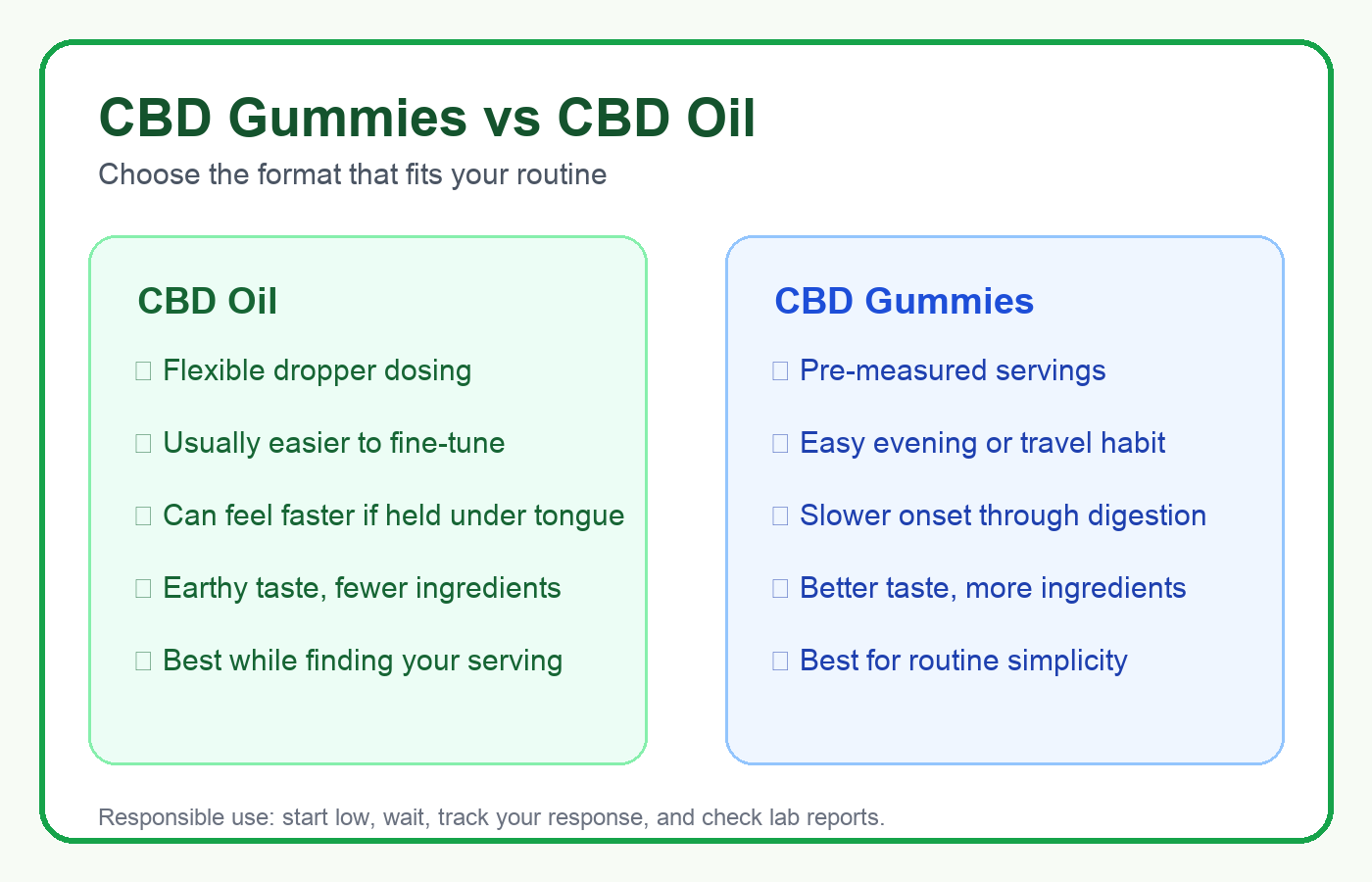
How CBD Oil Works in a Routine
CBD oil is usually sold in a small bottle with a dropper. You place drops under the tongue, hold them briefly, and then swallow. This is why CBD oil is popular with people who want a format they can fine-tune. If one serving feels too mild, the next serving can be adjusted in small increments instead of jumping from one whole gummy to two.
Oil is often the better match for daytime experimentation. For example, someone using CBD as part of a calm morning routine may prefer the control of a dropper. If that is your goal, the practical notes in our CBD oil for daytime stress guide can help you think through timing without overdoing it.
Absorption varies. The review article available through NCBI Bookshelf and PubMed Central explains why oral cannabinoids can have variable bioavailability. Food, product formulation, body chemistry, and how the product is taken all influence the result. That is why two people can use the same oil and describe different timing.
How CBD Gummies Work in a Routine
CBD gummies are edibles. You chew and swallow them, then your digestive system does the rest. That makes them slower than inhaled products and usually slower than carefully used sublingual oil. The upside is predictability. One gummy after dinner is simple. No dropper, no hemp taste, no measuring.
The slower onset is the part beginners must respect. General edible research in PubMed Central shows that oral cannabis effects can take time to build, especially compared with faster routes. CBD-only gummies are not the same as THC edibles, but the patience rule still applies: wait before taking more.
Gummies can be especially useful for people who forget supplements unless they are tied to a daily habit. They also avoid the earthy taste that makes some people abandon CBD oil after two days. If the format helps you stay consistent, that matters.
Timing, Onset, and Duration
For many users, CBD oil held under the tongue feels like the more responsive option. Gummies usually require more patience because they pass through digestion. Consumer health resources such as Healthline commonly describe gummies as taking roughly 30 minutes to 2 hours to feel noticeable, with effects often lasting several hours.
Oil is not magic, though. If you swallow immediately, you reduce the sublingual advantage. If you take gummies on a large meal, onset may be delayed. If you take either format late at night, you should pay attention to next-morning grogginess. The safest habit is to test a low amount on a quiet day before using CBD around work, driving, family obligations, or travel.
💡 Pro Tip
For gummies, wait at least 2 hours before deciding whether the serving was too small. Redosing too quickly is the classic edible mistake.
Dose Control: Dropper Flexibility vs Pre-Measured Simplicity
This is where CBD oil usually wins. A dropper allows small adjustments. That is useful if you are sensitive to supplements, combining CBD with a broader wellness plan, or trying to find the minimum effective amount. Our CBD oil strength guide explains why bottle concentration matters: a few drops from a strong bottle may contain more CBD than a full dropper from a mild bottle.
Gummies win on simplicity. A label might say one gummy contains a fixed amount. That removes measuring friction. The downside is less flexibility. If one gummy feels too little and two feel too much, you may need to cut pieces or switch products.
Label accuracy is another reason to buy carefully. A well-known JAMA study on cannabidiol extracts sold online found widespread mislabeling, and Johns Hopkins researchers later reported similar concerns in topical CBD products. This is why third-party lab reports matter for both oils and gummies.
Ingredients, Spectrum, and Product Quality
CBD oil usually has a shorter ingredient list: carrier oil, hemp extract, and sometimes flavoring. Gummies often include sweeteners, gelatin or pectin, acids, colors, and flavors. That does not make gummies bad. It simply means ingredient preferences matter more if you avoid sugar, animal gelatin, artificial colors, or specific allergens.
Spectrum also matters. Full-spectrum products contain CBD plus other hemp compounds and may contain trace THC where legally permitted. Broad-spectrum products include multiple hemp compounds but aim to remove THC. Isolate products focus on CBD alone. If you want a deeper comparison, read full spectrum vs broad spectrum vs isolate CBD.
For product research, public education resources from the FDA, the CDC, and NIDA are useful because they keep the safety conversation grounded. Marketing claims should never be treated as medical proof.
Which Format Fits Your Day?
For a morning or daytime routine, CBD oil is often easier to fine-tune. You can start small and avoid committing to a full edible serving. That makes sense for people who want to observe subtle effects while staying sharp.
For an evening routine, gummies can be easier. They pair naturally with a wind-down habit, especially if taste matters. People exploring sleep routines may also want to compare timing with our CBD for sleep guide, because late dosing is not ideal for everyone.
For travel or work bags, gummies are discreet. For home use, oil is more flexible. For people who dislike hemp flavor, gummies are friendlier. For people who dislike sugar or additives, oil may feel cleaner. The right answer is the one you can use responsibly and consistently.
📝 Important Note
CBD products are not one-size-fits-all. Keep a simple note of serving size, time taken, food, sleep, mood, and unwanted effects for the first week.
Safety, Interactions, and Responsible Use
CBD can interact with medicines. The FDA consumer update on CBD warns about drug interactions, possible liver injury, sleepiness, diarrhea, appetite changes, and sedation risks when CBD is combined with alcohol or other calming substances. The Mayo Clinic gives similar cautious guidance for consumers.
Prescription cannabidiol is different from over-the-counter wellness CBD. The FDA-approved medicine Epidiolex has formal dosing and monitoring. Its prescribing information includes liver enzyme warnings and interaction details. That does not mean every low-dose CBD product has the same risk profile, but it does mean CBD is biologically active and should be treated with respect.
Avoid mixing CBD with alcohol until you know how you respond. Be cautious if you take sedatives, seizure medicines, blood thinners, antidepressants, or multiple prescriptions. If you are pregnant, breastfeeding, managing liver disease, or buying CBD for someone with a medical condition, speak with a qualified healthcare professional first.
⚠️ Disclaimer
This article is for informational purposes only and does not constitute medical advice. The information provided about CBD and cannabis wellness products is current as of June 2026 but may change. Always consult qualified healthcare professionals for medical advice, especially if you use medication or have a medical condition. For our full disclaimer, visit cannastoreams.gr/disclaimer.
Simple Buying Checklist
Whether you choose CBD gummies or CBD oil, check the same basics. Look for a clear CBD amount per serving, batch-specific lab testing, cannabinoid profile, THC information, ingredient list, expiry date, and responsible usage instructions. If a product promises to cure diseases, treat that as a red flag. The FTC advertising guidance is a reminder that health claims need substantiation, not just confident wording.
If you want the cleanest first experiment, pick one format and keep everything else stable for several days. Do not start CBD gummies, a new sleep supplement, and a new workout recovery product all at once. You will not know what caused what. If you are comparing capsules or softgels as another low-friction option, our CBD capsules vs softgels comparison is the next logical read.
Final Verdict
In the CBD gummies vs CBD oil decision, oil is the better first choice for people who value control, flexible serving sizes, and a more adjustable routine. Gummies are the better first choice for people who value taste, convenience, and consistency. Neither format fixes poor product quality, rushed dosing, or unrealistic expectations.
My practical recommendation is simple: start with CBD oil if you are still learning your ideal serving size. Switch to gummies once you know roughly what works and want a more effortless habit. If you already know you hate hemp flavor, skip the self-punishment and start with gummies. Wellness routines only work when they survive real life.
Frequently Asked Questions
Are CBD gummies stronger than CBD oil?
Not automatically. Strength depends on the milligrams of CBD per serving and how your body absorbs that format. Oil often allows more precise adjustment, while gummies offer a fixed serving.
Which works faster, CBD gummies or CBD oil?
CBD oil held under the tongue is usually the faster option. Gummies must be digested first, so they usually take longer to feel noticeable.
Which is better for beginners?
CBD oil is often better for cautious beginners because it is easier to adjust in small steps. Gummies are better if convenience and taste are the main reasons you will stay consistent.
Can I use CBD gummies and CBD oil on the same day?
You can, but beginners should avoid stacking formats until they understand their response. Combining products makes it easier to take more CBD than intended.
Do CBD gummies or CBD oil show up on drug tests?
CBD itself is not usually the target of standard drug tests, but some full-spectrum products may contain THC. If drug testing matters, choose products with reliable batch lab reports and clear THC information.
