CBD for Menstrual Cramps: Safety Guide
CBD for menstrual cramps may support comfort, but evidence is limited. Learn formats, safety checks, and when to ask a clinician.

CBD for menstrual cramps is one of those wellness topics where curiosity has moved faster than clinical proof. Many adults are looking for gentler support during difficult cycle days, and CBD is often discussed because it interacts with the body’s endocannabinoid system, a signalling network involved in pain perception, inflammation, mood, and stress response. The honest answer is balanced: CBD may help some people feel more comfortable, especially as part of a wider routine, but it is not an established treatment for dysmenorrhea and should not replace medical care when cramps are severe, new, or disruptive.
This guide is written for adults who want an evidence-aware, practical view. We will cover what research can and cannot say, the differences between oils, gummies, and topicals, how to think about dose without guessing wildly, and the safety checks that matter before using CBD around your period.
📺 Video Guide
CBD for Menstrual Cramps: What the Evidence Says
Menstrual cramps are usually driven by prostaglandins, hormone-like compounds that help the uterus contract and shed its lining. Higher prostaglandin activity is linked with stronger contractions, inflammation, nausea, bowel changes, and pain that can radiate into the lower back or thighs. Standard approaches often include heat, rest, movement, magnesium-rich nutrition, and medicines such as NSAIDs when appropriate. CBD enters the conversation because laboratory and preclinical studies suggest anti-inflammatory and pain-modulating activity, but those mechanisms do not automatically prove strong results for period pain in humans.
A review of cannabinoids and dysmenorrhea describes biological plausibility through the endocannabinoid system, while a systematic review of medical cannabis for gynecologic pain found patient-reported relief signals but emphasized variable products, doses, routes, and study quality. That distinction matters. A person saying a cannabis product helped is useful real-world information, but it is not the same as a large CBD-only randomized clinical trial.
The best practical interpretation is cautious optimism. CBD may be worth discussing as supportive comfort care, especially for adults already interested in cannabis wellness, but anyone with severe cramps should consider screening for conditions such as endometriosis, fibroids, pelvic inflammatory disease, ovarian cysts, or adenomyosis. Pain that suddenly worsens, causes fainting, appears outside your period, or does not respond to usual measures deserves medical attention.
✓ Evidence-Based Takeaways
- ✓ CBD has plausible pain and inflammation pathways, but menstrual-cramp evidence is still limited.
- ✓ Topicals are often the gentlest starting format because they are used locally.
- ✓ Oral CBD may affect the whole body, including sleep, stress, and medication metabolism.
- ✓ Product testing, dose discipline, and interaction checks matter more than brand hype.
How CBD May Support Cycle Comfort
CBD, or cannabidiol, is a non-intoxicating cannabinoid. Unlike THC, it does not create a classic high. Researchers are interested in CBD because it appears to influence several targets connected with inflammation, nociception, and nervous-system sensitivity. A recent PubMed-indexed review on CBD in pain treatment describes analgesic and anti-inflammatory relevance, while broader clinical summaries such as StatPearls on cannabidiol explain its pharmacology and known therapeutic use in specific seizure disorders.
For period discomfort, the possible benefits are indirect rather than guaranteed. CBD may help some users wind down, sleep better, feel less tense, or tolerate discomfort more calmly. If the product also contains aromatic terpenes or other hemp compounds, the experience may feel broader than isolated CBD alone. Still, strong claims like “CBD cures cramps” are not responsible. A better claim is: CBD may be one supportive tool in a menstrual wellness routine, provided the product is legal, tested, appropriate for the person, and used with realistic expectations.
This is also where internal consistency matters. If you already use CBD oil for daytime stress, period-week CBD should not be treated as a separate island. Add up your total daily CBD exposure, notice whether it makes you sleepy, and avoid increasing dose just because symptoms are emotionally frustrating. Cycle pain is real, but panic dosing is how people end up with side effects.
Choosing Between Oils, Gummies, Capsules, and Topicals
The format you choose changes the experience. Topical CBD creams and balms are applied to the lower abdomen, lower back, hips, or thighs. They are popular for localized tension because they do not require swallowing CBD and usually create less concern about whole-body effects. If you are CBD-curious but cautious, a topical can be a sensible first experiment, especially alongside a heating pad and gentle stretching.
Oils and tinctures are more flexible. A product such as CBD Oil 10 10ml or CBD Oil 20 Full Spectrum 10ml lets adults adjust serving size carefully, which is useful when you are trying to understand your personal response. Gummies and capsules are easier to use but less adjustable. Edibles also take longer to feel because they pass through digestion first; that delay can tempt people to take more too soon. Do not do that. Wait, track, and keep the serving consistent.
Full-spectrum, broad-spectrum, and isolate products also differ. Full-spectrum hemp extracts contain multiple plant compounds and may contain trace THC where legally permitted. Broad-spectrum products aim to preserve several compounds while removing THC. Isolate is CBD without the broader plant profile. If drug testing, THC sensitivity, or local law is a concern, read certificates of analysis closely rather than trusting front-label language.
💡 Pro Tip
If your cramps are predictable, build a simple period-week log: product, serving size, timing, pain level, sleep, mood, and side effects. After two or three cycles, patterns become much clearer.
A Practical CBD Period-Week Routine
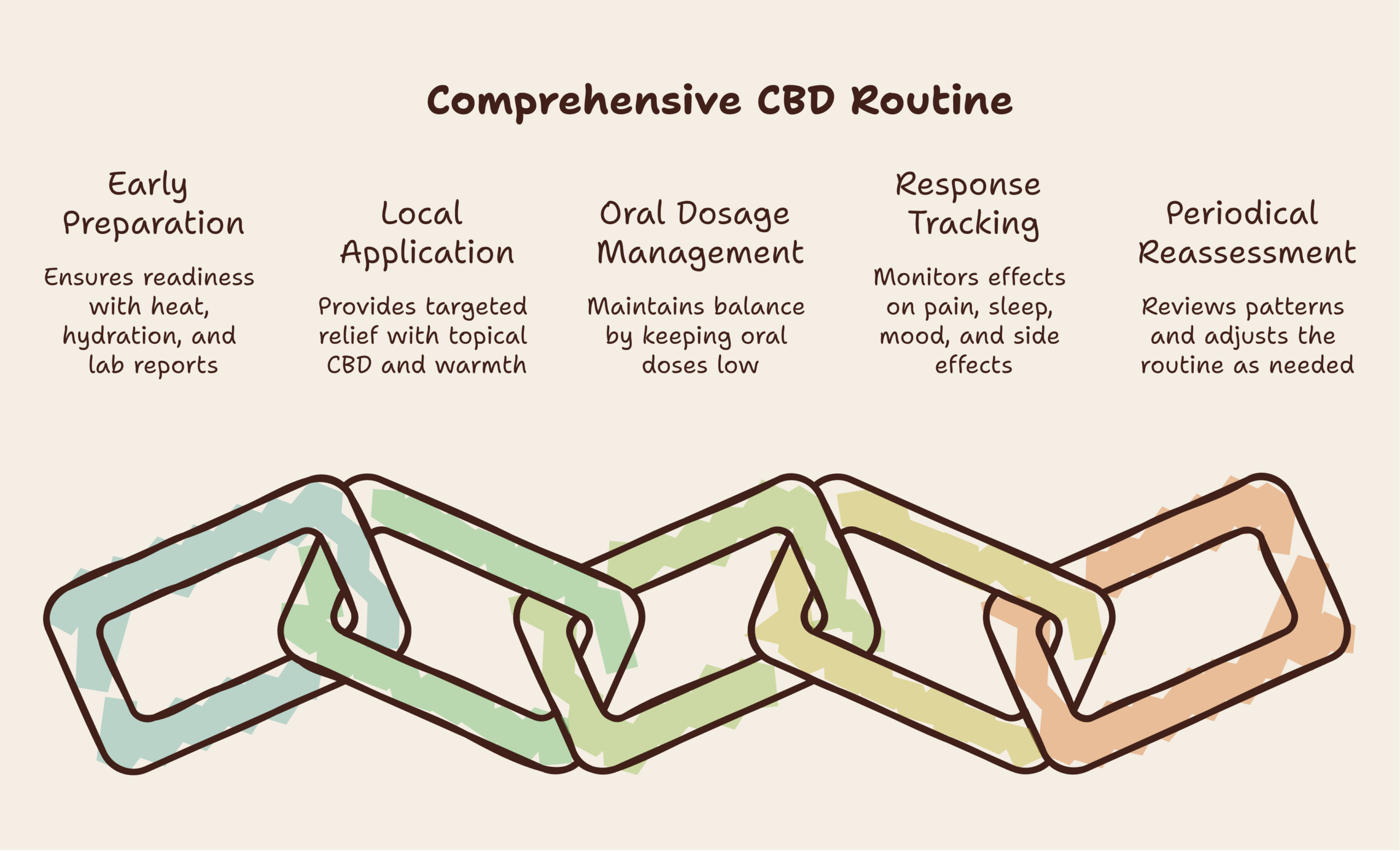
A responsible routine is boring in the best possible way. You want repeatable steps, not improvisation. The routine below is not a prescription; it is a structure adults can discuss with a clinician or adapt within product directions.
- Two days before expected cramps: prepare heat support, hydration, easy meals, and your product label or lab report.
- First discomfort: apply topical CBD locally if using one, then add heat for 20 to 30 minutes.
- Evening support: if using oral CBD, start with the lowest sensible serving and avoid combining with alcohol or sedatives.
- Peak cramp day: keep timing consistent, avoid stacking products, and record whether pain, sleep, or mood actually changed.
- After symptoms settle: pause or return to your normal routine rather than turning period-week dosing into automatic daily use.
The aim is not to “win” by taking more. The aim is to find the lowest-risk pattern that gives meaningful comfort. That might be topical CBD plus heat. It might be a small evening oral serving. It might be no CBD at all after you discover that magnesium, movement, sleep, or medical treatment works better for your body.
Safety Checks Before Using CBD for Menstrual Cramps
Safety deserves as much attention as comfort. The FDA consumer update on cannabis-derived products warns that CBD can cause liver injury and can affect how other medicines work. An FDA-supported randomized trial also examined CBD and liver enzyme elevations, which is one reason high-dose or daily oral CBD should not be treated casually.
Medication interactions are the biggest “do not wing it” area. Published case literature describes a CBD interaction with warfarin, including elevated INR, in reports such as an interaction between warfarin and cannabidiol. A broader review of cannabinoid drug interactions also explains why metabolism through liver enzyme pathways matters. If you take anticoagulants, antiepileptics, sedatives, antidepressants, liver-affecting medicines, or multiple prescriptions, talk with a healthcare professional first.
The WHO critical review of cannabidiol states that pure CBD is generally well tolerated with a good safety profile, but that statement does not mean every retail CBD product is perfect, accurately labeled, or appropriate for every person. The Australian TGA review of low-dose cannabidiol safety is also useful because it separates low-dose consumer contexts from high-dose prescription-style exposure.
📝 Important Note
Avoid CBD during pregnancy or breastfeeding unless a qualified clinician specifically advises otherwise. Also avoid experimenting before driving, operating equipment, or mixing with alcohol.
Product Quality: What to Check Before You Buy
Quality control is not glamorous, but it is where good cannabis wellness begins. Look for a recent certificate of analysis from an independent lab. The document should show CBD content, THC content, cannabinoid profile, and screening for heavy metals, pesticides, residual solvents, and microbial contamination. If a brand cannot show testing, skip it. If the lab report does not match the batch number, skip it. If the label promises miracle pain relief, definitely skip it.
For a deeper quality mindset, our COA guide for cannabis lab reports explains how to read testing documents instead of relying on marketing language. Our CBD capsules vs softgels comparison is also useful if you prefer measured servings over oils. If you are still learning the broader cannabinoid landscape, the CBG vs CBD guide helps distinguish CBD from another popular non-intoxicating cannabinoid.
Legal context matters too. In Greece, medical cannabis access is prescription-based and recreational cannabis remains illegal. Reporting on Greece’s first prescription era, Business of Cannabis described the first medical cannabis prescriptions in Greece, while consumer CBD and hemp-derived products occupy a separate retail conversation. Adults should check current local rules before buying or traveling with any cannabis-related product.
When CBD Is Not Enough
CBD should not become a way to normalize suffering. If cramps keep you home from work, cause vomiting, require repeated high-dose painkillers, or become worse over time, ask for medical evaluation. Severe period pain can be common without being normal. A clinician can help rule out underlying causes and recommend treatments with stronger evidence. CBD may sit beside that plan, but it should not block it.
It is also worth remembering that period discomfort is multi-layered. Pain, sleep, digestion, stress, mood, and inflammation can all feed each other. A useful routine might include heat, hydration, lower-caffeine days, gentle walking, pelvic relaxation exercises, consistent sleep, and medication when appropriate. CBD fits best when it complements those basics, not when it is expected to carry the whole problem alone.
⚠️ Disclaimer
This article is for informational purposes only and does not constitute medical advice. Information about CBD, medical cannabis, and cannabis regulation is current as of June 2026 but may change. Always consult qualified healthcare professionals for medical advice, especially if you have a health condition, take medication, are pregnant, or are breastfeeding. For our full disclaimer, visit cannastoreams.gr/disclaimer.
Frequently Asked Questions
Does CBD stop menstrual cramps?
Not reliably. Some adults report comfort support, but CBD is not an established treatment for dysmenorrhea. Think of it as a possible supportive tool, not a guaranteed cramp stopper.
Are CBD topicals better than gummies for cramps?
Topicals are useful for localized lower-abdomen or back tension and usually create fewer whole-body concerns. Gummies are convenient but less adjustable and take longer to feel.
Can CBD interact with period pain medicines?
CBD can interact with some medicines through liver metabolism pathways. If you use prescription medicines, blood thinners, sedatives, antiepileptics, or regular pain medication, ask a clinician or pharmacist first.
Should I use CBD every day or only during my period?
For cycle-specific discomfort, many adults prefer period-week use and then reassess. Daily use should be more deliberate, especially with oral CBD, higher servings, or medications.
What is the biggest red flag with CBD for cramps?
Using CBD to ignore severe, worsening, or unusual pelvic pain. If symptoms are intense or changing, medical evaluation matters more than trying another product.
