
CBD Edibles vs Oil: Onset, Duration & Safety
CBD edibles vs oil explained: compare onset, duration, absorption, safety checks, and responsible timing before choosing a CBD format.

CBD edibles vs oil is one of the most practical choices a wellness customer makes, because the format changes timing, flexibility, and how predictable the experience feels. Gummies, capsules, and other edibles move through the digestive system first. CBD oil can feel more flexible because it can be measured by drops and, when held under the tongue, may reach the bloodstream partly through oral tissues before the rest is swallowed. The right answer is not “which is stronger.” The better question is: which format matches your timing, your routine, your tolerance, and your safety profile?
This guide explains the difference in plain English for adults comparing CBD products in Greece. It uses responsible-use framing, current safety guidance from the U.S. Food and Drug Administration, consumer safety notes from the CDC, CBD pharmacokinetic research indexed by PubMed, and European safety context from EFSA. If you want a broader wellness angle, also read our guide to CBD oil for daytime stress.
⚠️ Disclaimer
This article is for informational purposes only and does not constitute medical advice. Information about CBD, hemp, and medical cannabis in Greece is current as of June 2026 but may change. Always consult qualified healthcare professionals before using CBD, especially if you take medication, are pregnant or lactating, have liver concerns, or manage a diagnosed medical condition. For our full disclaimer, visit cannastoreams.gr/disclaimer.
CBD edibles vs oil: the simple timing difference
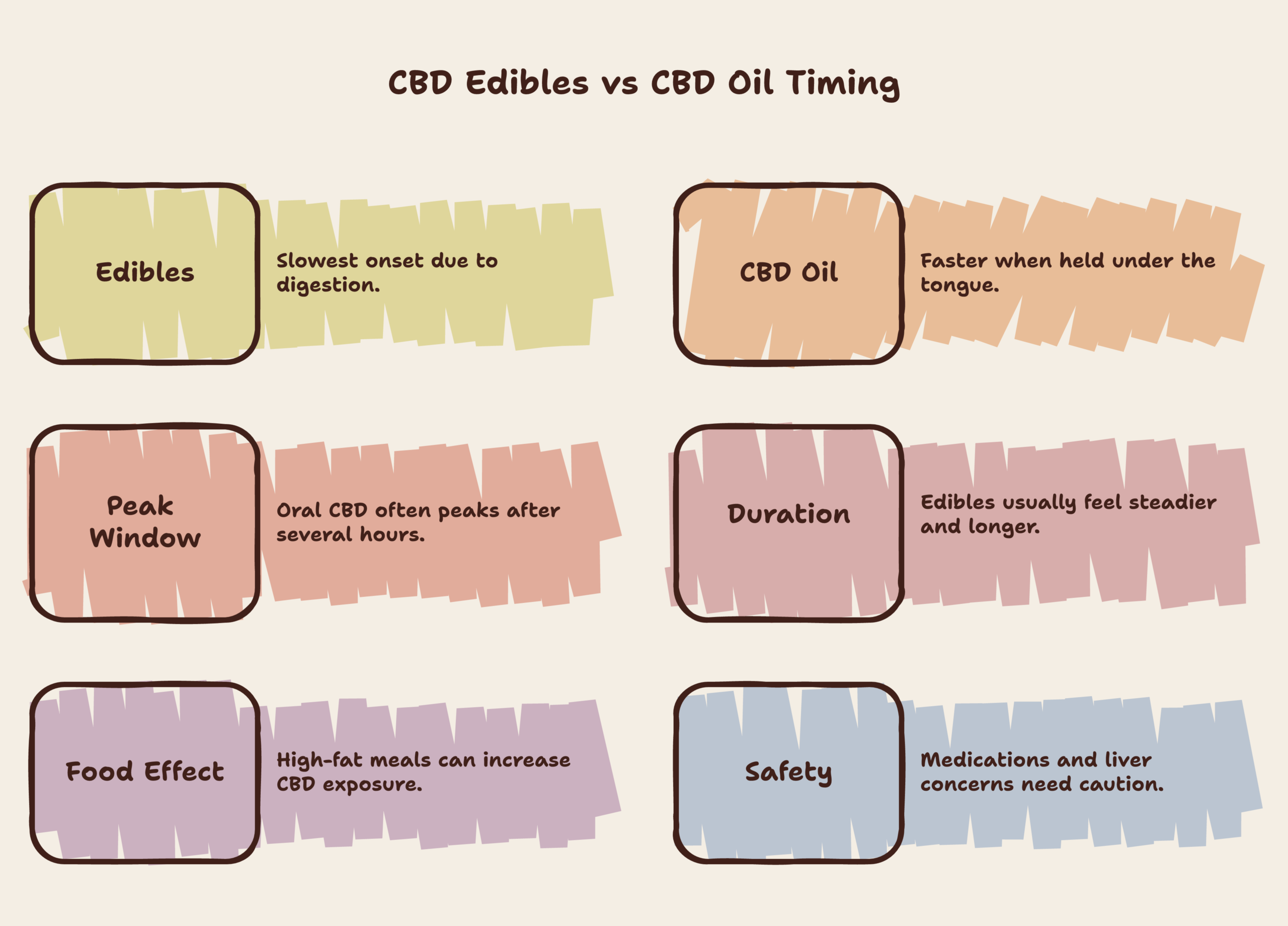
CBD edibles are designed for convenience. A gummy, mint, capsule, or infused snack is pre-portioned, discreet, and easy to add to a routine. The tradeoff is speed. Because edibles must be digested, the effect is usually delayed. Public health guidance on cannabis edibles warns that delayed effects can lead people to take more too soon, which is one reason the CDC discusses edible timing as a safety issue. CBD is non-intoxicating, but the same patience rule matters: wait long enough before deciding whether you need more.
CBD oil is more adjustable. You can measure a smaller or larger serving with the dropper, and many people hold it under the tongue for 60 to 90 seconds before swallowing. Research suggests that many “sublingual” oils still end up behaving partly like swallowed oral CBD, because some of the liquid is inevitably swallowed. A crossover study listed on PubMed found similar peak timing for CBD drops and capsules in the tested conditions. In real life, that means oil may be faster for some people, but it is not magic. Food, dose, product formulation, and your body all matter.
A fair rule of thumb is this: edibles are better for people who want a steady, routine-friendly format, while oil is better for people who want more control over serving size and timing. If your main goal is sleep support, compare this guide with our article on CBD for sleep timing and safety. If your goal is daytime calm, oil may be easier to adjust because you can start with a very small measured amount.
✓ Key Benefits
- ✓ Edibles: discreet, pre-measured, easy to repeat consistently.
- ✓ Oil: flexible serving size and easier small-step adjustments.
- ✓ Both: best used with patience, tracking, and product transparency.
- ✓ Safety: medication checks matter more than format preference.
Onset, peak, and duration: what the research suggests
For swallowed CBD products, the first noticeable effect often takes around one to two hours, although individual experiences vary. Reviews in the National Library of Medicine describe oral and oromucosal CBD peak timing across a broad range, with many results clustering several hours after use. Another NCBI clinical pharmacology overview notes that cannabidiol is highly lipophilic, undergoes metabolism through liver enzymes, and has variable absorption. That variability is exactly why two people can use the same edible and report different timing.
Peak timing is important because people often judge too early. If you take an edible, feel nothing after 30 minutes, and take another, the combined effect may arrive later than expected. CBD does not create the same intoxication profile as THC, but more is not always better. Higher intake can increase the chance of fatigue, gastrointestinal discomfort, interactions, or unwanted drowsiness. The Mayo Clinic summarizes CBD side effects and cautions, including dry mouth, diarrhea, reduced appetite, drowsiness, fatigue, and medication interactions.
Duration is also personal. Many consumers describe edibles as longer and smoother, often because digestion and metabolism stretch the curve. Oil may feel easier to schedule when you want a shorter trial window or when you want to adjust serving size. For a format comparison beyond oils and edibles, see our guide to CBD capsules vs softgels, where the same digestion-first logic applies.
💡 Pro Tip
Do not compare products only by milligrams on the label. Compare the serving size, format, certificate of analysis, ingredients, timing, and how consistently you can repeat the same routine.
Absorption: why food and formulation matter
CBD is fat-soluble, which means food can change exposure. A high-fat meal may increase CBD absorption compared with fasting, a point described in clinical pharmacology references such as NCBI Bookshelf. This does not mean everyone should take CBD with a heavy meal. It means consistency matters. If you take oil with breakfast one day and an edible on an empty stomach the next, you have changed more than the format. You changed the absorption context.
Formulation matters too. A broad-spectrum oil, isolate gummy, capsule, softgel, beverage, or topical product can feel different even when labels show similar CBD amounts. Independent lab testing is one of the few practical ways to know whether the label matches the product. The FDA cannabis product regulation page explains that CBD product oversight remains complex, and consumers should be cautious about unsupported claims.
At Puff ‘n Pass, the practical buying checklist is simple: choose a format you can use consistently, prefer products with batch testing, avoid products that promise to cure diseases, and check whether the cannabinoid profile fits your tolerance. For example, someone seeking a measured oil routine might look at Anti Stress 20 Broad Spectrum CBD Oil, while someone who wants a familiar edible format may compare options such as CBD cube gummies. Product availability can change, so always check the live product page before planning a routine.
A practical comparison for choosing your format
Choose CBD edibles if you want convenience first. Edibles are simple to carry, easy to understand, and usually pre-measured. They fit evening routines, travel routines, or people who dislike the herbal taste of oils. The downside is delayed feedback. You must be patient and avoid stacking servings too close together. If the edible includes other cannabinoids, the waiting rule becomes even more important because THC-containing edibles can feel stronger and more delayed than people expect.
Choose CBD oil if you want control first. Oil allows smaller adjustments, which is useful when you are new, sensitive, or comparing daytime and nighttime use. Many adults start low, track timing, and adjust slowly over several days rather than changing the serving every hour. Harvard Health notes that CBD research is promising in some areas but incomplete in many consumer uses, and that product quality varies, which is why a careful approach beats aggressive dosing. Read the Harvard Health overview of CBD for a balanced medical perspective.
A useful shopping question is: “What problem am I solving?” If you want a predictable evening ritual, an edible may make sense. If you want a measured, flexible format for daytime experimentation, oil may make sense. If you are comparing CBD for physical recovery, pair this guide with our CBD topicals for muscle recovery safety guide, because topical products follow a different logic from swallowed products.
📝 Important Note
If you take prescription medication, do not treat CBD as a casual supplement. CBD can interact with medicines through liver enzyme pathways, and professional advice matters.
Safety checks before using CBD edibles or oil
The most important safety check is medication. The FDA warns that CBD can interact with other medicines and may cause liver injury in some contexts. EFSA has also highlighted safety uncertainties around CBD as a novel food, including liver effects and data gaps, especially for younger people, pregnancy, lactation, and people using medications. You can read EFSA’s public update on the provisional safe level for cannabidiol as a novel food and the full scientific context in the EFSA Journal opinion.
The second safety check is age and vulnerability. CBD products are intended for adults, and cannabis products should be kept away from children and pets. Edibles require extra care because they can look like ordinary sweets. Store them securely, keep original packaging, and never leave gummies, chocolates, or capsules on a table where children can reach them. Consumer poison-center concerns around edibles are one reason many public health agencies emphasize storage and delayed onset.
The third safety check is legality. In Greece, non-medical hemp and CBD rules have historically focused on low-THC products, while medical cannabis follows a separate prescription framework. Regulatory details can change, and proposed reforms should not be treated as active law until implemented. If your concern is the Greek legal landscape, start with our hemp flower ban Greece consumer guide and our article on Greece cannabis penalties in 2026. For EU-wide background, the European Commission novel food page explains how novel food authorisations work.
How to test a CBD routine responsibly
Start with a product you can understand. The label should make the total CBD amount, serving size, ingredients, and cannabinoid profile easy to read. A certificate of analysis should show cannabinoid levels and ideally screen for contaminants. If a product makes disease-treatment promises, be skeptical. The FDA’s CBD food safety discussion repeatedly warns against unsupported health claims and emphasizes the need for better safety data.
Use a simple tracking method for the first week. Write down the product, serving amount, time taken, whether you used it with food, when you noticed effects, how long they lasted, and any side effects. Keep other variables stable. Do not test a new edible, a new oil, alcohol, and a late-night meal all at once, then try to guess what caused the result. Boring tracking gives better answers than dramatic experimentation.
For many adults, the best approach is “low, slow, and consistent.” Low means choosing a modest serving. Slow means waiting long enough before changing it. Consistent means repeating the same conditions before drawing conclusions. This approach is especially important when comparing CBD edibles vs oil, because the wrong conclusion is easy if you compare an edible after dinner with oil on an empty stomach.
Bottom line: which should you choose?
If you want convenience, consistent servings, and a longer routine-friendly experience, choose edibles. If you want flexible dosing, faster experimentation, and easier adjustments, choose oil. Neither format is automatically safer, stronger, or better. The best choice is the one you can use responsibly, with transparent lab-tested products and realistic expectations.
The smartest buyer compares timing, not hype. For edibles, wait patiently and protect against accidental access. For oils, measure carefully and keep your routine consistent. For both, check medication risks, avoid unsupported medical claims, and remember that CBD wellness is not a substitute for medical care. When in doubt, ask a qualified professional before starting.
Frequently Asked Questions
Are CBD edibles stronger than CBD oil?
Not automatically. Strength depends on milligrams per serving, absorption, food intake, formulation, and individual response. Edibles may feel longer, while oil may feel easier to adjust.
How long should I wait before taking more CBD?
For swallowed products, wait several hours before judging the result. Edibles and swallowed oils can peak later than expected, so taking more too soon can confuse your routine.
Is CBD oil better for daytime use?
Often, yes, because oil is easier to measure in small steps. But some people prefer low-dose edibles for convenience. Track your timing and avoid driving or risky tasks if you feel drowsy.
Can CBD interact with medication?
Yes. CBD can interact with medicines, especially those processed through liver enzyme pathways. Ask a healthcare professional if you take prescription medication.
Should beginners choose edibles or oil?
Beginners who want precise adjustment often prefer oil. Beginners who value simplicity may prefer edibles. In both cases, start low, wait patiently, and use lab-tested products.
