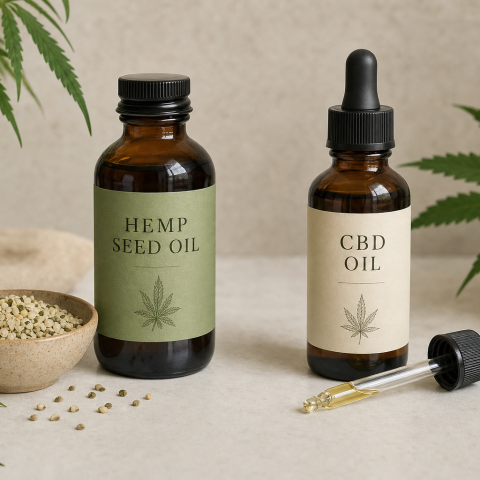
Hemp Seed Oil vs CBD Oil sounds like a comparison between two versions of the same product. It is not. One is pressed from hemp seeds and is mainly a food or cosmetic oil. The other is a product category built around a measured amount of cannabidiol, usually mixed into a carrier oil.
The bottles can look almost identical, and hemp seed oil may even be used as the carrier inside a CBD oil. The reliable way to tell them apart is to read the ingredient list, the stated amount of CBD, the intended use and the batch documentation rather than relying on leaves, green packaging or the word “hemp” on the front.
The difference starts with the part of the plant
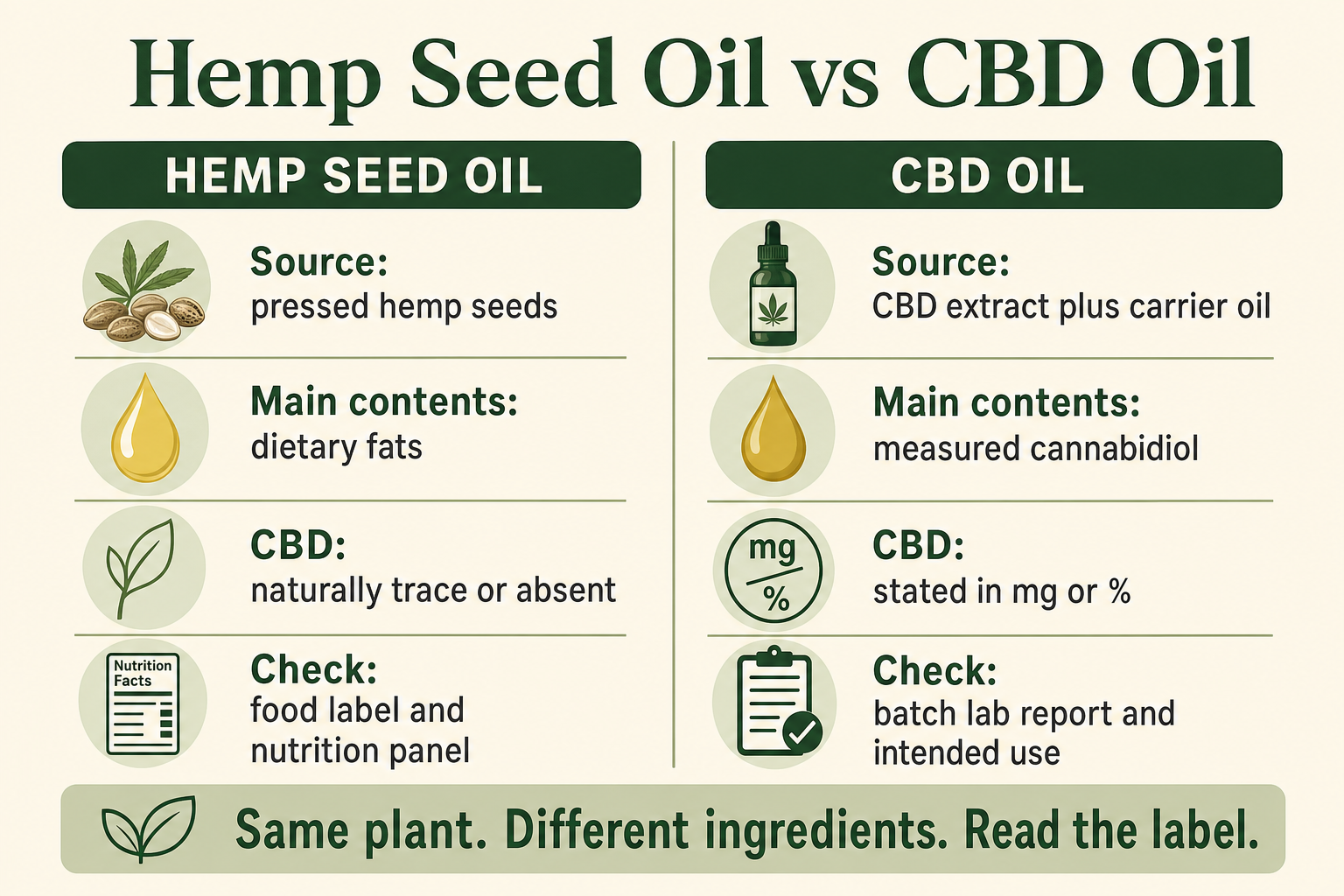
Hemp seed oil is made by pressing the seeds of Cannabis sativa. Its main components are dietary fats. In its review of hemp seed-derived food ingredients, the US Food and Drug Administration states that hemp seeds do not naturally contain THC. Any trace amounts of THC and CBD in seed ingredients can come from contact with other plant parts during harvesting or processing. The related hemp seed oil assessment letter describes an oil made mainly of polyunsaturated fats, including linoleic and alpha-linolenic acids.
CBD oil is defined by the cannabidiol it contains, not by the carrier. Manufacturers commonly combine a CBD extract or isolate with hemp seed oil, olive oil or another carrier. A bottle can therefore contain both hemp seed oil and CBD while still being sold as CBD oil. The important distinction is whether cannabidiol has been deliberately added and quantified.
Four quick identifiers
- “Cannabis sativa seed oil” points to an oil pressed from seed.
- A stated CBD amount in milligrams or percent points to a CBD formulation.
- “Hemp oil” alone is ambiguous and needs a full ingredient check.
- A leaf graphic does not identify the ingredient or prove cannabinoid content.
For cosmetics, the European Commission’s CosIng database lists Cannabis Sativa Seed Oil separately from cannabidiol derived from cannabis extract, tincture or resin. That separate naming helps with ingredient recognition. A CosIng entry describes an ingredient and possible cosmetic functions; it is not, by itself, a blanket marketing approval for every finished product or every intended use.
Hemp Seed Oil vs CBD Oil at a glance
The front label often sells a mood; the back label tells you what you are holding. This table focuses on information a shopper can verify without guessing at effects.
| Check | Hemp seed oil | CBD oil |
|---|---|---|
| Source | Pressed hemp seeds | CBD extract or isolate plus a carrier oil |
| Main label values | Fat, energy and serving information | CBD in mg, concentration and bottle volume |
| Expected CBD | Naturally trace or absent | Deliberately present and measurable |
| Useful document | Food or cosmetic label | Label plus batch-specific certificate of analysis |
| Typical purpose | Culinary ingredient or cosmetic emollient | Cannabidiol-containing formulation; rules depend on intended use |
Do not judge by colour or taste
Both products can be green or golden, taste grassy and come in amber dropper bottles. Those features do not show how much CBD is present. Only the label and a credible laboratory report can answer that question.
How to read a hemp seed oil label
On a food bottle, look for a clear product name, ingredient list, net quantity, storage instructions, best-before information and nutrition declaration. The European Commission’s summary of mandatory information for prepacked food sets out these core particulars under Regulation (EU) No 1169/2011. A simple bottle may list only hemp seed oil as its ingredient. A blend should identify the other oils as well.
Do not treat hemp seed oil as a back-door CBD product. If a label makes prominent cannabidiol claims but lists only seed oil, the claim and the ingredients do not line up. Conversely, a CBD product may list hemp seed oil first because it is the carrier and then identify cannabidiol or a hemp extract separately.
EU contaminant rules also distinguish seed-derived foods from cannabinoid extracts. Commission Regulation (EU) 2022/1393 set maximum levels for delta-9-THC equivalents in hemp seeds and products derived from them, including a specific value for hemp seed oil. That is a contaminant control for seed foods. It does not turn hemp seed oil into a CBD oil, and it does not establish that every cannabinoid extract is authorised for sale as food.
What a straightforward seed-oil label should answer
- Is the ingredient specifically named as hemp seed oil?
- Is it a single oil or a blend?
- Is the intended use food, cosmetic or something else?
- Are storage and best-before instructions clear?
- Does the seller avoid implying that ordinary seed oil supplies a measured CBD dose?
How to read a CBD oil label
A useful CBD label states the total cannabidiol in the bottle, the bottle volume and the carrier oil. If it gives a percentage, the total milligrams should still be easy to find or calculate. The label should also identify the intended use. Do not assume that a dropper bottle is meant to be swallowed; products sold as cosmetics or technical products belong to different regulatory categories and should be used only as directed.
The extract type matters, but the front-label category is not enough. “Full spectrum”, “broad spectrum” and “isolate” describe different formulation approaches. Our guide to full-spectrum, broad-spectrum and isolate CBD explains the vocabulary. Whatever the category, the current batch report should match the product name, batch number and concentration on the bottle.
Read milligrams before marketing language
“Premium”, “natural” and “strong” are not measurements. The total CBD in milligrams, bottle volume, ingredient list and batch report are measurements. If the numbers on those four items do not agree, choose another product.
A certificate of analysis should come from an identifiable laboratory and show the sample or batch it tested. Check the date, cannabinoid result and reporting units. Depending on the product, useful contaminant panels can include pesticides, heavy metals, residual solvents and microbiological screening. Our article on how to read a cannabis lab report covers the document in more detail.
Examples of clearly labelled product pages include a 5% CBD oil, a 10% CBD oil and a broad-spectrum CBD oil. These links are useful for comparing label fields and formats, not as medical recommendations. Stock, intended use and product documentation should be checked on the live page before purchase.
Food, cosmetic and medicinal rules are not interchangeable
A recurring source of confusion is the idea that “CBD is legal” settles every question. It does not. The product’s composition, intended use, claims and route to market all matter. The European Commission describes its Novel Food status Catalogue as a non-binding, non-exhaustive orientation tool. Food businesses must be able to establish a history of significant food consumption before 15 May 1997 or follow the novel-food route, and Member States may also apply national restrictions.
A 2023 statement endorsed by the European Commission’s toxicological safety committee said that a history of significant consumption before that date had not been demonstrated for CBD or other cannabinoids. It also said that no cannabinoid authorisation had then been added under the Novel Food Regulation. The same Commission statement on CBD as novel food placed primary enforcement responsibility with Member States. Current authorisations and national enforcement should therefore be checked rather than inferred from an old blog post or a product being visible online.
EFSA’s 2026 CBD novel-food risk-assessment presentation confirms that pre-market authorisation is required for CBD as novel food and reviews unresolved safety questions, vulnerable groups and drug-interaction concerns. This is one reason a cautious shopper should not treat CBD oil as an ordinary cooking oil.
Medicinal cannabidiol is another distinct category. The European Medicines Agency’s page for Epidyolex describes a prescription medicine for specific seizure disorders under medical supervision. That authorisation does not transfer to consumer CBD oils, and a retail product should not borrow prescription-drug claims. For a broader local overview, read our CBD buying guide for Greece.
Safety questions differ too
Hemp seed oil is assessed as a seed-derived oil, with the usual questions about food quality, allergens, rancidity, storage and nutritional composition. CBD oil adds questions about cannabidiol concentration, other cannabinoids, contaminants, interactions, intended use and product-specific legality. Treating those as the same safety review misses the main difference between the products.
CBD can interact with medicines and is not appropriate for everyone. EFSA’s 2026 review materials discuss data gaps involving the liver, nervous and reproductive systems and interactions with drug metabolism. The EMA’s medicinal-CBD information also shows why clinical cannabidiol is supervised rather than treated as a general wellness ingredient. Anyone taking prescription medication, managing liver disease, preparing for surgery, pregnant or breastfeeding should speak with a qualified clinician or pharmacist before considering a CBD product.
Keep prohibited intoxicating compounds out of the comparison
This guide concerns hemp seed oil and compliant CBD products. It does not recommend synthetic or semi-synthetic intoxicating cannabinoids, products sold for a high, or unverified blends. Avoid any bottle whose active ingredients are unclear or whose seller will not provide a current batch report.
Do not drive or operate machinery if a product makes you drowsy or impairs you. Keep all oils away from children and pets. If you want more context on changing formats and why the carrier can confuse the label, see our article on why Greek consumers are switching from flower to CBD oil formats.
A practical shopping check in Greece
Start with the job you expect the product to do. If you want an edible seed oil for dressings or a cosmetic emollient, look for hemp seed oil with clear food or cosmetic labelling. If you are evaluating a CBD formulation, the bottle must state CBD content and intended use, and the current batch documentation should support the claim.
- Name the category. Decide whether the product is food, cosmetic, medicine or another category. Do not invent a use that the label does not state.
- Read the full ingredients. “Hemp oil” is not precise enough. Look for seed oil, cannabidiol and the carrier as separate entries where applicable.
- Match the numbers. Compare total CBD, percentage, bottle volume and the certificate of analysis. They should describe the same batch.
- Check current rules. Product categories and enforcement can change. Use current official EU and Greek information rather than a generic legality slogan.
- Screen for personal risks. Ask a clinician or pharmacist about medicines, pregnancy, breastfeeding, liver concerns or other relevant conditions.
- Reject medical promises. A retail oil should not claim to diagnose, prevent or treat disease without the approvals required for a medicine.
Use the batch number as your anchor
A generic laboratory PDF for the brand is weaker than a report linked to the batch in your hand. If the report has no batch identifier, no date or no identifiable laboratory, ask for better documentation.
For more examples of oils, skincare and other formats, our guide to CBD product formats in Greece explains what changes when the intended use changes. Puff ‘n Pass staff can also help you read a product label and locate its available documentation; that support is product information, not medical advice.
Common label traps
The most common mistake is buying hemp seed oil while expecting a measured amount of CBD. A close second is seeing hemp seed oil in a CBD product and assuming the carrier is the active ingredient. Both errors disappear when you separate the carrier from the quantified cannabinoid.
- “Hemp oil” with no plant part: Ask whether it means seed oil or a cannabinoid extract in oil.
- A huge number on the front: Confirm whether it means milligrams of CBD, milligrams of total extract or something unrelated.
- No bottle volume: A percentage without volume makes comparison harder.
- One lab report for every product: Look for a batch match, not a generic certificate.
- Medical language on a retail oil: Treat disease claims as a warning sign, not as proof of quality.
- Online availability presented as legality: A live product page is not an official legal determination.
A better comparison is deliberately boring: ingredient, amount, volume, batch, intended use and seller identity. Those details will tell you more than a dramatic product name ever will.
Frequently asked questions
Is hemp seed oil the same as CBD oil?
No. Hemp seed oil is pressed from seeds and consists mainly of dietary fats. CBD oil contains a measured amount of cannabidiol mixed with a carrier oil. Hemp seed oil can be that carrier, so both names may appear on one CBD product.
Does hemp seed oil naturally contain CBD?
Hemp seeds do not naturally produce CBD. Seed-derived ingredients may contain trace contamination after contact with cannabinoid-bearing plant material during harvest or processing, but ordinary hemp seed oil is not a source of a measured CBD serving.
Can CBD oil use hemp seed oil as its carrier?
Yes. A manufacturer can add CBD extract or isolate to hemp seed oil. The ingredient list should identify the carrier and cannabidiol source, while the label should state the total CBD and bottle volume.
How can I verify the CBD amount?
Compare the label’s total milligrams, concentration and bottle volume with a recent certificate of analysis for the same batch. The report should name the laboratory, date the test and use clear reporting units.
Is every CBD oil sold online legal to consume in Greece?
Do not assume so. Rules depend on composition, intended use, claims and product category, and online availability is not official approval. Check current EU and Greek requirements and use the product only as labelled.
Choose the oil by evidence, not packaging
Hemp Seed Oil vs CBD Oil comes down to a seed-derived oil versus a cannabidiol formulation. They can share a bottle style, a colour palette and even the same carrier, but their composition, documentation, safety questions and regulatory routes differ.
When comparing products, ignore the leaf on the label for a moment. Find the ingredient list. Find the CBD amount. Find the intended use. Then match the batch number to the laboratory report. If any of those steps fails, the product has not given you enough information to make a careful choice.
Legal and medical disclaimer
This article is for informational purposes only and does not constitute medical advice. The information provided about medical cannabis in Greece is current as of January 2025 but may change. Always consult with qualified healthcare professionals for medical advice and treatment options. Decisions about medical cannabis should be made in consultation with authorized healthcare providers who understand your specific medical history and conditions. For our full disclaimer, visit cannastoreams.gr/disclaimer.
Product information at Puff ‘n Pass
If a label is unclear, ask to see the ingredient list and current batch documentation before buying. Puff ‘n Pass can explain available product formats and label fields without making medical claims.
Store links: Browse the online shop, read the FAQ, or review the full disclaimer.