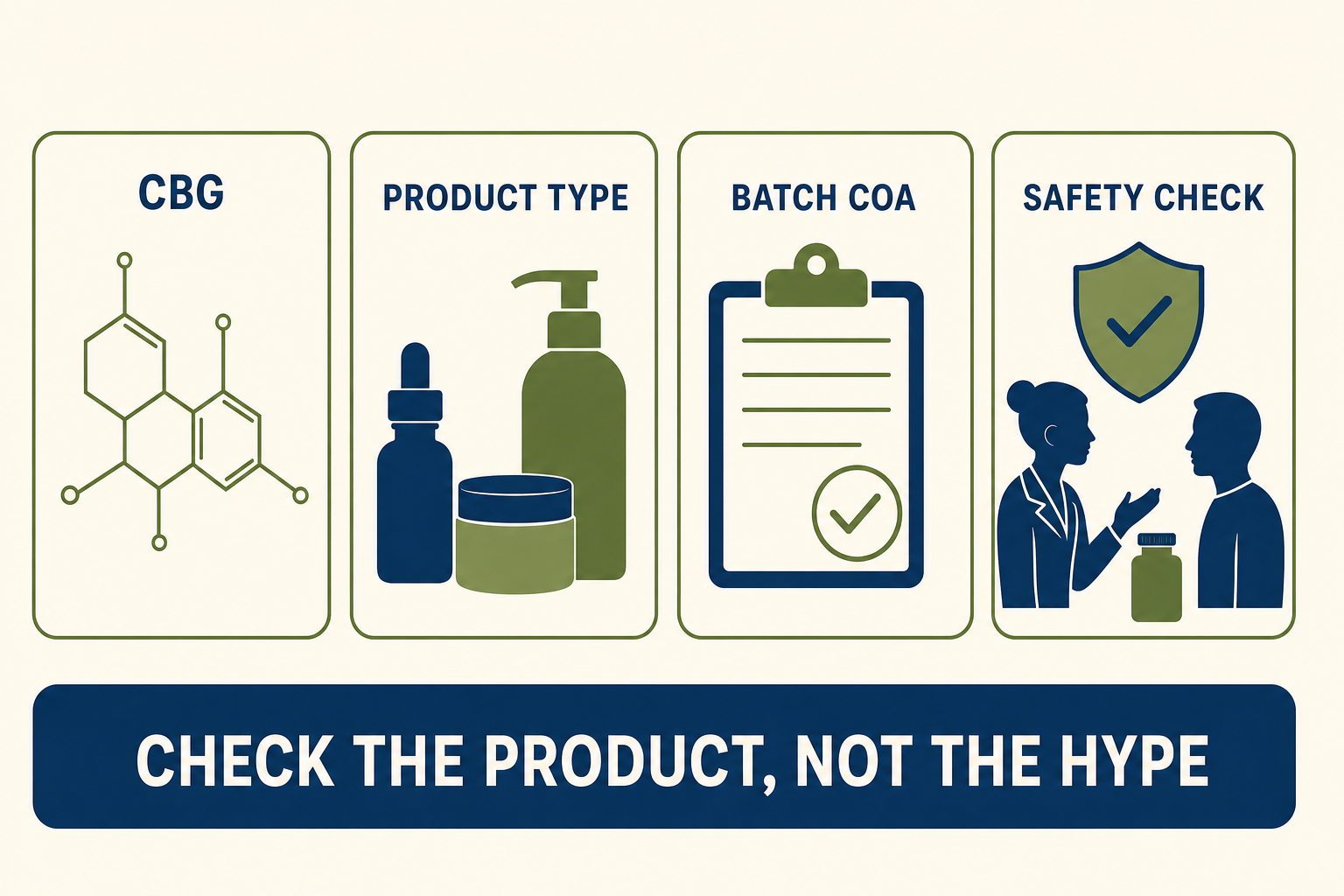
CBG in Greece 2026 is attracting attention from shoppers who already know CBD and want to understand another naturally occurring cannabinoid. The useful starting point is modest. CBG is a real plant compound, but a familiar acronym and a polished bottle do not prove that a product is lawful, accurately labelled, safe for a particular person, or supported by strong human evidence.
This guide separates the chemistry from the marketing. It explains what researchers know, where the evidence remains thin, how EU food rules affect cannabinoid products, and which checks matter before an adult consumer buys or uses anything in Greece.
What CBG is, without the mythology
Cannabigerol, shortened to CBG, is a phytocannabinoid found naturally in Cannabis sativa. The PubChem compound record identifies it as a plant metabolite with the molecular formula C21H32O2. In the plant, its acidic precursor, CBGA, sits early in the biosynthetic pathway that can lead to several better-known cannabinoids. That is why CBG is sometimes given an oversized nickname in marketing. The pathway is interesting chemistry, not evidence that a bottle of CBG can treat a disease.
A detailed pharmacology review indexed by PubMed describes CBG as a precursor molecule and examines its activity at several receptors. The same review is blunt about the evidence gap: CBG has been marketed with many benefit claims even though much less research has been done on it than on CBD. Most proposed therapeutic uses still come from cell studies, animal work, receptor experiments, or early human observations.
A sensible reading of a CBG label
- Confirm that the label states the total milligrams of CBG in the container.
- Calculate the amount per measured serving instead of relying on a front-label percentage.
- Check whether the product also contains CBD, THC, terpenes, flavourings, or other active ingredients.
- Match the batch number to an independent certificate of analysis.
- Treat disease claims as a warning sign, not as proof of quality.
Readers who need a direct comparison can use our earlier CBG versus CBD guide. The short version is that CBD has a larger human evidence base. CBG is newer to consumer shelves, and the gaps around repeated use, interactions, and product consistency matter.
What human research can and cannot tell us
The strongest published human experiment often discussed in CBG marketing is still small. A 2024 double-blind, placebo-controlled crossover field trial involved 34 healthy adults and tested a single 20 mg dose of hemp-derived CBG. The researchers reported lower anxiety and stress ratings at one measurement point, better verbal-memory performance, and no evidence of subjective intoxication or impairment in that short session.
Those findings are worth studying again, but they do not establish a treatment. Thirty-four healthy adults, one dose, remote sessions, and short follow-up cannot answer whether daily use works, whether the result applies to people with an anxiety disorder, or what happens after months of exposure. A result can be statistically significant and still be too narrow for a consumer health promise.
Another frequently cited source is a survey of people using CBG-predominant preparations. Respondents reported why they used the products, perceived effects, adverse events, and withdrawal symptoms. A survey records real experiences, but it has no placebo control and depends on self-selected participants and products whose composition may vary. It supports the need for trials; it does not turn personal reports into proof.
Keep the claim proportional to the study
“Studied for” does not mean “proven to treat.” A single-dose trial cannot support a long-term serving plan, and an animal or cell experiment cannot establish a human benefit. If a seller skips that distinction, the marketing is ahead of the evidence.
Safety evidence is still developing
CBG is often described as non-intoxicating because it does not produce the characteristic THC high in the limited human evidence available. Non-intoxicating does not mean risk-free. It says little about allergies, liver effects, pregnancy, interactions with medicines, contaminants, or the consequences of repeated use.
A 2025 human liver-chip study comparing four cannabinoids found CBG had the lowest toxicity potential in that experimental system at the tested concentrations and duration. The authors also reported limited oral-safety evidence for CBG and called for longer studies, more donors, and a wider dosing range. A laboratory model can flag biological responses; it cannot define a safe daily amount for the public.
Drug interactions deserve the same caution. An in-vitro study of twelve cannabinoids and common CYP drug-metabolising enzymes found varied inhibition patterns, including effects on CYP2C9 and CYP2C19. Laboratory inhibition does not prove that a particular retail dose will cause a clinical interaction. It is enough reason to ask a doctor or pharmacist before combining cannabinoid products with prescription medicines, especially medicines with a narrow therapeutic range.
The caution around under-studied cannabinoids is consistent with the wider regulatory record. EFSA’s 2026 update on CBD as a novel food still identified safety uncertainties and set a tightly scoped provisional intake level for a specific high-purity CBD formulation. That figure is not a CBG dose and must not be copied onto CBG products. It shows why regulators assess the exact substance, purity, process, population, and route rather than treating every cannabinoid as interchangeable.
Who should stop and ask first
Do not use CBG to replace prescribed care. Speak with a clinician or pharmacist first if you take regular medicines, have liver disease, are preparing for surgery, or have had a reaction to cannabis-derived products. Avoid cannabinoid products during pregnancy or breastfeeding; the FDA advises against cannabis-derived products, including CBD, in these periods, and CBG lacks adequate pregnancy-safety evidence.
CBG in Greece 2026: legality depends on the product
There is no responsible one-word answer to “Is CBG legal in Greece?” A chemical name does not settle the status of a finished product. Authorities can look at the plant material, extraction method, THC content, intended use, route of administration, labelling, advertising claims, and whether the product falls under food, cosmetic, medicinal, tobacco-related, or other rules.
For ingestible products, Regulation (EU) 2015/2283 governs the placing of novel foods on the EU market. The European Commission’s Novel Food status Catalogue is a useful orientation tool, but the Commission explicitly calls it non-binding and non-exhaustive. It also says food businesses must be able to show a history of significant food consumption before 15 May 1997 where relevant, and that Member States may impose specific restrictions.
That means a shop listing, foreign website, hemp origin, or low-THC statement is not enough by itself. An oil sold as a cosmetic is not automatically suitable for swallowing. A food supplement claim does not prove novel-food authorisation. A certificate showing cannabinoid percentages does not replace classification, labelling, and market-placement obligations.
Use a product-level check
Ask the seller for the product category, responsible EU business, complete ingredient list, batch certificate, intended use, and current basis for sale in Greece. If the answer is only “hemp is legal,” the answer is incomplete. Our Greek CBD legality guide explains the same product-first logic for CBD.
How CBG and CBD differ at the shop counter
CBG and CBD can appear in oils, mixed extracts, topical products, and inhaled formats, but the name on the front is only one part of the decision. CBD usually has more human research and a longer consumer track record. CBG products may contain smaller amounts, mixed cannabinoid profiles, or concentrated extracts, so the batch report deserves more attention than the colour of the packaging.
| Question | What to verify | Why it matters |
|---|---|---|
| What is in it? | CBG and CBD per container and per serving, plus all other cannabinoids | A product name may hide a mixed formula |
| How is it used? | Oral, topical, or inhaled route stated clearly | Rules, exposure, and risks differ by route |
| Was the batch tested? | Current independent COA matching the lot number | It checks composition and contaminant screens |
| What is promised? | No claim to diagnose, prevent, treat, or cure disease | Medical language can signal unlawful or unsupported marketing |
If you are learning how oil labels work, compare several familiar CBD formats. CBD Oil 10 10ml, CBD Oil 20 Full Spectrum 10ml, and Anti Stress 20 Broad Spectrum CBD Oil show why total milligrams, spectrum type, ingredients, and batch information need to be read together. These links are examples of label formats, not medical recommendations and not evidence that a separate CBG product shares the same regulatory status.
For a closer look at terminology, see our CBD oil compliance checklist and legal buying guide for Greece.
The batch certificate matters more than the trend
An independent certificate of analysis, or COA, should identify the laboratory, sample or batch number, test date, analytical method, and measured cannabinoid profile. For concentrated extracts, consumers should also look for contaminant panels that cover pesticides, heavy metals, residual solvents, and microbes. A QR code is convenient, but it is only useful if it opens a real report for the exact batch in your hand.
The problem is not theoretical. A 2024 analysis of 202 commercial CBD products found that 74% differed from the labelled CBD potency by at least 10%, while some samples contained detected heavy metals, residual solvents, or pesticides. The study examined US CBD products, not Greek CBG products, so its percentages cannot be transferred directly. It still shows why a cannabinoid label should be checked rather than trusted on design alone.
Five-minute COA check
- Match the product and batch numbers.
- Compare measured CBG, CBD, and THC with the package.
- Check the units carefully: percent, milligrams per gram, and milligrams per millilitre are not interchangeable.
- Confirm that contaminant results are reported, not merely described as “tested.”
- Check the date and the laboratory’s identity.
Our illustrated guide to reading cannabis lab reports explains the common columns and units. If a seller cannot provide the report, choose a better-documented product instead of guessing.
A cautious way to approach CBG
No evidence-based public dosing guideline exists for over-the-counter CBG wellness use. Copying a dose from CBD, a small experiment, a social post, or another person is not a substitute for individual advice. Concentration, route, food, other ingredients, medicines, and personal biology can all change exposure.
Adults who still choose to explore a lawful, properly documented product should change one variable at a time. Read the manufacturer’s directions, avoid combining it with alcohol or other substances that may impair you, and do not drive until you know how the complete product affects you. Stop if you feel unwell. Record the product, batch, serving, time, other medicines, and response so that a clinician can make sense of any problem.
Consumer checklist
- The product category and intended use are clear.
- A responsible business in the EU is named on the label.
- The batch COA matches the package and includes THC and contaminant results.
- The seller makes no disease-treatment promise.
- A pharmacist or doctor has reviewed possible medicine interactions where relevant.
- The product can be kept away from children and pets.
Inhaled formats add separate respiratory and hardware concerns. Anyone considering them should first read our vape cartridge and device safety guide. Choosing an oil or topical does not remove the need to verify its category and directions.
Frequently asked questions
Is CBG the same as CBD?
No. Both are phytocannabinoids, but they have different structures, receptor activity, research histories, and product profiles. CBD has been studied more extensively in humans. A claim established for CBD cannot automatically be applied to CBG.
Does CBG make you high?
The limited published human evidence has not shown the characteristic intoxication associated with THC. The finished product still matters. A mixed or inaccurately labelled formula may contain other cannabinoids, so check the batch report and do not drive until you know how it affects you.
Is every hemp-derived CBG product legal in Greece?
No blanket assumption is safe. Status depends on the finished product, intended use, route, composition, THC, claims, and the rules that apply to its category. Ask for the current product-level basis for sale in Greece.
Can CBG treat anxiety, pain, or inflammation?
CBG is being studied, but current evidence does not justify treating an over-the-counter CBG product as a proven therapy. Do not replace prescribed treatment. Discuss symptoms and cannabinoid use with a qualified healthcare professional.
What should I check before buying?
Check the product category, responsible EU business, complete ingredients, CBG per serving, intended route, batch-matched COA, THC result, contaminant panel, warnings, and current Greek market status. Walk away from cure claims or a missing report.
The practical conclusion
CBG deserves careful research, not a marketing coronation. The early human trial is interesting, and laboratory work helps researchers decide what to test next. Neither supplies a general medical claim or a universal serving size.
For CBG in Greece 2026, the best consumer habit is to evaluate the finished product. Check its category, ingredients, batch analysis, THC result, seller, claims, and interaction risks. If the legal basis or evidence is vague, do not fill in the gaps with optimism.
Legal disclaimer
This article is for informational purposes only and does not constitute medical advice. The information provided about medical cannabis in Greece is current as of January 2025 but may change. Always consult with qualified healthcare professionals for medical advice and treatment options. Decisions about medical cannabis should be made in consultation with authorized healthcare providers who understand your specific medical history and conditions. For our full disclaimer, visit cannastoreams.gr/disclaimer.
Ask for the paperwork before the product
Puff ‘n Pass staff can help adult shoppers read labels and identify the documents that should accompany a product. We do not diagnose conditions or replace advice from a doctor or pharmacist.
Store information: Visit the online shop or review our frequently asked questions.