
CBD Vape Safety Guide: Cartridges and Care
CBD vape safety guide for choosing cartridges, reading lab reports, avoiding additives, and caring for devices responsibly.

CBD vape safety is not about making vaping sound harmless. It is about reducing avoidable risk when an adult has already decided to use a CBD cartridge, disposable, or refillable vaporizer. The safest choice for your lungs is always not inhaling anything unnecessary, but if you do choose a CBD vape, the quality of the liquid, the device temperature, the lab report, and your own health profile matter more than the flavor on the label.
This guide is written for adults in Greece who want a calm, evidence-aware way to compare CBD cartridges, CBD liquids, and compatible vape devices. We will cover what to check before buying, how to read a certificate of analysis, which additives deserve extra caution, how to maintain a cartridge or coil, and when to stop and speak with a healthcare professional. For a broader foundation on product differences, you may also want our CBD edibles vs oil guide and our CBD in Greece legal buying guide.
📺 Video Guide
Watch the CBD vape safety video guide
CBD Vape Safety Starts With the Product Type
The first rule is simple: only vape products that were formulated for inhalation. A CBD tincture in olive oil, hemp seed oil, or MCT oil is designed for oral use, not for a heated coil. Oral oils can be too thick for cartridges, can burn poorly, and may expose the lungs to substances that were never meant to be aerosolized. If a label says drops, tincture, oral oil, food supplement, or “take under the tongue,” treat it as an oral product.
A CBD vape product should clearly identify itself as vape liquid, e-liquid, cartridge liquid, or a compatible disposable. The ingredient list should be short and understandable. CBD extract, botanical terpenes, propylene glycol, vegetable glycerin, or other declared vape carriers may appear depending on the formula. What you do not want is mystery oil, unexplained thickener, no batch number, no manufacturer information, or no lab testing. The FDA’s cannabis-derived product guidance repeatedly warns that unapproved CBD products can raise safety and quality concerns, especially when labels make therapeutic claims that are not supported by approval.
This is also where format matters. A sealed cartridge is convenient because the liquid, hardware, and resistance are designed to work together. A refillable tank gives more control but creates more room for mistakes, including incompatible liquids, overheated coils, and residue buildup. Disposable devices are easy but can hide important details about battery quality and liquid composition. None of these formats is automatically “safe.” The question is whether the format gives you enough information to make a responsible decision.
✓ Quick Buying Checks
- ✓ The label says it is made for vaping, not oral use.
- ✓ The batch has a recent third-party lab report.
- ✓ CBD and THC levels match the label.
- ✓ Ingredient list avoids unexplained oils and thickeners.
- ✓ Seller can answer basic questions without vague claims.
How to Read a CBD Vape Lab Report
A certificate of analysis, often called a COA, is one of the most useful safety filters. It should be connected to the exact batch you are buying, not a generic brand page from last year. The cannabinoid panel tells you how much CBD is present and whether THC, CBG, CBN, or other cannabinoids were detected. For athletes, that detail is not cosmetic: the WADA Prohibited List treats cannabidiol as an exception, but other cannabinoids can still create anti-doping risk in competition.
A serious COA should also test for contaminants. Pesticides matter because concentrated extracts can concentrate residues. Heavy metals matter because hemp is a bioaccumulator and because some devices contain metal parts exposed to heat. Residual solvents matter when extraction or formulation is not well controlled. Microbial testing matters when plant material or flavoring systems are not handled properly. The National Academies review on cannabis and health makes clear that cannabis research is complex and product-specific, so clean sourcing and transparent testing are practical safeguards.
Do not treat a lab report as decoration. Check the sample name, batch number, test date, laboratory name, and limits of detection. If the seller cannot connect the COA to the product in your hand, the report is weak evidence. If the report only shows CBD percentage but not contaminants, it is incomplete for inhalation products. If the COA shows a cannabinoid profile that does not match the label, that is a reason to walk away.
Additives, Vitamin E Acetate and Lung Risk
The clearest modern warning comes from the EVALI outbreak in the United States. The CDC investigation into EVALI identified vitamin E acetate as strongly linked to the outbreak, especially in THC-containing vape products from informal sources. That does not mean every vape risk is caused by vitamin E acetate, but it does prove a broader point: additives that seem harmless when swallowed or used on skin can behave very differently when heated and inhaled.
For CBD vape safety, avoid products that use thickening agents, cutting oils, or vague “proprietary blends” to change texture. Be cautious with sweet, dessert-style flavor profiles if the manufacturer does not disclose flavoring safety. The American Lung Association continues to warn that inhaled aerosols can expose users to chemicals that may irritate or harm lung tissue. A wellness label does not cancel basic respiratory biology.
Temperature matters too. If a cartridge tastes burnt, metallic, or unusually harsh, stop using it. Burnt taste often means the coil is dry, degraded, overheated, or no longer wicking properly. Continuing to pull through a burnt coil is not a toughness test. It is a sign that the device is no longer delivering the liquid as intended. For related device choices, see our cannabis vape safety guide and browse compatible options like a simple CCELL vape pen battery when you need a basic 510 setup.
💡 Pro Tip
If a cartridge needs extreme heat to produce vapor, the problem may be viscosity, hardware compatibility, or an old coil. Do not solve that by pushing the device harder.
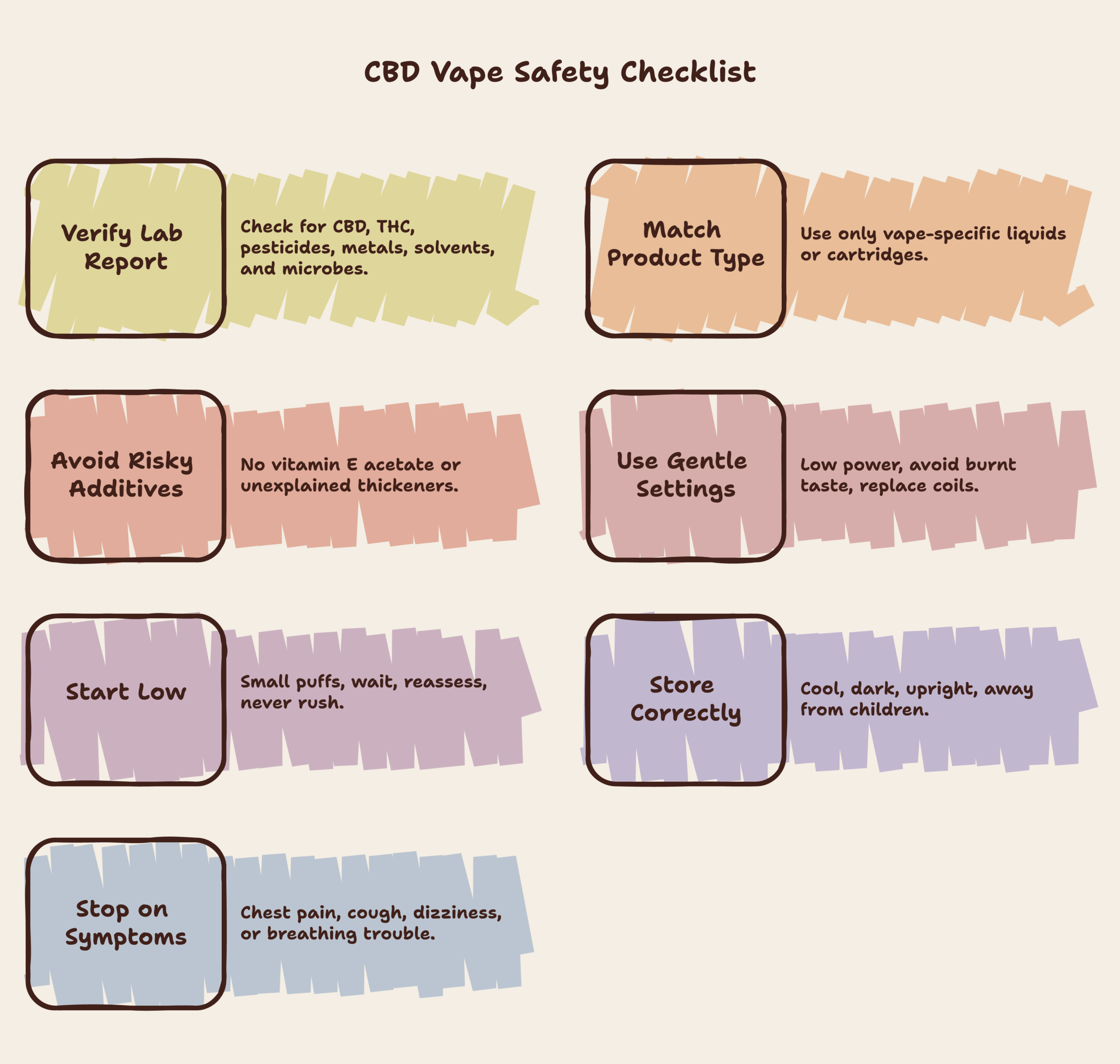
Device Care for CBD Vape Safety
Good hardware habits reduce avoidable exposure. Keep your battery clean, keep cartridge contacts dry, and avoid overtightening the cartridge. A 510 cartridge should make contact without being forced. If you screw it down aggressively, you can damage the center pin, create weak connection, or encourage leaks. Store cartridges upright in a cool, dark place, especially during summer in Athens, because heat can thin liquid and increase leakage.
With refillable devices, prime the coil before use and give the wick time to saturate. Take gentle puffs rather than sharp cigarette-style pulls. High-power cloud chasing is a poor match for CBD wellness use because overheating can degrade liquid, create harsh vapor, and make dosage harder to judge. The Consumer Reports discussion of CBD vaping highlights why product quality and inhalation uncertainty deserve caution.
Replace coils or cartridges when flavor changes, vapor production drops, or the draw becomes inconsistent. Do not try to resurrect a burnt coil by adding random liquid, poking the wick, or increasing wattage. For dry herb devices, follow manufacturer cleaning instructions and keep residue under control. If you prefer reusable hardware, a purpose-built herb vaporizer is a different category from a CBD liquid pen, so do not assume the same material, temperature, or maintenance rules apply.
Dosing, Timing and Interactions
Inhaled products act faster than oral products because vapor reaches the bloodstream through the lungs. That is why one of the most useful rules is still “start low and go slow.” Take one or two small puffs, wait, and notice how you feel before using more. Do not combine first use with alcohol, sedatives, driving, or important work. If you already know you are sensitive to cannabinoids, use extra caution.
CBD is often described as non-intoxicating, but non-intoxicating does not mean interaction-free. Reviews indexed in PubMed on cannabinoid CYP interactions show that CBD can affect drug-metabolizing enzymes, especially at higher doses. People taking antiepileptic drugs, anticoagulants, immunosuppressants, heart medicines, sedatives, or psychiatric medication should treat CBD as something to discuss with a clinician, not as a casual supplement.
The World Health Organization’s cannabidiol Q&A notes that CBD is generally well tolerated in its pure state, but it also separates pure CBD from real-world extracts and products. That distinction matters. A vape cartridge is not pure CBD in a vacuum. It is CBD plus carrier liquid, flavoring, hardware, heat, storage history, and user technique. For adults seeking slower, non-inhaled routines, products like CBD Oil 10 10ml or Phyto Relax 10 Broad Spectrum CBD Oil may be worth comparing with inhaled formats.
📝 Important Note
Stop vaping and seek medical advice if you develop chest pain, shortness of breath, persistent cough, severe dizziness, fainting, or symptoms that feel unusual for you.
A Responsible CBD Vape Buying Checklist
Before you buy, ask five questions. First, is the product clearly made for vaping? Second, is there a current COA for this batch? Third, are CBD, THC, and other cannabinoids declared clearly? Fourth, are contaminants tested, not merely ignored? Fifth, does the seller avoid medical promises? The CDC’s CBD information reminds consumers that CBD products are not risk-free and that most marketed uses are not FDA approved.
For adults in Greece, legal and compliance context also matters. Laws and enforcement around hemp, THC, novel cannabinoids, and product categories can change, so read labels carefully and avoid assuming that an imported product is automatically appropriate. Our hemp flower ban Greece guide explains why category details matter, and our CBD in Greece 2026 guide is a practical companion when comparing products.
If you choose a CBD vape, buy fewer better products rather than many unknown ones. Keep packaging until the cartridge is finished, because batch numbers and manufacturer details are useful if something goes wrong. Never share a mouthpiece when someone is sick. Keep devices away from children and pets. Do not leave batteries charging unattended. These details sound boring, but boring is good when the goal is harm reduction.
What to Avoid Completely
Avoid any CBD vape product that refuses basic transparency. No lab report, no batch number, no ingredient list, no manufacturer contact, no clear product category, or a seller who says “trust us” should be enough to stop the purchase. Avoid refilling cartridges with homemade mixtures. Avoid vaping oral CBD oil. Avoid products that promise to cure anxiety, pain, insomnia, or disease. The FDA warning letter database is full of examples showing how common unsupported CBD health claims can be.
Also avoid treating stronger as better. High concentration does not automatically mean better value, especially if you are new to inhaled CBD. Stronger liquids can make it easier to overshoot your preferred effect, and more intense flavoring can hide poor formulation. The New England Journal of Medicine report on vaping-associated lung injury evidence reinforced how inhaled product composition can matter dramatically. Safety is not only about the cannabinoid. It is about the entire aerosol you create and inhale.
⚠️ Disclaimer
This article is for informational purposes only and does not constitute medical advice. The information provided about CBD and cannabis wellness products is current as of June 2026 but may change. Always consult qualified healthcare professionals for medical advice, especially if you have respiratory disease, cardiovascular risk, pregnancy, or prescription medication use. For our full disclaimer, visit cannastoreams.gr/disclaimer.
Frequently Asked Questions
Is vaping CBD safer than smoking cannabis?
Vaping avoids combustion smoke, but it still exposes the lungs to heated aerosol. Product quality, additives, device temperature, and personal health conditions all matter.
Can I put regular CBD oil in a vape pen?
No. Oral CBD oils and tinctures are not designed for inhalation. Use only products specifically formulated and labeled for vaping.
What should a CBD vape lab report include?
Look for cannabinoid potency, THC level, pesticides, heavy metals, residual solvents, microbes, batch number, test date, and the name of the independent lab.
Why is vitamin E acetate mentioned in vape safety?
CDC investigations strongly linked vitamin E acetate to the EVALI lung injury outbreak, especially in THC vape products from informal sources. It should not be used in vaping products.
Can CBD interact with medication?
Yes. CBD can affect drug-metabolizing enzymes and may interact with some medications. Speak with a clinician if you take prescription medicines.
