
CBD Blood Pressure Guide: Heart Safety Basics
CBD blood pressure guide for adults: evidence, heart safety, medicine interactions, and practical product choices before using CBD.

CBD blood pressure is one of the most searched wellness questions right now because people want calm, sleep, and stress support without accidentally making heart health more complicated. The honest answer is nuanced: early human research suggests cannabidiol may modestly influence blood pressure in some situations, especially under stress, but CBD is not a hypertension treatment and it can interact with medicines that matter. For adults in Greece who already track their cardiovascular health, the smarter move is to understand the evidence, choose products carefully, and speak with a clinician before combining CBD with prescription drugs.
This guide is written for informed adults, not for hype. We will separate what human studies actually show from what wellness marketing often implies, then connect that evidence to practical choices like CBD oil strength, vaping, edibles, timing, and product quality. If you need broader context first, our CBD in Greece 2026 legal buying guide explains the local shopping basics, while this article focuses specifically on heart safety.
📺 Video Guide
What Research Says About CBD Blood Pressure
The strongest starting point is a small randomized crossover study published in 2017. In that trial, healthy volunteers took a single 600 mg dose of cannabidiol, and researchers reported lower resting systolic blood pressure and a smaller blood pressure rise during stress testing. The result is often quoted online, but the details matter: it was a small study, it used a high single dose, and the participants were healthy adults rather than patients being treated for hypertension. You can read the abstract on PubMed or the full paper through JCI Insight.
Later research moved closer to real cardiovascular questions. A clinical trial in adults with untreated hypertension reported lower 24-hour ambulatory blood pressure after short-term oral CBD compared with placebo, and another hypertension study found reductions of roughly 4 mmHg systolic and 3 mmHg diastolic after several weeks of chronic oral CBD in a specific formulation. Those are interesting signals, not a license to self-medicate. The 2023 hypertension data is indexed by PubMed and related ambulatory blood pressure results are also available on PubMed.
A 2024 systematic review of randomized controlled trials concluded that oral CBD may reduce blood pressure compared with placebo, especially during stress or sleep, but the evidence base remains limited and dose-dependent. That is why responsible retailers should avoid promising that CBD “fixes” blood pressure. The safer message is that CBD may affect cardiovascular markers, so people with heart conditions should treat it like an active supplement rather than a harmless flavor additive. The review can be found through PubMed.
✓ Evidence Snapshot
- ✓ Small human studies suggest CBD can modestly lower blood pressure in some settings.
- ✓ Effects appear more consistent during stress, sleep, or hypertension trials than in every resting condition.
- ✓ CBD should not replace prescribed blood pressure medication.
- ✓ Product strength, dose, medicines, alcohol, and liver health change the risk profile.
Why CBD Is Not a Blood Pressure Medicine
The gap between “may influence blood pressure” and “treats hypertension” is huge. Prescription antihypertensive medicines are tested across large populations, standardized doses, long-term monitoring, and safety endpoints. Most consumer CBD products are not studied that way, and product labels can vary in accuracy depending on supplier quality. Even if a person notices calmer evenings or lower stress, that does not prove their cardiovascular risk is controlled.
This distinction is especially important because high blood pressure is often silent. Someone can feel relaxed and still have unhealthy readings. Replacing medication with CBD, skipping a doctor visit, or using a high-strength oil without monitoring can create a false sense of control. If your interest in CBD blood pressure comes from a diagnosis, bring your product label, dose, and medication list to your doctor or pharmacist.
For a related responsible-use perspective, see our CBD for anxiety evidence and safety guide. Stress, sleep, and blood pressure overlap, but they are not the same target. CBD may feel useful in a stress routine while still being inappropriate for someone on multiple cardiovascular medicines.
Heart Safety: What Adults Should Check First
Before using CBD for any wellness goal connected to the heart, start with the boring checks. They are boring because they work. Know your usual blood pressure readings, know your medications, know whether you have liver disease, and know whether you already use sedatives, alcohol, nicotine, or other substances that could change alertness or metabolism.
The FDA CBD consumer update warns that cannabidiol can cause liver injury, interact with other drugs, and increase drowsiness when combined with alcohol or central nervous system depressants. FDA researchers also reported liver enzyme elevations in a randomized trial using approximately 400 mg per day for four weeks, which is far above many casual wellness doses but still relevant for people stacking multiple CBD products. The FDA randomized trial summary is worth reading if you assume natural automatically means low-risk.
The CDC cannabis health effects guidance also reminds consumers that THC-containing cannabis can acutely affect heart rate, blood pressure, coordination, and driving safety. CBD itself is not intoxicating in the same way as THC, but many products contain other cannabinoids, terpenes, or traces of THC. That makes certificate-of-analysis checks and trusted suppliers important, not decorative.
💡 Pro Tip
If you track blood pressure at home, log readings at the same time each day and do not judge CBD from one relaxed evening. Trends matter more than one number.
CBD Oil, Vapes, and Edibles: Which Format Fits Heart-Conscious Use?
Format changes timing. CBD oil taken under the tongue is popular because it is easy to start low, adjust gradually, and avoid inhalation. Edibles are convenient but slower and easier to overdo because effects may build after a delay. Vapes act faster, but inhalation is not the first choice for someone thinking carefully about heart or lung health. For a deeper comparison, our CBD edibles vs oil guide explains onset and duration in more detail.
For heart-conscious adults, CBD oil is usually the most sensible first format because you can measure small amounts and pause quickly if it does not suit you. Products such as CBD Oil 5 10ml or CBD Oil 10 10ml make more sense as cautious starting points than jumping straight into very high-strength products. Higher strengths like CBD Oil 20 Full Spectrum 10ml may fit experienced users, but the label strength should be matched with actual milligrams per serving, not vibes.
Vapes can be useful for adults who already prefer inhaled products, but they are not ideal if the goal is steady wellness tracking. If you are comparing cartridge safety, revisit our CBD vape safety guide. Heart-conscious use rewards consistency, product transparency, and restraint. It does not reward chasing the fastest effect.
Medication Interactions Are the Main Practical Risk
The most important safety issue is not whether CBD is “good” or “bad” for blood pressure. It is whether CBD changes how your existing medicines behave. Cannabidiol is metabolized through liver enzyme systems that also process many common drugs. Depending on the medicine, CBD may increase side effects, change sedation, or alter drug levels. People taking blood pressure medication, anticoagulants, antiepileptics, antidepressants, sleep medication, or multiple prescriptions should not guess.
This is why pharmacists can be valuable. A pharmacist can look at your actual medication list and flag interaction concerns faster than a generic article can. The Harvard Health CBD overview makes the same practical point: CBD shows promise, but much remains unknown, and interactions are real. The British Heart Foundation also takes a cautious stance for people thinking about CBD and heart health.
A practical rule: if a medication carries a grapefruit warning, do not assume CBD is safe with it. Grapefruit warnings often involve liver enzymes, and CBD can influence some of the same metabolic pathways. That does not mean the combination is always forbidden. It means the combination deserves professional review.
📝 Important Note
Do not stop or reduce prescribed blood pressure medication because CBD seems relaxing. Hypertension management belongs with a qualified clinician.
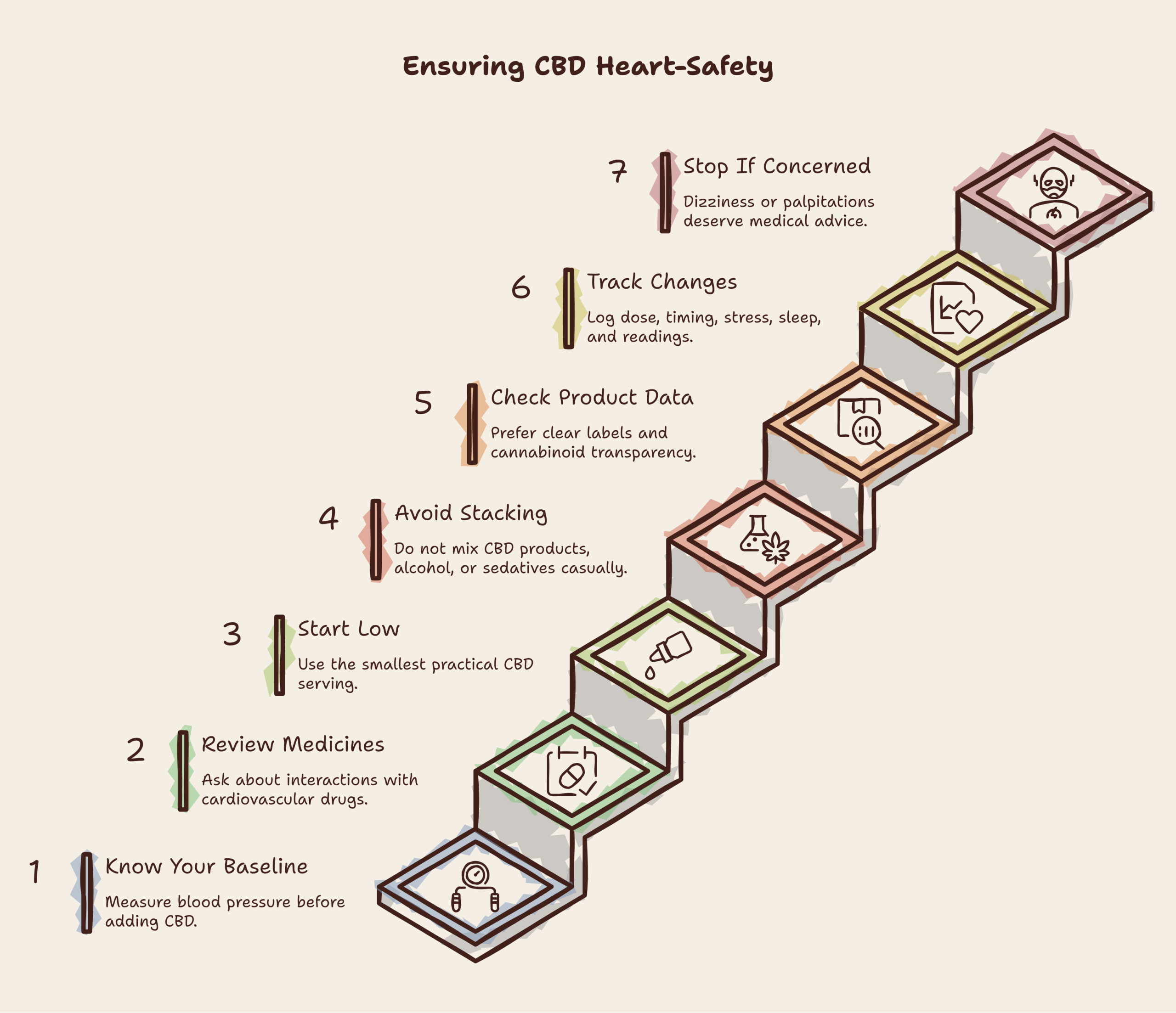
A Simple Safety Checklist Before Trying CBD
Use this checklist before buying or changing your routine. It is intentionally practical because heart safety is built from small decisions repeated consistently.
- Know your baseline. Measure blood pressure consistently for several days before adding CBD.
- Review medicines. Ask a doctor or pharmacist about interactions, especially with cardiovascular drugs.
- Start low. Use the lowest practical serving and wait before increasing.
- Avoid stacking. Do not combine oils, gummies, vapes, alcohol, and sedatives casually.
- Check product data. Prefer clear labels, batch information, and cannabinoid transparency.
- Track changes. Record dose, timing, sleep, stress, and readings instead of relying on memory.
- Stop if something feels off. Dizziness, unusual fatigue, palpitations, or faintness deserve caution.
This checklist also fits broader wellness routines. If your goal is recovery or sleep rather than blood pressure, compare it with our CBD workout recovery guide and CBD sleep evidence guide.
What the WHO Says About Pure CBD
The World Health Organization has stated that pure cannabidiol does not appear to have abuse potential and is generally well tolerated, while also recognizing the need to evaluate preparations carefully. That distinction matters because “pure CBD” in a scientific review is not the same as every real-world product on a shelf. The WHO cannabidiol Q&A and WHO CBD critical review are useful counterweights to exaggerated fear, but they do not cancel the FDA’s warnings about liver effects, drug interactions, and consumer-product uncertainty.
A balanced reading is simple: CBD is not intoxicating like THC, does not appear to carry the same abuse profile as THC, and may have legitimate wellness uses. At the same time, it is biologically active. If a compound is active enough to help some people feel calmer, sleep better, or possibly shift cardiovascular markers in studies, it is active enough to deserve careful dosing and interaction checks.
How to Shop Smarter at Puff n Pass
When choosing CBD products, begin with your goal. If the goal is daytime stress support, a lower-strength broad-spectrum or CBD oil may be easier to evaluate than a complex product with several potent cannabinoids. If the goal is evening relaxation, avoid mixing CBD with alcohol or sedatives unless your clinician says it is acceptable. If the goal is pain, inflammation, or recovery, remember that symptom relief and blood pressure control are different outcomes.
At Puff n Pass, adult shoppers can compare CBD oils, hemp products, edibles, and accessories with staff guidance, but the most responsible answer is sometimes “ask your doctor first.” That is not bad customer service. That is trust. If you use prescription medication, have cardiovascular disease, are pregnant, breastfeeding, or buying for someone younger than 21, pause and get medical advice before experimenting.
Quality cues include clear product names, sensible strengths, realistic claims, and supplier transparency. Be skeptical of any product that promises dramatic blood pressure results, instant medical outcomes, or “no side effects.” Good CBD retail should feel calm and specific, not like a carnival barker in a lab coat.
⚠️ Disclaimer
This article is for informational purposes only and does not constitute medical advice. Information about CBD, heart health, and medical cannabis in Greece is current as of July 2026 but may change. Always consult qualified healthcare professionals for medical advice, especially if you have hypertension, cardiovascular disease, liver disease, or take prescription medication. For our full disclaimer, visit cannastoreams.gr/disclaimer.
Frequently Asked Questions
Can CBD lower blood pressure?
Some small human studies suggest CBD may modestly lower blood pressure in certain settings, especially stress or sleep, but it is not an approved treatment for hypertension.
Can I take CBD with blood pressure medication?
Ask your doctor or pharmacist first. CBD can interact with medicines through liver enzyme pathways and may affect side effects or drug levels.
Is CBD oil safer than vaping for heart-conscious adults?
For cautious tracking, CBD oil is usually easier to measure and adjust. Vaping acts faster but is not ideal for people prioritizing heart and lung safety.
What dose should I start with?
There is no universal dose. Start with the lowest practical serving on the product label and increase only after checking tolerance and professional advice if you take medication.
Should I monitor blood pressure when using CBD?
Yes, if blood pressure is part of your reason for using CBD. Track readings consistently and do not judge from a single relaxed evening.
Is CBD the same as THC for heart effects?
No. CBD is not intoxicating like THC, but products can vary and THC-containing cannabis may acutely affect heart rate, blood pressure, coordination, and driving safety.
