There’s a long history of artists, musicians, and writers reaching for cannabis before sitting down to work. Louis Armstrong smoked daily. Carl Sagan wrote about how it shifted his thinking. But is there real science behind the connection between cannabis and creativity, or is it mostly folklore? The answer turns out to be more interesting than a simple yes or no.
If you’ve ever tried brainstorming after a few puffs and felt like your ideas came faster or weirder than usual, you’re not imagining things. But the mechanism at work might not be what you expect. Let’s break down what research actually says, which strains and methods tend to work best, and how to use cannabis as a creative tool without sabotaging your output.
The Science Behind Cannabis and Creative Thinking
Researchers typically split creativity into two categories: divergent thinking (generating many possible solutions to a problem) and convergent thinking (narrowing down to the single best answer). Cannabis appears to have very different effects on each.
A 2017 study published in Consciousness and Cognition found that cannabis users scored higher on measures of divergent thinking, but the researchers concluded this was largely driven by changes in personality, specifically increased openness to experience. Cannabis didn’t directly light up creativity centers in the brain. Instead, it lowered the mental barriers that normally filter out unusual ideas.
Neuroscientist Andrew Huberman reviewed these findings on his podcast and pointed out something worth noting: cannabis increases dopamine release in the frontal lobe, the part of your brain responsible for abstract thinking and connecting seemingly unrelated concepts. That dopamine surge can make you more comfortable with ambiguity and less likely to dismiss half-formed ideas before they develop.
Here’s where it gets tricky. A 2014 study from Psychopharmacology tested actual creative output in controlled settings and found that high doses of THC actually impaired divergent thinking, while low doses had no significant effect compared to placebo. The researchers suggested that people who feel more creative while high may be experiencing reduced self-criticism rather than enhanced idea generation.
💡 Pro Tip
If you want to use cannabis for creative work, keep doses low. Microdosing (2.5-5mg THC) tends to preserve cognitive function while still loosening up your thinking. Higher doses can make ideas feel brilliant in the moment but harder to execute or remember later.
How Cannabis Actually Changes Your Creative Process
Forget the cliché of the stoned genius having a eureka moment. What cannabis does for creativity is more subtle and more useful than that.
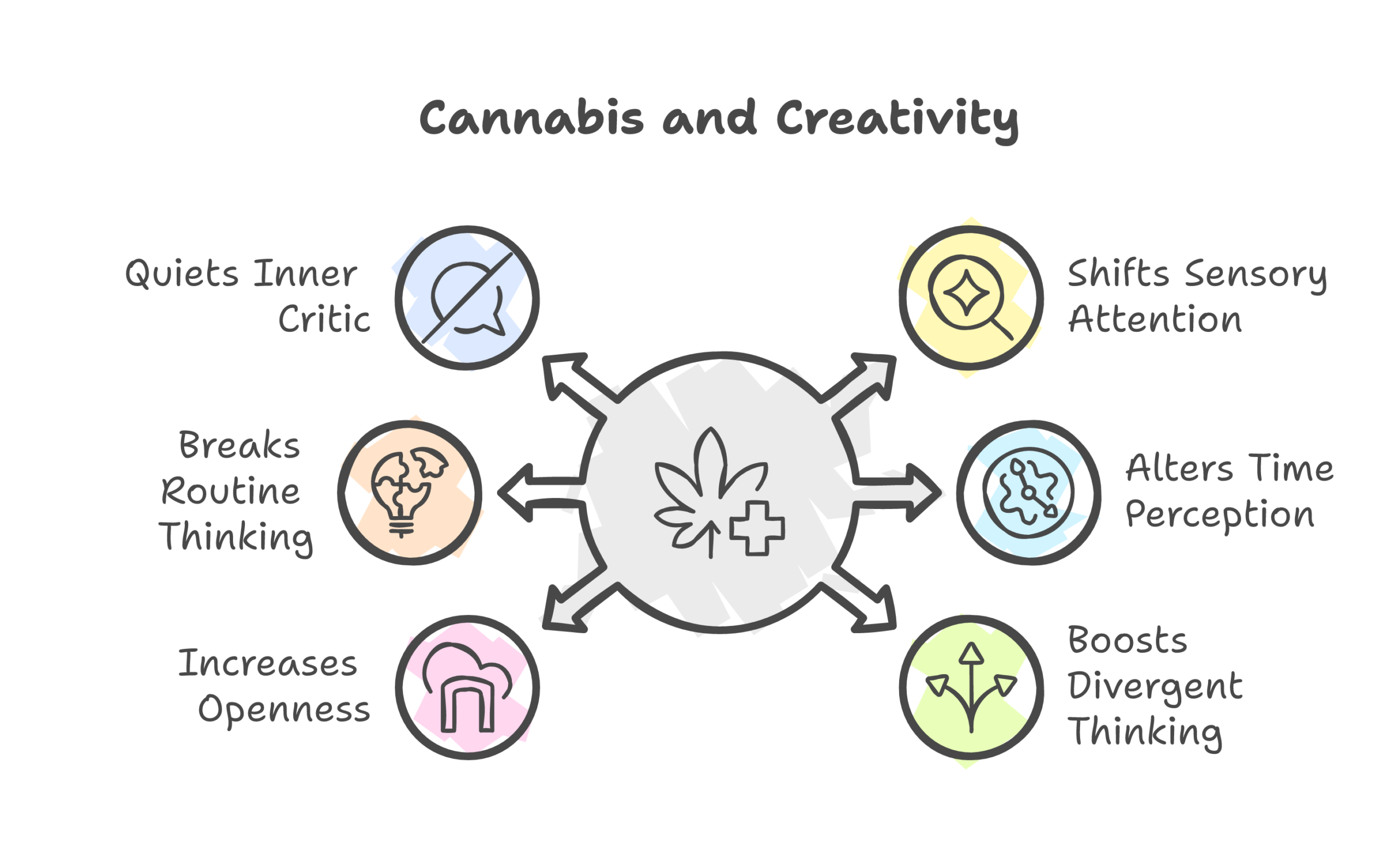
It quiets your inner critic. Most people who struggle with creative work aren’t lacking ideas. They’re too quick to judge and discard them. Cannabis, particularly strains high in THC, reduces activity in the default mode network, the brain region associated with self-referential thinking and rumination. When that inner voice gets quieter, you’re more willing to follow unusual ideas and see where they go.
It shifts your attention. Cannabis alters how your brain prioritizes sensory input. Colors seem brighter, music hits differently, textures become more interesting. For visual artists, musicians, and writers who work with sensory detail, this perceptual shift can surface observations they’d normally overlook.
It breaks routine thinking patterns. Your brain loves efficiency. It builds neural shortcuts that let you solve familiar problems quickly, but those same shortcuts make it harder to think in genuinely new ways. THC disrupts some of these automatic patterns, according to research from Nature Neuropsychopharmacology, which can force your brain to take unfamiliar routes between ideas.
It changes your relationship with time. Creative work often suffers from impatience. You want the painting done, the draft finished, the song recorded. Cannabis tends to slow your subjective experience of time, which can make it easier to sit with a piece, experiment, and revise without feeling rushed.
Best Strains for Creative Work
Not all cannabis works the same way for creative pursuits. Strain choice matters, and so does the cannabinoid and terpene profile. Here’s what tends to work based on both user reports and the limited research available.
Sativa-dominant strains are the traditional pick for creative sessions. They tend to produce more cerebral, energizing effects rather than the body-heavy sedation you get from indicas. Strains like Jack Herer, Durban Poison, and Green Crack (despite the unfortunate name) are consistently rated by users as creativity boosters on platforms like Leafly.
Terpene profile matters more than indica vs sativa labels. The sativa/indica distinction is becoming outdated as we learn more about how individual compounds affect the experience. Look for strains high in:
- Limonene (citrusy) for mood elevation and focus
- Pinene (piney) for alertness and memory retention
- Terpinolene (floral, herbal) found in many strains users describe as “creative” or “uplifting”
Avoid strains heavy in myrcene if you want to stay productive. Myrcene is the terpene most associated with couch-lock, and while relaxation has its place, it’s usually not what you want when you’re trying to paint, write, or compose.
✓ Top Strains for Creative Sessions
- ✓ Jack Herer – Clear-headed, energizing, good for writing and brainstorming
- ✓ Blue Dream – Balanced hybrid, relaxed focus without sedation
- ✓ Durban Poison – Pure sativa, strong cerebral effects, great for daytime work
- ✓ Tangie – High limonene, uplifting and mood-boosting
- ✓ Super Lemon Haze – Energetic, citrusy, pairs well with music and visual art
Cannabis and Different Types of Creative Work
How cannabis affects your creative work depends heavily on what kind of work you’re doing. Here’s where it tends to help and where it can get in the way.
Visual art and design. Many visual artists report that cannabis heightens their color perception and spatial awareness. A survey by NCBI researchers found that artists who used cannabis recreationally often described enhanced pattern recognition and a stronger emotional connection to their work. The downside? Fine motor control can suffer at higher doses, making detailed technical work harder.
Writing. Cannabis and altered states of consciousness have a long history in literature. The practical reality is mixed. Cannabis can help during brainstorming and freewriting sessions where you want to generate raw material. It’s less helpful during editing and revision, which require the precise, critical thinking that THC tends to dampen. Many writers who use cannabis for creative purposes follow a “write high, edit sober” approach.
Music. This is probably where cannabis has the strongest anecdotal support. Musicians from jazz to hip-hop have credited cannabis with helping them hear new patterns, improvise more freely, and connect emotionally with their performances. Research from Frontiers in Pharmacology suggests that cannabis may alter auditory processing in ways that genuinely change how people perceive rhythm and melody.
Problem-solving and innovation. If your creative work involves finding novel solutions to defined problems, be careful. While cannabis can help you generate more options during the brainstorming phase, it can impair your ability to evaluate those options critically. The American Psychological Association notes that executive function, including planning and decision-making, tends to decrease under the influence of THC.
Setting Up Your Creative Cannabis Session
If you want to get the most out of combining cannabis with creative work, preparation matters. Here’s a practical framework that accounts for what the research shows about dose, timing, and environment.
Start with your materials ready. Have your canvas set up, your document open, your instrument tuned. Cannabis can scatter your attention, so removing setup friction before you consume means you can channel the effects directly into work rather than wandering off to organize your desk for 45 minutes.
Choose your consumption method carefully. Vaping or smoking gives you faster onset (5-15 minutes) and shorter duration, which makes it easier to control your experience. Edibles take 30-90 minutes to kick in, last much longer, and are harder to dose precisely. For creative work, inhalation methods give you more control over where you end up on the spectrum between “slightly loosened up” and “too far gone to work.”
Keep a capture system nearby. One of the genuine benefits of cannabis for creativity is that it can surface unexpected connections and ideas. The problem is that short-term memory takes a hit. Keep a notebook, voice recorder, or open notes app within arm’s reach so you can grab ideas before they evaporate. Many cannabis-using creatives swear by voice memos for this reason.
Set a loose intention, not a rigid goal. “I’m going to explore color combinations” works better than “I need to finish this logo by 8pm.” Cannabis creativity thrives in open-ended exploration. Deadlines and pressure don’t mix well with THC.
📝 Important Note
Keep your first few cannabis creativity sessions judgment-free. Don’t evaluate the quality of what you produce until you’re sober. Some of it will be genuinely interesting. Some won’t. The goal initially is to understand how cannabis affects your specific creative process before trying to optimize it.
The Role of CBD in Creative Flow
THC gets most of the attention when people talk about cannabis and creativity, but CBD plays a supporting role that’s worth understanding.
CBD doesn’t produce the “high” that shifts perception, but it does reduce anxiety, which is one of the biggest creativity killers. Performance anxiety, fear of failure, imposter syndrome: these are all anxiety-driven barriers that stop people from starting or following through on creative projects. The World Health Organization has acknowledged CBD’s anxiolytic properties, and a growing body of research supports its use for generalized anxiety.
For people who find THC too distracting or anxiety-inducing for focused work, a CBD-dominant or balanced CBD:THC product can offer the anxiety reduction without the cognitive disruption. Some creatives use CBD alone as a daily supplement and report that it helps them stay in flow states longer without the attentional wandering that comes with THC.
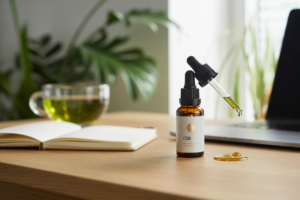
Products like Anti Stress Broad Spectrum CBD Oil are designed with this kind of functional use in mind, providing calming effects without intoxication.
Famous Creatives Who Used Cannabis
The list of accomplished artists who’ve been open about using cannabis is long enough to fill its own article. A few standouts:
Carl Sagan wrote anonymously (under the pseudonym “Mr. X”) about how cannabis helped him see things from new perspectives and make connections he wouldn’t have made otherwise. His essay, later confirmed as his, described vivid sensory experiences and sudden insight into problems he’d been working on. Read the full account via his 1969 essay.
Steve Jobs spoke about marijuana and LSD helping him think about things differently, though he was careful to note that these were tools for shifting perspective rather than sources of ideas themselves. As reported by Biography.com, Jobs considered his psychedelic experiences among the most important things he’d done.
Lady Gaga has been open about using cannabis while writing music, telling Rolling Stone that it helped her access emotions and musical ideas she couldn’t reach sober. She’s also been candid about the need to moderate use and not let it become a crutch.
The pattern across these stories is consistent: cannabis as a tool for shifting perspective, not as a substitute for skill or discipline. Every creative who credits cannabis for their work also puts in enormous hours of sober practice and refinement.
Potential Downsides and How to Avoid Them
I’d be doing you a disservice if I painted this as all upside. Cannabis can genuinely hurt your creative output if you’re not thoughtful about how you use it.
The “everything seems brilliant” trap. Under the influence of THC, your self-evaluation circuits are dampened. Ideas that feel revolutionary at 11pm might look embarrassingly basic the next morning. This isn’t a reason to avoid cannabis for creative work, but it is a reason to always review your output with fresh, sober eyes before committing to it.
Dependency risk. If you only feel creative when you’re high, that’s a warning sign. Some regular users develop a psychological dependency where they can’t access creative states without cannabis. This typically resolves with a tolerance break, but it’s worth monitoring.
Memory and follow-through. THC impairs short-term memory and can make it harder to maintain complex creative projects over time. If your work requires tracking multiple threads, maintaining continuity, or building on previous sessions, heavy cannabis use between sessions can create gaps. The National Institute on Drug Abuse documents these cognitive effects in detail.
Amotivational syndrome. While the “lazy stoner” stereotype is overblown, chronic heavy use can reduce motivation in some people, according to studies published in Psychological Medicine. If your creative output starts declining rather than improving, it might be time to reassess your usage patterns.
Practical Tips for Cannabis-Enhanced Creativity
Based on both the available research and the consistent patterns from artists who use cannabis productively, here’s what works:
- Microdose first, macro later. Start with 2.5-5mg THC or a single small hit. You can always take more, but you can’t take less. The sweet spot for most people is just barely noticeable, enough to shift your thinking without impairing your ability to execute.
- Separate ideation from execution. Use cannabis for brainstorming, freewriting, sketching, and exploring. Do your editing, refining, and technical work sober. This “generate high, refine sober” approach gives you the best of both states.
- Keep a strain journal. Different strains affect you differently. Track which ones put you in a creative zone and which ones send you to the couch. Over time, you’ll build a personal reference guide that’s more useful than any blog post.
- Don’t use it every time. Creative muscles need exercise without chemical assistance too. If you rely on cannabis for every session, you may lose access to the creative states you can reach naturally. Alternate between assisted and unassisted sessions.
- Create the right environment. Cannabis amplifies your surroundings. A cluttered, noisy space will scatter your attention. A clean, inspiring workspace with good music or comfortable silence will focus it. Set up your environment before you consume.
📺 Video Guide
Frequently Asked Questions
Does cannabis actually make you more creative?
The research is mixed. Cannabis appears to increase openness to experience and reduce self-criticism, which can feel like enhanced creativity. However, controlled studies show that high doses can actually impair divergent thinking. Low doses seem to offer the best balance between loosened thinking and maintained cognitive function.
What’s the best cannabis dose for creative work?
Most experienced creative users recommend microdosing in the range of 2.5-5mg THC. This is enough to shift your headspace without impairing your ability to actually do the work. Higher doses (15mg+) tend to make ideas feel amazing but make execution difficult.
Should I use sativa or indica for creativity?
Sativa-dominant strains are generally preferred for creative work because of their energizing, cerebral effects. However, the terpene profile matters more than the sativa/indica label. Look for strains high in limonene and pinene, and avoid those heavy in myrcene if you want to stay productive.
Can CBD help with creativity without getting high?
CBD won’t produce the perceptual shifts associated with THC-driven creativity, but it can reduce anxiety, which is one of the biggest barriers to creative work. Many artists use CBD to stay calm and focused during creative sessions without the cognitive disruption that THC brings.
Is it bad to always use cannabis when doing creative work?
Using cannabis as your only creative tool can become a crutch. If you find you can’t access creative states without it, consider taking a tolerance break. The best approach is to alternate between cannabis-assisted and unassisted sessions so you develop your creative abilities in both states.
⚠️ Disclaimer
This article is for informational purposes only and does not constitute medical advice. The information provided about cannabis is current as of March 2026 but may change. Always consult with qualified healthcare professionals for medical advice and treatment options. Cannabis laws vary by jurisdiction. Check your local regulations before purchasing or using cannabis products. For our full disclaimer, visit cannastoreams.gr/disclaimer.