
Cannabis for Inflammation: What We Know in 2026
Cannabis for inflammation may help with pain, stiffness, and sleep for some adults. Here is what the 2026 evidence says and how to choose products safely.

Cannabis for inflammation gets talked about like a settled answer, but the real picture is messier. Some cannabinoids interact with pathways involved in pain, immune signaling, and inflammatory response, yet the strongest human evidence still sits closer to symptom relief than to a clean “anti-inflammatory” verdict. If you are curious about cannabis for inflammation, the smart move is to separate lab findings from real-world outcomes, then choose products and dosing with a little skepticism instead of wishful thinking.
That matters because inflammation is not one thing. Acute inflammation after an injury is different from long-running low-grade inflammation seen in arthritis, autoimmune disease, metabolic disorders, or gut issues. The U.S. National Center for Complementary and Integrative Health notes that cannabis and cannabinoids may help with a small number of symptoms in some conditions, but the evidence is still uneven. The FDA makes the same point in plainer language: products are everywhere, claims move faster than proof, and buyers need to pay attention to quality and labeling.
📺 Video Guide
How inflammation works, and where cannabis may fit
Inflammation is your body’s repair and defense system. In the short term, that is useful. In the long term, it can become part of the problem. Researchers have spent years studying how the endocannabinoid system influences immune cells, pain perception, and tissue response. A NCBI overview of the endocannabinoid system explains why cannabinoids keep showing up in discussions about inflammation, especially through CB1 and CB2 receptor activity. A PubMed review on cannabinoids and inflammation also describes plausible mechanisms, including effects on cytokines and immune signaling.
Plausible mechanism does not automatically mean predictable benefit for every person. That gap is where many articles get sloppy. The research is stronger for chronic pain linked to inflammatory conditions than it is for proving that cannabis directly lowers inflammation markers in a reliable, clinically meaningful way across the board. That is why articles like our guide to cannabis for chronic pain tend to land on symptom management, not miracle-cure language.
✓ What cannabis may realistically help with
- ✓ Pain that has an inflammatory component
- ✓ Sleep disruption linked to discomfort
- ✓ Stress and tension that make symptoms feel worse
- ✓ Local relief when topicals are used on sore joints or muscles
What the research actually says in 2026
If you strip away the hype, three evidence buckets matter most. First, preclinical work. Lab and animal studies often show cannabinoids influencing inflammatory pathways. Second, condition-specific human trials. These are useful but inconsistent because products, doses, and patient populations vary wildly. Third, large evidence reviews. Those tend to come back with the same frustrating conclusion: there may be benefit for some people, especially in pain-related conditions, but the effect size is modest and the quality of evidence is mixed.
The Harvard Health review on cannabis and chronic pain is a good reality check. It points to modest benefit in some settings, especially with THC-containing products, while also noting side effects and the need for better trials. A systematic review indexed in PubMed reached a similar place: some improvement in pain outcomes, but not enough to justify sweeping claims. For arthritis-related questions, the Arthritis Foundation takes a cautious tone and stresses product quality, dosing restraint, and medical supervision.
That cautious tone is the right one. People dealing with inflammatory bowel disease, autoimmune disorders, or rheumatoid conditions often want a simple answer. There usually isn’t one. Cannabis may ease pain, help some people sleep better, or reduce stress around symptoms, but it should not replace disease-specific treatment plans. The CDC also reminds users that cannabis can affect attention, coordination, and mental state, which matters if you are already managing fatigue, brain fog, or medication side effects.
💡 Pro Tip
When someone says cannabis “reduces inflammation,” ask what they mean. Are they talking about pain scores, sleep, stiffness, lab markers, or imaging? Those are not the same outcome.
CBD, THC, and topicals are not interchangeable
A lot of disappointment comes from buying the wrong type of product for the wrong goal. CBD oils, THC products, balanced formulas, and topicals behave differently. The NCCIH and FDA consumer guidance both emphasize that labeling and potency vary more than most people expect.
CBD is usually the first stop for people who want to avoid intoxication. That makes sense, especially if daytime function matters. But CBD by itself is not automatically stronger for inflammation. In some pain studies, THC-containing products performed better, though side effects also increased. If you want a basic primer, our CBD for arthritis guide and THC vs CBD comparison cover the tradeoffs in more detail.
Topicals deserve a separate mention because they are often the most practical entry point for localized discomfort. Creams, balms, and gels may be worth trying when the problem is a knee, shoulder, hand, or lower back flare. They are less useful for systemic inflammatory conditions. If the target area is specific, a topical plus a boring but reliable tracking habit is usually smarter than jumping straight to high-dose oral products.
📝 Important Note
If your goal is daytime relief, start with the mildest product that fits the job. Many people overshoot the dose, feel worse, and decide cannabis for inflammation does nothing, when the real problem was poor product fit.
How to shop without getting fooled by weak or sketchy products
This is where quality matters more than marketing. Look for third-party certificates of analysis, batch numbers, cannabinoid breakdown, and contaminant screening. If a brand has no recent lab results, move on. The FDA has repeatedly published warning letters and consumer updates because the market still includes mislabeled or unsupported products. That does not mean every product is bad. It means buyers need receipts, not vibes.
Reading the lab sheet gets easier once you know what to look for. Potency, heavy metals, pesticides, residual solvents, microbial contaminants, and batch date tell you more than any glossy brand story. If you need a refresher, our cannabis lab results guide breaks down what a clean report should contain.
Terpenes can matter too, although they are often oversold. There is interesting discussion around compounds like beta-caryophyllene, myrcene, and limonene, but this is an area where marketing tends to outrun evidence. Treat terpene claims as part of the picture, not the whole picture. Our terpenes explainer is useful if you want the short version without the fluff.
A practical checklist before trying cannabis for inflammation
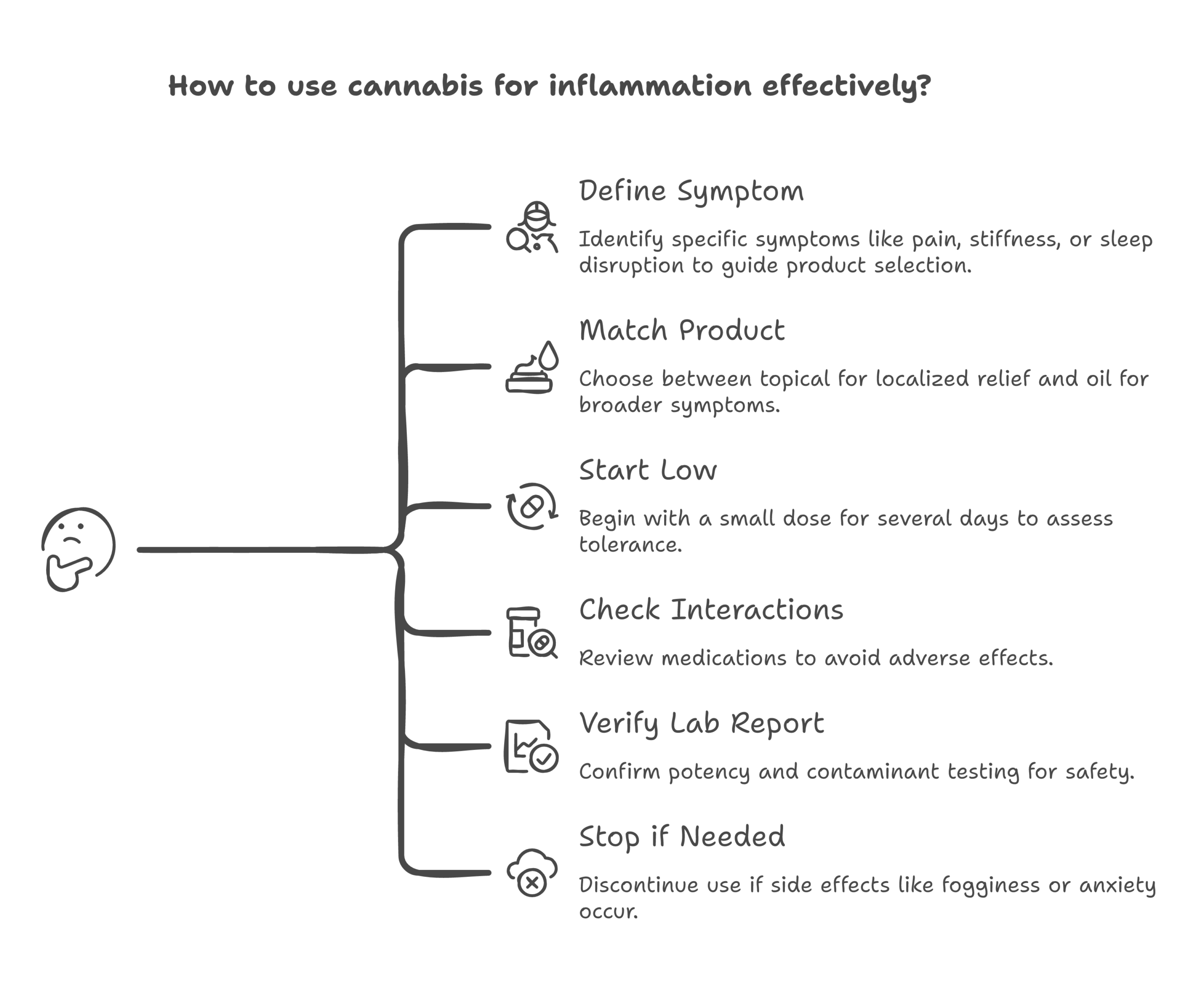
Here is the part most people skip. Before buying anything, define the actual problem. Is it joint stiffness in the morning, nerve pain at night, post-workout soreness, poor sleep from discomfort, or a diagnosed inflammatory condition already being treated by a clinician? Once you know the target, choosing becomes less random.
- Pick one symptom to track. Pain score, sleep quality, or morning stiffness is enough.
- Choose the simplest product first. Topical for one body area, low-dose oil for broader symptoms.
- Start low and stay there for several days. Tiny adjustments beat dramatic jumps.
- Check interactions. The NCBI StatPearls entry on cannabidiol and several hospital systems warn about drug interactions, especially with sedatives, blood thinners, and seizure medications.
- Review the legal context where you live. Product access and allowed formulations vary by country and use case.
- Stop if side effects outweigh the upside. Relief is not relief if you feel foggy, anxious, or too tired to function.
💡 Pro Tip
Give any new routine a fair test with notes. Memory is terrible at this. A seven-day log is better than your gut feeling after one rough night.
Who should be extra careful
Not everyone is a good candidate. Pregnant or breastfeeding people, anyone with a history of psychosis, people who need to drive or operate machinery, and anyone taking multiple medications should slow down and get professional guidance first. The Substance Abuse and Mental Health Services Administration and the CDC’s mental health guidance both highlight higher-risk groups and possible downsides.
There is another trap here: using cannabis to cover up symptoms that need proper medical workup. Swollen joints, unexplained digestive symptoms, fever, sudden weight loss, or persistent fatigue deserve diagnosis first. Cannabis for inflammation can be part of a plan. It should not be the plan when the underlying cause is still unknown.
If anxiety tends to amplify physical symptoms for you, keep dosage especially conservative. THC can help some people relax, but it can also push others in the wrong direction, so the calmest option is often the safest starting point.
⚠️ Disclaimer
This article is for informational purposes only and does not constitute medical advice. Information about cannabis products, risks, and access is current as of April 2026 and may change. Always speak with a qualified healthcare professional if you have a diagnosed inflammatory condition, take prescription medication, or are unsure whether cannabis is appropriate for you. For our full disclaimer, visit cannastoreams.gr/disclaimer.
The bottom line
Cannabis for inflammation is promising in some contexts, but “promising” is not the same as proven. The better case today is that certain cannabis products may help some adults manage pain, stiffness, sleep disruption, or stress that comes with inflammatory conditions. That is useful. It is just not a blank check for every product on the shelf.
If you want to try it, keep the process boring. Buy from a source with real lab tests. Start with a specific symptom in mind. Use the lowest dose that makes sense. Track what changes. If nothing improves, that tells you something valuable too. Chasing stronger products without a plan is how people waste money and blame the plant for a bad buying decision.
And if your main goal is daily function, not just occasional relief, consistency matters more than novelty. The most useful product is the one that fits your routine, respects your risk level, and actually helps you feel better without creating a new problem.
Frequently Asked Questions
Does cannabis actually reduce inflammation?
It may influence inflammatory pathways, but the strongest human evidence today is more about symptom relief, especially pain and sleep disruption, than about proving reliable inflammation reduction across every condition.
Is CBD or THC better for inflammation?
It depends on the symptom and your tolerance. CBD is often easier to use during the day because it is not intoxicating. THC may help more with pain for some users, but it also brings a higher risk of side effects.
Are cannabis topicals worth trying?
For localized soreness or joint discomfort, yes, they can be a sensible first step. They are less likely to help with widespread or systemic inflammatory conditions.
Can cannabis replace anti-inflammatory medication?
Do not make that switch on your own. Cannabis may be used as part of a broader symptom-management plan, but replacing prescribed treatment without medical guidance is risky.
How long should I test a product before deciding?
Give it at least several days, sometimes a week, with the same low dose and a simple symptom log. Changing dose and product every day makes it impossible to judge what is working.
What is the biggest mistake buyers make?
Buying a product with weak labeling, no recent lab tests, and a claim that sounds too clean to be true. Quality control is still a huge part of the equation.
