Cannabis Retail Licence Greece: 200m Rule
Cannabis retail licence Greece guide: 500m school buffer, permits, products, penalties and compliance tips for 2026.

The new cannabis retail licence Greece conversation is not just about paperwork. It is about where cannabis wellness stores can operate, what they can sell, and how businesses in Greece should prove they are safe, transparent and compliant. The headline rule is simple enough: licensed cannabis-product retail stores are expected to stand at least 200 meters from schools. The practical reality is more complicated, especially for operators choosing locations in dense Athens neighborhoods.
Greek press coverage of the Health Ministry proposal describes a dedicated retail framework for low-THC and CBD products, including a school-distance requirement, a digital registry and stricter penalties for non-compliance. See the overview from Greek Reporter. This guide explains what the 200m buffer means, why it exists, and how consumers and store owners should read the rule in June 2026.
Cannabis Retail Licence Greece: What Is Changing?
For years, Greek cannabis retail operated in a confusing space. Consumers saw CBD oils, hemp accessories, cosmetics, edibles-style wellness products and low-THC items in specialist shops, online stores and sometimes general retail. At the same time, medical cannabis has followed a separate path involving prescriptions, pharmaceutical controls and state-supervised production. The proposed retail licence framework is an attempt to separate legitimate wellness commerce from risky informal sales.
The distinction matters. The Hellenic National Organization for Medicines supervises medicines and health-related products, while Greek law also aligns with European rules on hemp, food safety, cosmetics and controlled substances. Businesses cannot simply treat “CBD” as a magic label that removes every obligation. The European Commission novel food framework is relevant for ingestible cannabinoid products, and cosmetic products must comply with the EU cosmetics rules.
In plain English, the state is moving toward a model where cannabis-related consumer products are sold by identifiable, licensed, inspectable businesses. That is good for serious operators and better for consumers who want product labels, lab reports and responsible advice instead of guesswork. It is also stricter than the older “open a shop and hope the rules are unclear” model.
✓ Key Benefits
- ✓ Clearer licensing for legitimate CBD and low-THC retailers
- ✓ More consumer confidence through traceable products and inspections
- ✓ Stronger separation between wellness retail and illegal trafficking
- ✓ Better protection around schools and youth-facing areas
How the 200m School Buffer Works in Practice
The 200m rule is designed to keep licensed cannabis-product stores away from schools. The policy logic is familiar: governments want adult-use or cannabis-adjacent retail to be visible enough to regulate, but not so close to minors that it looks normalized or casually accessible. Similar zoning principles appear in many cannabis markets. For comparison, New York’s Office of Cannabis Management explains distance rules around schools and houses of worship in its retail dispensary location guidance, while Canadian provinces publish their own cannabis store siting rules through official agencies such as the Alcohol and Gaming Commission of Ontario.
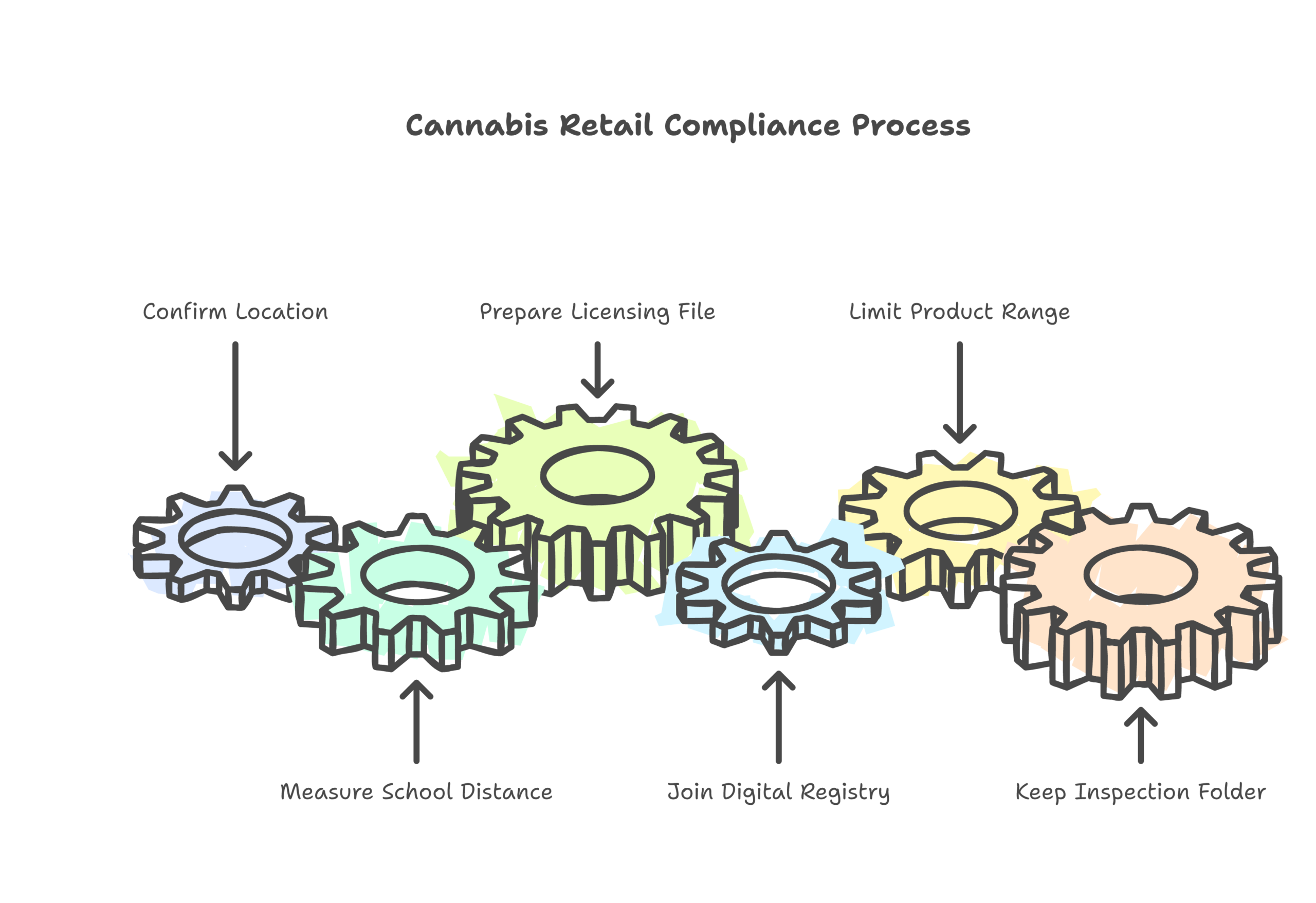
The important question is how Greece will measure the 200 meters. Is it from property line to property line, main entrance to main entrance, or along the pedestrian route? The public reporting so far gives the distance, but not enough technical detail for a lease decision. That means businesses should not rely on a rough Google Maps radius. Before signing a rental agreement, a retailer should ask the municipality or regional authority how distance is calculated and keep written evidence in the licensing file.
This is especially important in Athens, Piraeus, Thessaloniki and other dense urban areas where schools, tutoring centers, nurseries and youth facilities can sit very close to retail streets. A storefront that looks perfect commercially may be impossible legally. For a consumer-focused store like Puff ‘n Pass, this makes location due diligence just as important as product selection. It also connects naturally with our wider Greek cannabis laws guide, because legality is not only about THC percentage. It is also about where, how and by whom products are sold.
💡 Pro Tip
If you are evaluating a cannabis retail location in Greece, document the 200m calculation before paying a deposit. A compliant lease is cheaper than a beautiful shop that cannot receive a licence.
What Products Could Licensed Stores Sell?
The proposed framework points toward CBD products and cannabis-derived products within a low-THC threshold. The reported change to 0.3% THC would align Greece more closely with the hemp threshold used in several international contexts. The USDA hemp program, for example, uses 0.3% delta-9 THC as a legal dividing line for hemp in the United States. The European context is more fragmented, but the direction is similar: low-THC hemp can be treated differently from controlled high-THC cannabis.
That does not mean everything with CBD is automatically safe, legal or appropriate. The US Food and Drug Administration continues to warn that cannabis-derived products can carry risks, especially around health claims, contamination and drug interactions. The CDC cannabis health effects guidance also highlights that cannabinoids can affect coordination, mental health, sleep and medication safety depending on the compound and dose.
For Greek consumers, the safest route is to choose transparent formats: compliant CBD oils, topicals, cosmetics and wellness products with clear labels and lab documentation. If you want to understand formats, our full spectrum vs broad spectrum vs isolate CBD guide explains how different extracts compare. For shoppers who prefer non-flower options, products such as CBD Oil 10 10ml, CBD Oil 20 Full Spectrum 10ml and Cannaline Intimate CBD Gel Lubricant show the type of clearly packaged products that fit better with a regulated retail environment.
Compliance Checklist for Store Owners
A serious cannabis retail licence Greece application should be treated like a regulated retail project, not a casual shop opening. Start with the basics: company documents, tax clearance, insurance clearance, criminal record certificates where required, property documents, floor plans and lease terms. Then add cannabis-specific evidence: supplier invoices, certificates of analysis, product labels, THC compliance documents, staff procedures and customer communication rules.
The digital registry may become the backbone of enforcement. If a store is not properly registered, it may not be able to operate legally in the sector. This resembles the wider movement toward traceability in cannabis markets. The US Drug Enforcement Administration still treats marijuana as a controlled substance federally, while regulated state markets use licensing, seed-to-sale tracking and inspections to distinguish legal operators from illegal sellers. Greece is not copying the US model exactly, but the enforcement logic is similar: if authorities cannot identify the operator and the product chain, the risk profile rises.
Store owners should also prepare staff scripts. Employees need to explain product categories without making medical promises. They should know when to refer customers to healthcare professionals, especially if the customer is pregnant, taking medication, has a history of psychosis or is shopping for a minor. The National Academies cannabis evidence review hosted by NCBI is a useful reminder that cannabis evidence is mixed by condition, compound and outcome. Retail staff are not doctors.
📝 Important Note
Do not confuse retail licensing for low-THC wellness products with medical cannabis prescribing. Medical cannabis access in Greece follows a different pathway, which we cover in our medical cannabis Greece guide.
Penalties, Inspections and Why the Rule Has Teeth
The reported penalty package is severe: fines, licence withdrawal and potential prison exposure for serious violations. That is not unusual when governments try to shut the gap between legitimate retail and uncontrolled synthetic or high-THC sales. Europe has already seen rapid action against risky semi-synthetic cannabinoids. The European Union Drugs Agency cannabis topic page tracks the broader market shift, including product innovation and public health concerns.
The biggest enforcement risks are predictable: selling banned dried flower, selling products above the permitted THC threshold, mislabeling cannabinoid content, making medical claims, operating too close to a school, or operating without registry approval. Stores should expect inspections to focus on invoices, product packaging, lab reports and whether staff understand the rules. Consumers should expect a more curated selection and fewer vague claims.
This matters because Greece has already been through waves of HHC, THCP and other alternative cannabinoid products. Our Greece THCP ban explainer and hemp flower ban guide both show the same pattern: when a product category expands faster than the rules, enforcement eventually catches up.
What Consumers Should Look for in 2026
Consumers do not need to become lawyers, but they should ask better questions. Is the store licensed or preparing for licensing? Does the product show cannabinoid content clearly? Is there a certificate of analysis? Does the seller avoid exaggerated medical claims? Are age and responsible-use boundaries respected? These questions protect you from poor quality products and protect the wider legal market from bad actors.
Independent science resources can help you separate evidence from marketing. PubMed hosts peer-reviewed cannabis research, including studies on cannabinoids, pain, sleep and safety. A good starting point is the PubMed cannabidiol safety search. For product education, our COA lab report guide explains how to read cannabinoid percentages and contaminant testing before buying.
The practical consumer takeaway is this: the new cannabis retail licence Greece framework should make the best stores more professional. It may also remove casual sellers who cannot document products, distance rules or compliance. That is inconvenient for some businesses, but healthier for the market.
⚠️ Disclaimer
This article is for informational purposes only and does not constitute legal or medical advice. The information about cannabis retail licensing in Greece is current as of June 2026 but may change as legislation, ministerial decisions and local procedures develop. Always consult qualified legal, tax and healthcare professionals before making business or health decisions. For our full disclaimer, visit cannastoreams.gr/disclaimer.
Frequently Asked Questions
Is the 200m school buffer already active in Greece?
As of June 2026, the rule is discussed as part of Greece’s new cannabis retail framework. Operators should treat it as a serious compliance requirement and verify implementation details with the competent regional authority before leasing or opening a store.
Does the rule apply to medical cannabis pharmacies?
The reported retail framework focuses on cannabis-product stores for CBD and low-THC consumer products. Medical cannabis is regulated separately through medical, pharmaceutical and prescription pathways.
Can licensed stores sell dried hemp flower?
Current reporting says Greece is banning the retail sale, supply, purchase and use of dried cannabis flower even when THC is low. Consumers should choose compliant non-flower CBD formats and check current law before buying.
What should a business check before applying for a licence?
Check the 200m school distance, lease suitability, registry requirements, tax and insurance clearances, criminal record documents, product lab reports, supplier traceability and staff procedures.
What is the safest buying approach for consumers?
Buy from transparent specialist retailers, choose products with clear labels and certificates of analysis, avoid exaggerated medical claims, and speak with a healthcare professional if you take medication or have a medical condition.
