What Are CBD vs CBG, Exactly?
If you’ve spent any time browsing a dispensary or wellness store, you’ve probably noticed that CBD and CBG are showing up on more labels than ever. Both are cannabinoids found in hemp and cannabis plants, both are non-intoxicating, and both interact with your body’s endocannabinoid system (ECS). But the similarities start to thin out once you look at how each one actually works.
CBD (cannabidiol) has been the poster child of the cannabis wellness world for years. CBG (cannabigerol) is newer to the mainstream, though it’s been quietly earning a reputation among people who want something different from their cannabinoid routine. Understanding how these two compare can help you pick the right product for what you’re actually trying to accomplish.
📺 Video Guide
CBG Is the Mother Cannabinoid
Every cannabinoid in the cannabis plant starts life as CBGA (cannabigerolic acid). As the plant matures, enzymes convert CBGA into THCA, CBDA, and other cannabinoid acids. By the time a hemp plant reaches harvest, most of the CBG has already transformed into other compounds, which is why mature plants typically contain less than 1% CBG. This makes extraction more expensive and the end product pricier than CBD, according to researchers at the National Center for Biotechnology Information.
CBD, on the other hand, is abundant in mature hemp plants. Most hemp strains contain between 15 and 25% CBD, making it far easier and cheaper to produce. This is one of the main reasons CBD products flooded the market first, while CBG has taken longer to become commercially available.
Some growers have started developing CBG-dominant strains and harvesting plants earlier to capture more CBG before it converts. These specialized growing techniques are closing the gap, but CBG products still carry a premium in most markets.
💡 Quick fact
CBG is sometimes called the “stem cell” of cannabinoids because it’s the chemical precursor to CBD, THC, and CBC. Without CBG, none of the other major cannabinoids would exist in the plant.
How They Interact with Your Body
This is where CBD and CBG really diverge. Your endocannabinoid system has two main receptor types: CB1 receptors (concentrated in your brain and nervous system) and CB2 receptors (found primarily in your immune system and peripheral organs).
CBD takes an indirect approach. Rather than binding directly to CB1 or CB2 receptors, it modulates them from a distance. It also inhibits the FAAH enzyme, which breaks down anandamide, one of your body’s natural endocannabinoids. The result is that your own endocannabinoids stick around longer and do more work. CBD also interacts with serotonin receptors (5-HT1A) and vanilloid receptors (TRPV1), which is part of why it’s associated with mood regulation and pain perception.
CBG is more direct. It binds to both CB1 and CB2 receptors with meaningful affinity, similar to how THC works, but without producing a high. CBG also hits alpha-2 adrenergic receptors, which influence norepinephrine levels. This is likely why many users report that CBG feels more energizing and focus-oriented compared to the calming effects they get from CBD. A 2021 study published in Frontiers in Pharmacology noted that CBG showed promising activity at multiple receptor sites, though human clinical trials remain limited.
Effects You’ll Actually Notice
People describe CBD and CBG experiences quite differently, even though both are working on the same system.
CBD tends to produce a calming, relaxing sensation. It’s what most people reach for when they’re trying to wind down after a long day, manage physical discomfort, or ease into sleep. If you’ve ever taken a CBD gummy before bed and noticed your body feeling a bit looser and your mind quieter, that’s the typical experience.
CBG goes in a different direction. Users commonly report feeling more alert, focused, and mentally clear after taking it. There’s no jittery edge like caffeine, just a steady sense of being “switched on.” This makes it popular as a morning or workday supplement. Some people compare it to the mental clarity you get from a good night’s sleep, just available in a bottle.
Both cannabinoids have shown anti-inflammatory properties in preclinical research, and both may help with pain management. The difference is in the accompanying mental state: CBD relaxes you, CBG sharpens you.
✓ When to choose each
- ✓ CBD for evenings – winding down, sleep support, physical relaxation
- ✓ CBG for mornings – focus, productivity, mental clarity without jitters
- ✓ Both together – some users stack them for balanced, whole-day support
What the Research Says So Far
CBD has a significant head start in clinical research. The FDA approved Epidiolex (a CBD-based medication) for treating certain types of epilepsy in 2018, making it the first plant-derived cannabinoid product to receive federal approval in the US. Studies have explored CBD for anxiety, chronic pain, inflammation, and sleep disorders, though many of these areas still lack large-scale human trials.
CBG research is earlier-stage but growing fast. A 2020 survey of CBG users published in the journal Cannabis and Cannabinoid Research found that the majority of respondents used CBG for anxiety, chronic pain, and insomnia, and most reported that it was more effective than conventional treatments. Animal studies have explored CBG’s potential for inflammatory bowel disease, neuroprotection, and appetite stimulation.
The honest take: CBD has more published data behind it right now. CBG is catching up, and early results are promising, but anyone who tells you CBG is “clinically proven” for specific conditions is getting ahead of the science. Use both with realistic expectations.
Product Types and How to Use Them
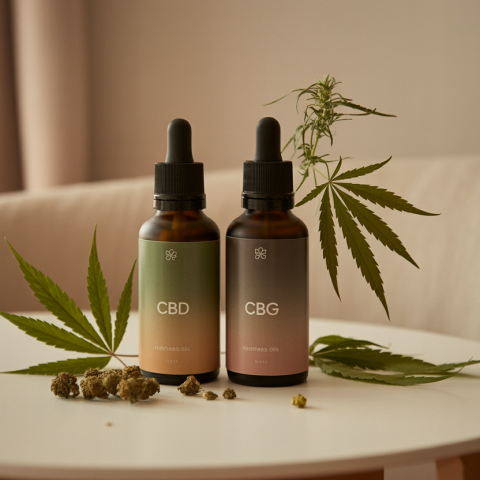
Both CBD and CBG come in similar product formats. Oils and tinctures are the most common, offering fast absorption when held under the tongue for 60 seconds before swallowing. Capsules provide consistent dosing without any taste. Gummies are popular for people who want a pre-measured dose with minimal fuss.
Topicals containing CBD or CBG can be applied directly to the skin for localized relief. Some brands now offer combination products that contain both cannabinoids, banking on the entourage effect, where multiple cannabinoids work better together than in isolation.
Dosing differs between the two. CBD dosing is fairly well-established, with most people starting at 10-25 mg per day and adjusting from there. CBG dosing is less standardized because the research base is thinner. Most CBG products suggest starting at 5-10 mg and working up. Since CBG is more expensive per milligram, starting low also makes financial sense. Check our CBD dosage calculator for a starting point if you’re new to cannabinoids.
📝 Dosing note
If you’re currently taking medications, talk to your doctor before adding CBD or CBG. Both can interact with liver enzymes (particularly CYP450) that metabolize common prescription drugs, potentially changing how those medications work.
Price and Availability
This is where CBD has a clear advantage. Because CBD is abundant in mature hemp plants, it’s cheap to extract at scale. You can find quality CBD oils for $0.03-0.10 per milligram. CBG products typically run 2-3 times more expensive, around $0.08-0.20 per milligram, because of the lower yields and specialized growing requirements.
The price gap is narrowing as more CBG-dominant hemp strains reach the market and extraction methods improve. But for now, if budget is a factor, CBD offers better value per milligram. Some people split the difference by using a full-spectrum CBD product that naturally contains small amounts of CBG, getting both cannabinoids without paying CBG-isolate prices.
Availability is also lopsided. CBD products are sold everywhere from gas stations to pharmacies. CBG products are mostly found at specialized cannabis wellness retailers and online shops. That’s changing, but slowly.
Can You Take CBD and CBG Together?
Yes, and many people do. The idea behind combining them is that they work through different mechanisms, so stacking them could cover more ground than either one alone. Some brands sell 1:1 CBD:CBG oils specifically for this purpose.
A practical approach that some users follow: CBG in the morning for focus, CBD in the evening for relaxation. This lets you match the cannabinoid’s natural tendencies to the time of day when you’ll benefit most. Others prefer the combined product for a balanced, all-day effect.
There’s no evidence that combining CBD and CBG causes adverse interactions. Both are generally well-tolerated, and the World Health Organization has stated that CBD has a good safety profile. CBG safety data is thinner but so far shows a similar pattern of minimal side effects.
Side Effects to Watch For
CBD’s documented side effects include dry mouth, drowsiness (especially at higher doses), diarrhea, and reduced appetite. These tend to be mild and dose-dependent. Most people taking standard wellness doses don’t experience any of them.
CBG side effects are less well-documented simply because fewer people have been studied. Anecdotal reports suggest similar tolerability to CBD, with occasional dry mouth or mild digestive changes. Some users note that CBG can feel mildly stimulating, which could be unwanted if you’re taking it too close to bedtime.
Neither cannabinoid will get you high. Both are non-intoxicating at any dose, according to the DEA’s classification framework. If a product labeled as CBD or CBG produces intoxicating effects, it likely contains undisclosed THC, which is a quality control issue, not a property of the cannabinoid itself.
⚠️ Quality matters
Always buy CBD and CBG products that come with third-party lab results (Certificates of Analysis). These verify the cannabinoid content and confirm the product is free of heavy metals, pesticides, and residual solvents. If a brand won’t show you lab results, shop elsewhere.
Full Spectrum, Broad Spectrum, or Isolate?
This distinction applies to both CBD and CBG products. Full spectrum means the extract contains all the cannabinoids, terpenes, and flavonoids naturally present in the plant, including trace amounts of THC (under 0.3% in the US, under 0.2% in the EU). Many researchers believe full spectrum products are more effective because of the entourage effect.
Broad spectrum removes the THC while keeping everything else. This is a good middle ground if you want the entourage effect benefits but need to avoid THC entirely, whether for drug testing or personal preference.
Isolate is pure CBD or pure CBG with nothing else. It’s the most predictable option for dosing, but you lose the potential synergy of the other plant compounds. If you’re specifically trying to compare how CBD and CBG feel individually, isolates are the cleanest way to do that.
Making Your Choice
The right pick depends on what you’re trying to get out of it. If relaxation, sleep support, or general evening wellness is the goal, CBD is the proven choice with years of user data and clinical research behind it. If you want daytime mental clarity, focus support, or something that won’t make you sleepy, CBG is worth trying.
If you’re on a budget, start with CBD. It’s cheaper, more available, and has more research supporting its uses. If you’ve been using CBD for a while and want to expand your cannabinoid knowledge, adding CBG to the mix could give you a different perspective on what these compounds can do.
There’s no wrong answer here. Both are safe, legal in most jurisdictions, and non-intoxicating. The best approach is to try one, give it a couple of weeks at a consistent dose, and see how your body responds before making a judgment.
Frequently Asked Questions
Will CBD or CBG show up on a drug test?
Neither CBD nor CBG should trigger a positive drug test on their own. Standard drug tests look for THC metabolites. However, full-spectrum products contain trace THC that could accumulate with heavy use. If drug testing is a concern, use broad-spectrum or isolate products and verify with lab results.
Is CBG stronger than CBD?
“Stronger” isn’t the right framing. CBG has a higher binding affinity for cannabinoid receptors than CBD does, but they produce different effects. CBG isn’t a more potent version of CBD; it’s a different compound with its own profile. Think of them as complementary rather than competitive.
Can I give CBD or CBG to my pets?
CBD for pets has become a growing market, with products specifically formulated for dogs and cats. CBG pet products are much rarer. Always use pet-specific products (human dosages and formulations may contain ingredients toxic to animals) and consult your vet before starting.
How long does it take for CBD and CBG to work?
Onset time depends on the product type. Sublingual oils typically take 15-30 minutes. Capsules and edibles take 45-90 minutes because they pass through your digestive system first. Topicals work within 15-45 minutes on the applied area. Both CBD and CBG follow similar absorption timelines.
Why is CBG so much more expensive than CBD?
It comes down to plant biology. Hemp plants contain 15-25% CBD but only about 1% CBG at harvest time. Extracting meaningful amounts of CBG requires either processing much more plant material or harvesting early before CBG converts to other cannabinoids. Both approaches increase cost. As CBG-dominant strains become more common, prices are expected to drop.