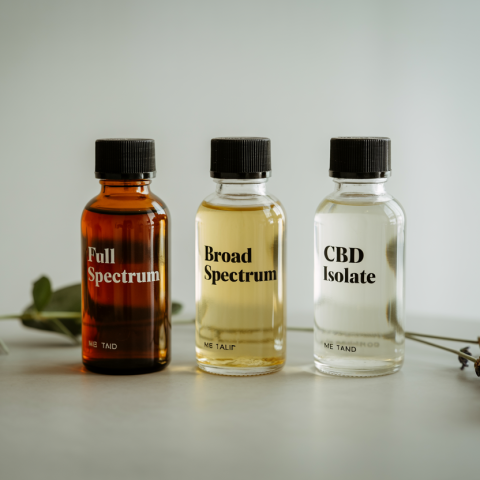
If you’ve spent any time shopping for full spectrum CBD products, you’ve probably noticed three terms that keep showing up: full spectrum, broad spectrum, and isolate. These aren’t just marketing buzzwords. They describe genuinely different products with different chemical profiles, and the one you pick can affect how well CBD works for you.
The confusion makes sense. Brands don’t always explain these terms clearly, and some use them inconsistently. A 2023 FDA report found that many CBD products don’t even accurately reflect what’s on the label. So let’s cut through the noise. If you’re new to CBD, this guide will help you understand what each type actually contains, how they differ, and which one makes sense for your situation.
What full spectrum CBD actually means
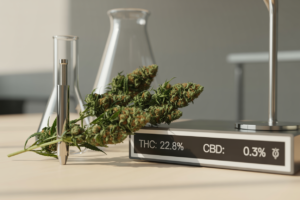
Full spectrum CBD contains everything the hemp plant produces. That includes CBD (cannabidiol), small amounts of THC (under 0.3% in legal products), other cannabinoids like CBG and CBN, terpenes, flavonoids, and fatty acids. Nothing gets stripped out during extraction.
Why does that matter? Because these compounds work together. A 2011 study published in the British Journal of Pharmacology described what researchers call the “entourage effect,” where cannabinoids and terpenes appear to enhance each other’s therapeutic properties. In plain terms: the whole plant extract may work better than any single compound on its own. Our guide to the entourage effect goes deeper into the science behind this.
The THC content in full spectrum products is minimal. We’re talking about trace amounts that won’t get you high. But they’re there, and that small presence contributes to the entourage effect. Research from the Frontiers in Plant Science journal supports this synergistic interaction between cannabinoids.
The catch: those trace amounts of THC can sometimes show up on drug tests. If your employer tests for cannabis, this is worth knowing about, even if the amount is far below psychoactive levels. Products like our CBD Oil 20% Full Spectrum fall into this category.
✓ Full spectrum advantages
- ✓ Maximizes the entourage effect with all plant compounds intact
- ✓ Research suggests better efficacy for pain and inflammation compared to isolate
- ✓ Most natural, least processed form of CBD
- ✓ Contains additional beneficial cannabinoids (CBG, CBN, CBC)
Broad spectrum CBD: the middle ground
Broad spectrum CBD starts the same way as full spectrum. Manufacturers extract everything from the plant, then go back and remove the THC. You still get the other cannabinoids, terpenes, and plant compounds. You just don’t get the THC.
This type has become increasingly popular because it offers a compromise. You get some version of the entourage effect without worrying about THC showing up on a drug test. According to Project CBD, broad spectrum products retain enough of the plant’s chemical diversity to produce meaningful synergistic effects, though possibly less than full spectrum.
The removal process isn’t perfect, though. Some broad spectrum products still contain trace amounts of THC (typically under 0.01%), while the additional processing can also reduce the concentration of some beneficial terpenes. Quality varies significantly between manufacturers. A study published by JAMA Network found that CBD product labeling accuracy remains inconsistent across the industry.
If you want to explore broad spectrum options, our Anti Stress 20% Broad Spectrum CBD Oil and Phyto Relax 10% Broad Spectrum CBD Oil are both third-party tested for quality.
CBD isolate: pure and simple
CBD isolate is exactly what it sounds like: pure CBD, isolated from everything else. It typically tests at 99%+ purity. No other cannabinoids, no terpenes, no THC. Just cannabidiol in crystalline or powder form.
Some people prefer this precisely because of its simplicity. You know exactly what you’re getting, and you can measure dosing with precision. Athletes subject to drug testing often choose isolate for this reason, as the World Anti-Doping Agency (WADA) removed CBD from its prohibited list in 2018 but still bans THC.
The downside? You lose the entourage effect entirely. A 2015 study from the Lautenberg Center for Immunology and Cancer Research found that CBD isolate has a “bell-shaped” dose-response curve. That means there’s a narrow effective window: too little does nothing, too much does nothing, and you have to hit the sweet spot. Full spectrum CBD didn’t show this pattern in the same study, working more consistently across a range of doses.
Isolate also tends to be flavorless and odorless, which makes it easy to add to foods or drinks. If you can’t stand the earthy taste of hemp, this is your way around it.
💡 Quick comparison
Full spectrum = all compounds including trace THC. Broad spectrum = all compounds minus THC. Isolate = pure CBD only. The more compounds present, the stronger the entourage effect, but the higher the chance of trace THC detection.
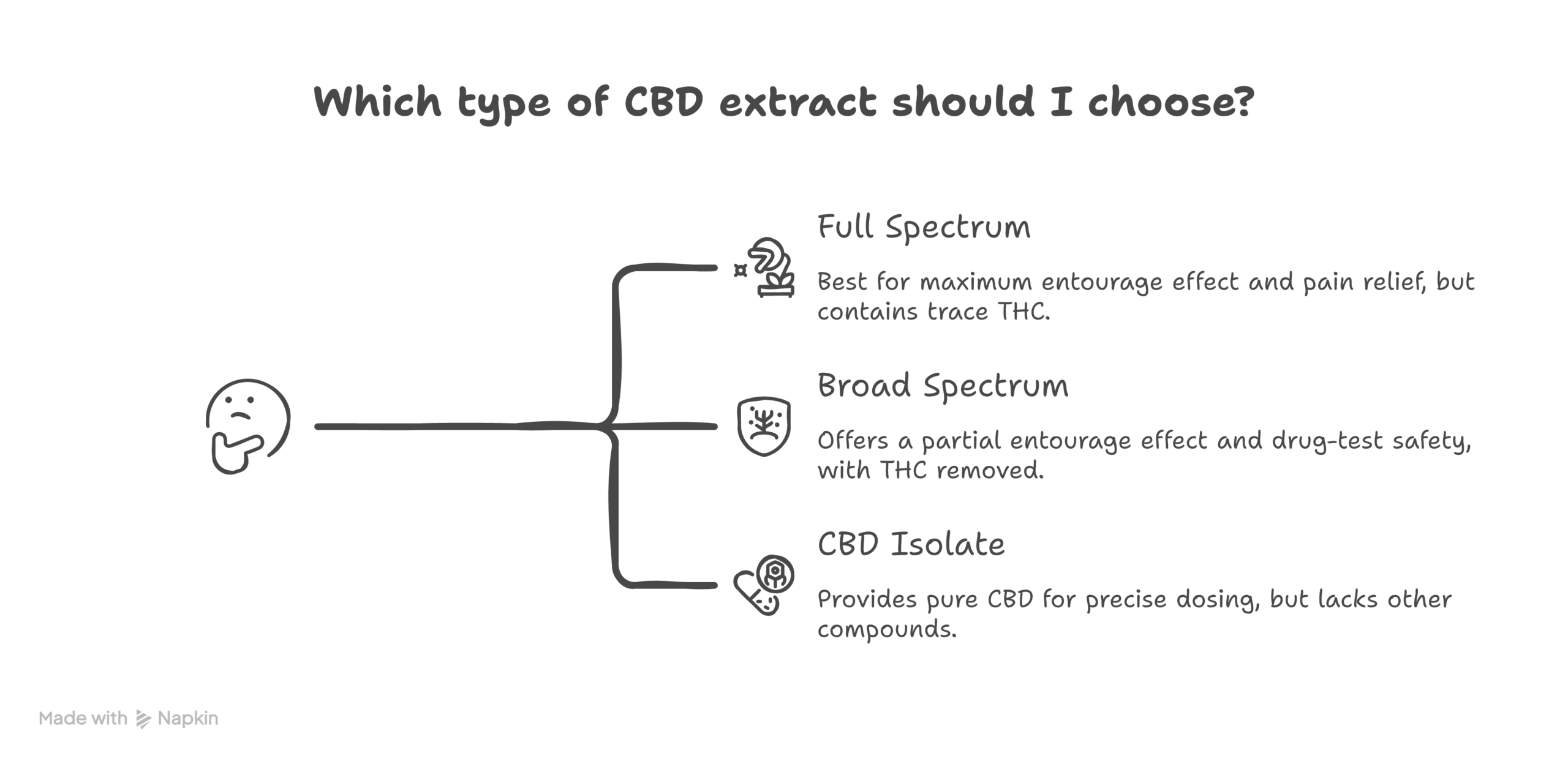
How the extraction process shapes each type
Understanding extraction methods helps explain why these products behave differently. Most reputable manufacturers use supercritical CO2 extraction, which the European Industrial Hemp Association considers the gold standard. This method uses pressurized carbon dioxide to pull cannabinoids and terpenes from plant material without leaving solvent residues.
For full spectrum products, the extract goes through minimal post-processing. The goal is to keep the chemical profile as close to the original plant as possible. Broad spectrum requires additional steps: chromatography or distillation to selectively remove THC while preserving other compounds. This is technically demanding, which is part of why broad spectrum products sometimes cost more.
CBD isolate undergoes the most processing. After initial extraction, the oil goes through winterization (removing fats and waxes), then further purification until only CBD remains. The result is a white crystalline powder that can be dissolved in carrier oils for tinctures or pressed into tablets.
Which type works best for specific needs
Your ideal choice depends on what you’re trying to accomplish. Here’s a practical breakdown.
For pain and inflammation: Full spectrum CBD generally performs best. The combination of cannabinoids and terpenes creates a broader anti-inflammatory response. A 2020 review in Frontiers in Pharmacology found that whole-plant cannabis extracts showed stronger anti-inflammatory properties than purified cannabinoids alone. If you’re comparing THC vs CBD for pain, the relationship between these cannabinoids matters more than either one in isolation.
For anxiety and sleep: Both full and broad spectrum work well here. The terpene myrcene, found in both types, has sedative properties according to research from the National Institutes of Health. If drug testing isn’t a concern, full spectrum gives you the complete package. Otherwise, a quality broad spectrum product should still deliver noticeable results.
For drug test sensitivity: CBD isolate is the safest option. Even broad spectrum products can contain trace THC due to manufacturing limitations. If your career depends on clean drug tests, isolate removes the uncertainty.
For precise dosing: Isolate gives you the most control. Since it’s pure CBD, you can calculate exact milligram doses without accounting for other variables. This matters if you’re working with a healthcare provider to dial in a specific therapeutic dose. Our guide to choosing the right CBD oil strength walks through the dosing process step by step.
Price differences and what drives them
You’ll notice price variations between these three types. Full spectrum products typically sit in the middle price range because extraction is straightforward. Broad spectrum can cost 10-20% more due to the additional THC removal step. Isolate prices vary widely: bulk isolate powder is cheap, but finished isolate products can be priced similarly to full spectrum.
What matters more than price is third-party lab testing. The CDC has noted cases of CBD products containing undisclosed substances. A Certificate of Analysis (COA) from an independent lab tells you exactly what’s in the product and, just as importantly, what isn’t. Any brand that won’t share their lab results should raise immediate questions.
Understanding how different cannabinoids like CBG compare to CBD can also help you evaluate whether a full spectrum product’s additional compounds are worth the investment for your specific needs.
📝 What to look for on the label
Always check for: the type of extract (full spectrum, broad spectrum, or isolate), CBD content per serving in milligrams, THC content (should be <0.3% for full spectrum, <0.01% for broad spectrum, 0% for isolate), carrier oil used, and a QR code or link to third-party lab results. If any of this is missing, keep looking.
Common misconceptions worth clearing up
“Full spectrum CBD will get you high.” It won’t. The THC content in legal full spectrum products is under 0.3%, which is roughly 30 times less than the THC in typical recreational cannabis. You’d need to consume unrealistic quantities to feel any psychoactive effect.
“Isolate is safer because it’s pure.” Purity and safety aren’t the same thing. All three types are considered safe when produced by reputable manufacturers using quality hemp. The World Health Organization concluded in its 2018 review that CBD has a good safety profile and is generally well-tolerated.
“Broad spectrum is just watered-down full spectrum.” The THC removal process doesn’t dilute the other compounds. A well-made broad spectrum product should have comparable levels of CBD, minor cannabinoids, and terpenes. The only thing missing is THC.
“More expensive always means better.” Not necessarily. Price reflects extraction method, testing standards, and brand positioning. Some mid-range products outperform premium ones in independent testing. According to Leafly’s CBD shopping guide, the best approach is checking lab results rather than relying on price as a quality indicator.
Bioavailability: how your body absorbs each type
The spectrum type isn’t the only factor affecting how well CBD works. The delivery method (sublingual oil, capsules, topicals, edibles) plays a big role in bioavailability, which is the percentage of CBD that actually reaches your bloodstream.
Research published in Molecules journal found that oral CBD bioavailability ranges from just 6-19%. Sublingual administration (holding oil under your tongue for 60-90 seconds) tends to be more efficient because CBD absorbs directly through the mucous membranes, bypassing the digestive system.
Full spectrum products may have a slight edge here. The terpenes and fatty acids present in full spectrum extracts can improve CBD absorption. One theory is that terpenes increase cell membrane permeability, allowing cannabinoids to pass into the bloodstream more easily. This is still being studied, but early findings from the Journal of Natural Products are encouraging.
Making your decision
Here’s the honest take: for most people, full spectrum CBD is probably the best starting point. The research on the entourage effect, while still evolving, consistently points toward whole-plant extracts outperforming isolated compounds. If you don’t face drug testing and you’re comfortable with legal trace amounts of THC, full spectrum gives you the most complete product.
If drug testing is a real concern but you still want that synergistic effect, broad spectrum is your best bet. Just make sure you buy from a brand that provides updated lab results confirming THC levels below detection thresholds.
Choose isolate if you need absolute certainty about THC content, want flavorless CBD for cooking or mixing, or are working with a healthcare provider on precise dosing protocols.
Whichever type you choose, start with a low dose and increase gradually. Give each dosage level at least a week before adjusting. CBD isn’t an instant-results compound for most applications, and finding your personal sweet spot takes patience.
⚠️ Disclaimer
This article is for informational purposes only and does not constitute medical advice. The information provided about CBD products is current as of March 2026 but may change as new research emerges. Always consult with qualified healthcare professionals before starting any CBD regimen, especially if you take prescription medications. CBD can interact with certain drugs, particularly those metabolized by the cytochrome P450 enzyme system. For our full disclaimer, visit cannastoreams.gr/disclaimer.
Frequently asked questions
Can full spectrum CBD make you fail a drug test?
Yes, it’s possible. While full spectrum CBD products contain less than 0.3% THC, regular use can cause THC to accumulate in your body over time. Standard workplace drug tests look for THC metabolites, not CBD. If drug testing is part of your job, consider broad spectrum or isolate products instead.
Is full spectrum CBD legal in Europe?
In most EU countries, CBD products derived from industrial hemp with less than 0.2-0.3% THC are legal. Greece allows CBD products with up to 0.2% THC from certified hemp varieties. Regulations vary by country, so check your local laws before purchasing. The European Food Safety Authority (EFSA) is currently evaluating CBD as a novel food ingredient.
How long does it take to feel the effects of CBD?
This depends on the delivery method. Sublingual oils typically take 15-30 minutes to produce effects. Edibles and capsules need 1-2 hours because they pass through the digestive system. Topicals work within minutes on the applied area but don’t reach the bloodstream. The spectrum type (full, broad, or isolate) doesn’t significantly change onset time, though full spectrum may produce more noticeable effects at lower doses.
Can you switch between CBD types?
Absolutely. There’s no medical reason you can’t switch between full spectrum, broad spectrum, and isolate. Some people use full spectrum during periods when drug testing isn’t a concern, then switch to isolate when they need to be THC-free. Just note that when switching, it may take a few days for your body to adjust to the different compound profile.
What does a CBD Certificate of Analysis (COA) show?
A COA from a third-party lab lists the cannabinoid profile (how much CBD, THC, CBG, CBN, and other cannabinoids are present), terpene analysis, and testing results for contaminants like pesticides, heavy metals, and residual solvents. For full spectrum products, the COA should show THC below the legal limit. For broad spectrum, THC should be below the limit of detection (LOD). For isolate, CBD purity should be 99% or higher.