Industrial Hemp THC Limit: Greece and EU 0.3% Guide
Understand the industrial hemp THC limit, Greece’s 0.3% proposal, EU CAP rules, CBD products, and consumer safety in 2026.

The industrial hemp THC limit is one of those small legal numbers that can change a whole market. For years, many European hemp businesses worked around the old 0.2% THC threshold. The EU’s Common Agricultural Policy now uses a 0.3% THC ceiling for eligible hemp varieties, and Greece has been debating a similar move for industrial hemp. That sounds like a simple technical alignment, but for growers, CBD brands, retailers, and consumers, the practical meaning is more nuanced.
This guide explains what 0.3% means, what it does not mean, why Greece’s proposal matters, and how adults shopping for wellness products should read labels, lab reports, and legal claims. The short version: 0.3% is a cultivation and compliance threshold, not a free pass for every hemp product or every retail format.
📺 Video Guide
Industrial Hemp THC Limit Explained
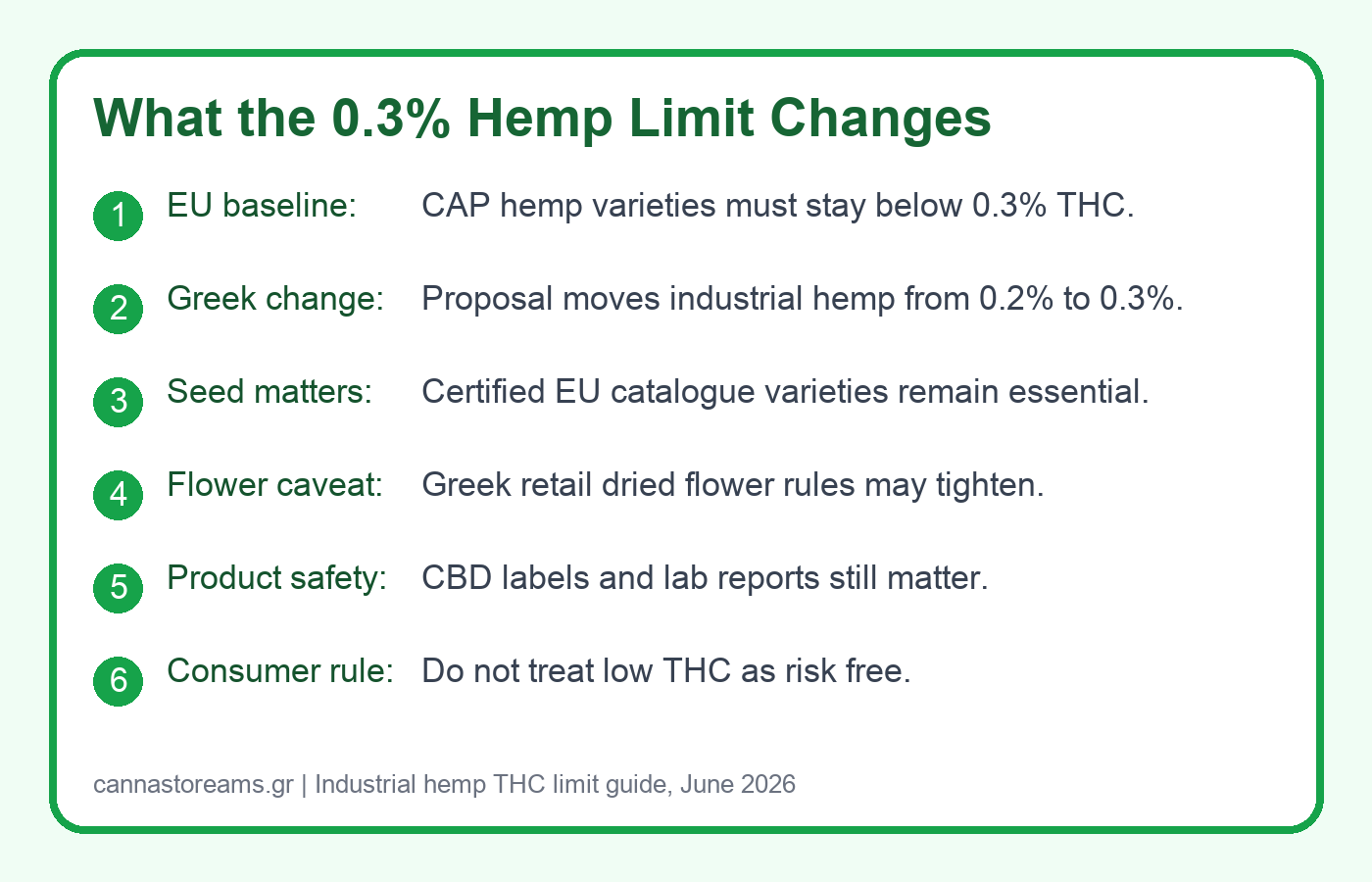
In European policy, industrial hemp usually means approved varieties of Cannabis sativa L. cultivated for fibre, seed, biomass, cosmetics, foods, extracts, or other non-intoxicating industrial uses. The European Commission says hemp farmers seeking CAP support must use certified seed from varieties in the EU common catalogue, and that the cultivated variety must have THC content below 0.3%. That is the number now shaping how the European market talks about hemp.
The important distinction is scope. The EU 0.3% rule is primarily an agricultural and subsidy rule, especially under the 2023 to 2027 Common Agricultural Policy. It does not automatically legalise every consumer product containing hemp, and it does not override every national rule on extracts, foods, flowers, cosmetics, or narcotics law. Member states still have room to create stricter national conditions, which is why Greek shoppers can see EU headlines and still face local restrictions.
For consumers, the industrial hemp THC limit should be read as a boundary marker. Below the limit, hemp is treated differently from high-THC cannabis for certain agricultural and industrial purposes. Above it, a crop may fall outside hemp support rules or trigger stricter controls. That does not mean a product below 0.3% is automatically appropriate for everyone, accurately labelled, or permitted in every sales channel.
✓ Key Takeaways
- ✓ The EU CAP hemp threshold is now below 0.3% THC for eligible varieties.
- ✓ Greece’s existing and proposed rules must be checked locally, not assumed from EU headlines.
- ✓ CBD products still need lab reports, ingredient checks, and responsible use.
- ✓ Low THC does not mean no regulation, no risk, or no quality concerns.
What Changed at EU Level
The EU shift from 0.2% to 0.3% matters because it gives farmers and processors a little more biological breathing room. Hemp plants are agricultural crops, and THC can vary with genetics, weather, harvest timing, and testing method. A slightly higher ceiling may reduce the risk that an otherwise compliant crop becomes commercially unusable because of a marginal test result. Industry groups have argued for years that the old 0.2% limit was unusually restrictive compared with several other markets.
The change also improves alignment with international trade norms. The USDA Foreign Agricultural Service has described the EU hemp market and noted the 0.3% ceiling under the current CAP framework. The United States also uses 0.3% delta-9 THC as the federal hemp line, although the American framework is separate from EU law and has its own complications.
At the product level, separate EU food safety rules can apply. For example, Commission Regulation (EU) 2023/915 includes maximum levels for delta-9 THC equivalents in hemp seeds and derived products such as hemp seed oil. This is a different issue from the field limit. A hemp crop can be legal to cultivate under one rule while a finished food product still needs to meet separate contaminant, novel food, labelling, or safety requirements.
What the Greece Proposal Means
Greece has historically treated industrial hemp more conservatively, with a 0.2% THC threshold under the national hemp framework. Reporting on the 2026 Greek health bill says Article 41 would move the industrial hemp threshold toward 0.3%, aligning the number with the EU CAP approach. But the same reporting also warns that dried hemp flower intended for retail sale could face a much stricter treatment. Business of Cannabis reported that the bill was tabled in May 2026 and that the proposed change combines a higher industrial THC limit with tighter rules on retail dried flower.
That combination is why shoppers should avoid simplistic claims like “Greece legalised 0.3% hemp.” The better reading is this: Greece may align industrial cultivation limits with the EU baseline while still restricting some consumer-facing formats. In practice, hemp biomass for processing, CBD cosmetics, hemp foods, and dried flower can be treated differently. The same plant family does not mean the same legal route.
If you operate a store, farm, or wellness brand, the safest approach is to track the final adopted law, government circulars, and enforcement practice rather than relying on draft-bill summaries. If you are a consumer, the safest approach is simpler: buy from responsible retailers, avoid products that make medical promises, and check whether the product format is clearly permitted for retail sale.
What the 0.3% Hemp Limit Changes
For farmers, the move to 0.3% can widen the range of viable hemp genetics and reduce crop-loss risk. For processors, it can make sourcing easier because more EU-certified varieties may be commercially useful. For CBD and wellness businesses, it can support a more stable supply chain, especially where raw hemp is processed into compliant cosmetics, oils, foods, or extracts. For consumers, the change may eventually improve product variety and consistency, but only if the final products are tested properly and sold within the law.
The change does not remove the need for certificates of analysis. A proper COA should show cannabinoid content, THC level, batch number, test date, laboratory identity, and ideally contaminant screening. If you want a deeper practical guide, our article on how to read cannabis lab reports explains what to look for before buying. The same discipline applies to hemp products: the label is a claim, but the lab report is the evidence.
The 0.3% number also does not tell you how a product will feel. A non-intoxicating CBD oil, a hemp seed food, a topical balm, and a dried flower product are not interchangeable. Route of use, dose, other cannabinoids, terpenes, and product quality all matter. For a broader cannabinoid primer, see our THC vs CBD guide, which breaks down the difference between intoxicating and non-intoxicating cannabinoid profiles.
💡 Pro Tip
When comparing hemp products, look for batch-specific lab reports rather than generic “under legal THC limit” statements. The best retailers make verification boringly easy.
CBD Products, Safety, and Labelling
CBD is often the consumer-facing reason people care about hemp rules. The World Health Organization’s CBD review found that pure cannabidiol shows no evidence of abuse or dependence potential, but that does not make all commercial CBD products equal. A finished product may contain other cannabinoids, residual solvents, contaminants, inaccurate potency, or ingredients that matter for allergies and drug interactions.
Public health agencies continue to take a cautious stance. The CDC’s CBD guidance notes potential risks including liver effects, interactions with medicines, drowsiness, diarrhoea, and appetite or mood changes. The U.S. FDA cannabis and CBD page similarly stresses that CBD product regulation and safety evidence remain complicated outside approved medicines.
That is why responsible hemp commerce should sound careful, not magical. If a product promises to cure anxiety, pain, insomnia, or chronic disease, treat that as a red flag. If you use prescription medication, are pregnant, are breastfeeding, have liver concerns, or are buying for an older adult, speak with a qualified healthcare professional first. For wellness use, lower-risk habits include starting with modest serving sizes, avoiding mixing with alcohol or sedatives, and not driving if you feel impaired or unusually drowsy.
Why Hemp Is Not the Same as Intoxicating Cannabis
Hemp and high-THC cannabis are both part of the cannabis plant family, but regulation separates them because their typical chemical profiles and intended uses differ. Hemp is usually cultivated for fibre, seeds, extracts, cosmetics, wellness products, or industrial materials. High-THC cannabis is regulated because delta-9 THC can intoxicate, impair, and create legal or health risks. If you want the science background, the National Academies cannabis evidence review is a useful overview of potential benefits and risks across cannabis research.
The body’s endocannabinoid system is involved in pain, appetite, mood, sleep, inflammation, and memory. A readable medical overview from NCBI Bookshelf explains how cannabinoid receptors and endogenous cannabinoids function. But the existence of this system does not mean every cannabis-derived product is automatically therapeutic. Effects depend on the compound, dose, formulation, person, and context.
For practical shopping, separate the category from the claim. Hemp seed oil is mostly a nutritional oil. CBD oil is a cannabinoid product. A topical works differently from an edible. A full-spectrum extract is not the same as an isolate. If you are deciding between forms, our CBD capsules vs softgels comparison and CBD oil daytime safety guide can help you think through timing, format, and responsible expectations.
📝 Important Note
A legal THC threshold is not a dosage recommendation. Product type, route of use, personal sensitivity, medication use, and local law all matter.
What Shoppers Should Check Before Buying
First, check the product category. Hemp seed foods, CBD oils, topicals, cosmetics, and dried botanical products may fall under different rules. Second, check the lab report. The report should match the exact batch and show THC content clearly. Third, check the retailer’s language. Trustworthy businesses explain limits and disclaimers; questionable sellers lean on exaggerated claims or vague “legal everywhere” wording.
Fourth, watch for EU novel food and food safety issues. The European Commission novel food catalogue and application summaries are relevant because many cannabinoid extracts sold as ingestible products sit in a more complex regulatory zone than simple hemp seed foods. The European Food Safety Authority’s CBD topic page has also highlighted data gaps around CBD safety for food uses.
Finally, check your own use case. If your goal is relaxation, sleep, or recovery, you still need a sensible routine. A product that works for one person may feel too strong, too weak, or simply irrelevant for another. Use the industrial hemp THC limit as a legality clue, then use lab reports and responsible guidance as your quality filter.
⚠️ Disclaimer
This article is for informational purposes only and does not constitute medical or legal advice. The information about medical cannabis and industrial hemp in Greece is current as of June 2026 but may change. Always consult qualified healthcare professionals for medical advice and qualified legal professionals for compliance decisions. For our full disclaimer, visit cannastoreams.gr/disclaimer.
Frequently Asked Questions
Is the industrial hemp THC limit in the EU now 0.3%?
For CAP-supported hemp varieties, the EU threshold is below 0.3% THC. That does not automatically decide every national retail rule or finished-product rule.
Does 0.3% THC mean a product cannot cause any effects?
No. The number is a legal and agricultural threshold. Effects depend on serving size, formulation, cannabinoids, route of use, and personal sensitivity.
Is Greece already fully aligned with the EU 0.3% hemp rule?
Greece has been considering a 2026 move toward 0.3% for industrial hemp, but consumers and businesses should check the final adopted law and local enforcement details.
What should I ask for before buying CBD or hemp products?
Ask for a batch-specific certificate of analysis, clear ingredients, THC content, serving guidance, and a retailer that avoids medical cure claims.
Does the 0.3% limit apply to hemp seed foods too?
Hemp seed foods can also face separate food safety rules, including THC-equivalent limits in certain EU regulations. Crop rules and food rules are related but not identical.
