Cannabis and Fitness: Pre vs Post Workout Guide
How does cannabis fit into your fitness routine? Compare pre-workout and post-workout cannabis use for recovery, focus, and pain relief in 2026.

The relationship between cannabis and fitness has shifted from taboo to mainstream conversation. More athletes, gym-goers, and weekend warriors are experimenting with cannabis as part of their exercise routines, whether to get in the zone before a workout or to speed up recovery afterward. But the timing of your consumption matters more than most people realize.
According to a 2019 study published in Frontiers in Public Health, around 80% of cannabis users in states with legal access reported combining cannabis with exercise. That number keeps climbing. So what does the science actually say about using cannabis before hitting the gym versus after? And which approach makes more sense for your goals?
How cannabis interacts with your body during exercise
Your body’s endocannabinoid system (ECS) plays a direct role in regulating pain, inflammation, mood, and energy balance. When you exercise, your body naturally produces endocannabinoids like anandamide, sometimes called the “bliss molecule.” This is actually what researchers now believe causes the runner’s high, not endorphins as previously thought.
When you introduce plant-based cannabinoids like THC and CBD into this system, they bind to the same receptors your body already uses during physical activity. THC primarily activates CB1 receptors in the brain, affecting perception, mood, and pain sensitivity. CBD works more indirectly, influencing inflammation and stress response through multiple pathways.
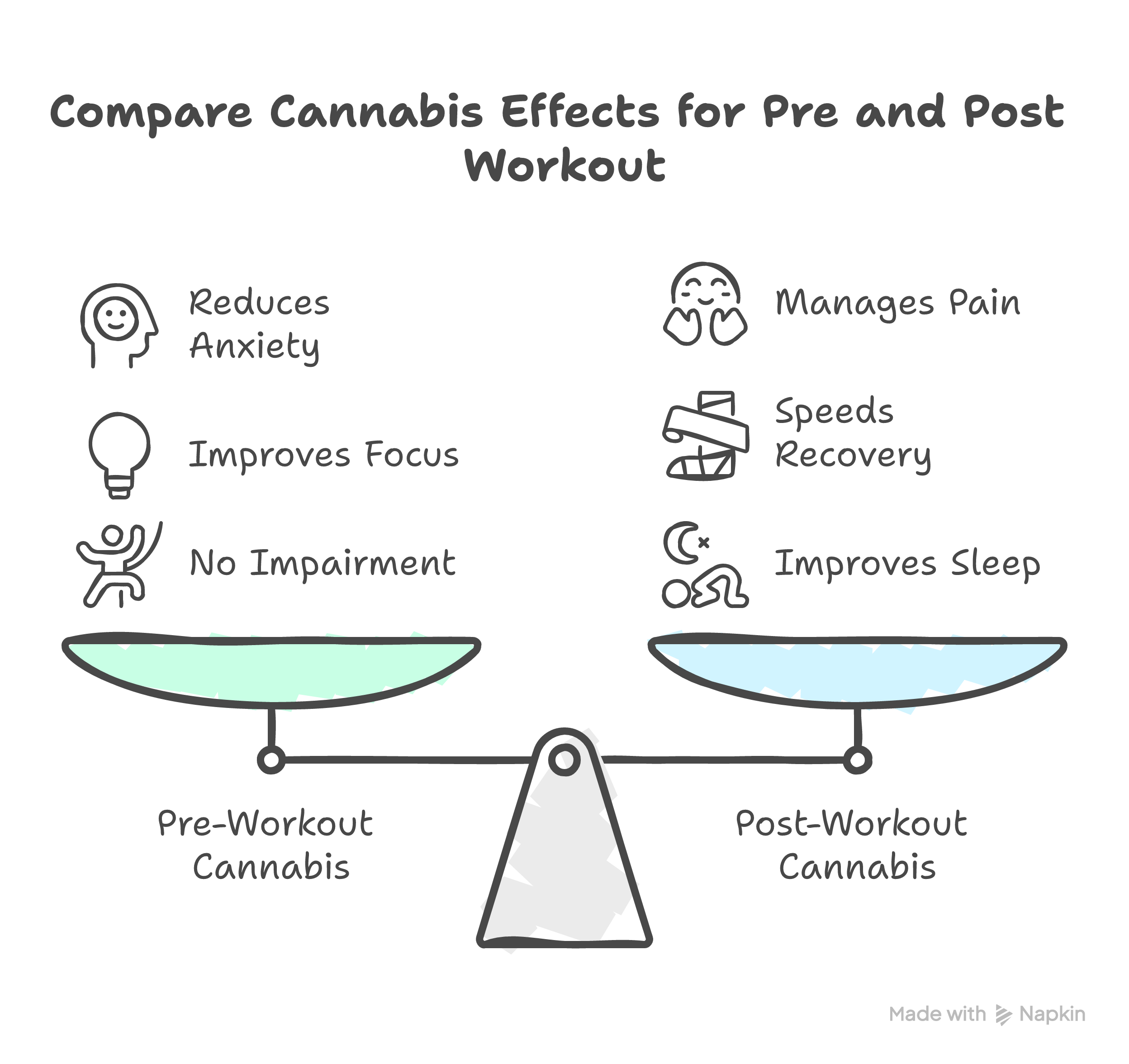
This is why the timing question matters so much. The effects you want before a workout (focus, motivation, reduced anxiety) are completely different from what you need after (pain relief, reduced inflammation, better sleep for recovery).
Pre-workout cannabis: what happens when you consume before exercise
Using cannabis before a workout is polarizing. Some people swear it helps them lock into a flow state during repetitive exercises like running, cycling, or swimming. Others find it wrecks their coordination and makes them want to sit on the couch instead. Both experiences are valid, and they come down to a few key factors.
A study from the University of Colorado Boulder found that cannabis users who consumed before exercise reported greater enjoyment and were more likely to stick with their routines over time. The researchers noted that cannabis seemed to reduce the perception of effort, making hard workouts feel more manageable.
However, there are legitimate concerns. THC increases your heart rate, which can compound the cardiovascular stress of intense exercise. The American Heart Association has flagged this as a potential risk, particularly for people with underlying heart conditions. Coordination and reaction time also take a hit, making pre-workout cannabis a poor choice for activities that demand precision or quick reflexes, like heavy weightlifting or team sports.
💡 Pro Tip
If you want to try pre-workout cannabis, start with a low-THC, higher-CBD strain or product. CBD oil taken 30-45 minutes before exercise can help with focus and reduce pre-gym anxiety without the impairment that comes with higher THC doses.
Best activities for pre-workout cannabis use
Not every workout pairs well with cannabis. Based on user reports and the limited research available, here is where pre-workout consumption tends to work best:
Cardio and endurance training. Running, cycling, hiking, and swimming are where most people report positive results. The combination of reduced perceived effort and increased enjoyment seems to shine during long, steady-state activities. Ultra-runner Avery Collins has spoken publicly about using cannabis during training runs of 100+ miles.
Yoga and stretching. Cannabis can deepen body awareness and help people connect with their yoga practice on a different level. The enhanced proprioception some users report makes it easier to hold poses and tune into muscular tension.
Where it falls short. Heavy compound lifts (squats, deadlifts, bench press) and sports requiring quick decision-making are generally not a good match. Impaired coordination and altered depth perception can increase injury risk.
Post-workout cannabis: the recovery angle
This is where the science gets more interesting and less controversial. Post-workout cannabis use, particularly CBD, has a growing body of evidence behind it. The main benefits cluster around three areas: inflammation reduction, pain management, and sleep quality.
Exercise causes micro-tears in muscle fibers. That is literally how you get stronger. But the inflammation that follows can cause significant soreness (delayed onset muscle soreness, or DOMS) and slow down your ability to train again. The World Health Organization’s 2018 report on CBD noted its anti-inflammatory properties, and subsequent research from the National Institutes of Health has confirmed that cannabinoids interact with inflammatory pathways relevant to exercise recovery.
Many athletes are choosing cannabis-based recovery products over traditional NSAIDs like ibuprofen. Long-term NSAID use is linked to gastrointestinal issues and kidney problems, while cannabis topicals for athletes offer localized relief without those systemic side effects.
✓ Post-workout cannabis benefits supported by research
- ✓ CBD reduces exercise-induced inflammation through the ECS
- ✓ THC and CBD both help manage post-exercise pain without NSAID risks
- ✓ Cannabis use before bed improves sleep quality, which is critical for muscle repair
- ✓ Topical CBD products provide targeted relief for sore muscles and joints
- ✓ Reduced cortisol levels may support better recovery outcomes
CBD vs THC for fitness: choosing the right cannabinoid
The cannabinoid you choose matters as much as the timing. CBD and THC serve different purposes in a fitness context, and understanding the distinction can help you build a smarter routine.
CBD for fitness is the safer, more versatile option. It does not cause intoxication, will not impair your motor skills, and is legal in most jurisdictions. CBD’s anti-inflammatory effects are well-documented by the National Center for Complementary and Integrative Health (NCCIH). For athletes, CBD works well both before and after exercise. A dose 30-60 minutes pre-workout can reduce anxiety and improve focus. Post-workout, it helps manage inflammation and promotes relaxation.
THC for fitness is more nuanced. Its pain-relieving properties can help you push through tough workouts, and the euphoria can make exercise more enjoyable. But the psychoactive effects come with trade-offs: impaired coordination, increased heart rate, and the potential for anxiety or paranoia at higher doses. If you use THC around workouts, keep doses low and avoid it before any activity where loss of coordination could be dangerous.
Many fitness enthusiasts are gravitating toward products that combine both cannabinoids. Full-spectrum CBD products contain small amounts of THC alongside CBD, terpenes, and other compounds. This “entourage effect” may deliver better results than either cannabinoid alone, according to research published in the British Journal of Pharmacology.
What the pros are doing
Professional athletes have increasingly gone public about their cannabis use. The World Anti-Doping Agency (WADA) raised the THC threshold in 2013 from 15 ng/mL to 150 ng/mL, essentially signaling that out-of-competition use is not their primary concern. CBD was removed from the prohibited list entirely in 2018.
Former NFL players have been particularly vocal. A 2023 study in JAMA Network Open found that a significant percentage of former professional football players reported using cannabis for pain management, many as a replacement for opioids. MMA fighters, triathletes, and CrossFit athletes have also spoken about incorporating cannabis into their recovery protocols.
The pattern among professional athletes is clear: most use cannabis primarily for recovery, not performance. They consume after training, often in the form of topicals, tinctures, or edibles, to manage the physical toll of their sport.
Practical guide: building cannabis into your workout routine
If you want to experiment with cannabis and fitness, here is a framework that balances the research with real-world practicality.
For pre-workout use:
- Stick to CBD-dominant products or very low THC doses (2.5-5mg max)
- Consume 30-45 minutes before your session
- Choose activities where impaired coordination is not dangerous
- Stay hydrated, as cannabis can cause dry mouth and reduce your awareness of thirst
- Skip it entirely for heavy lifting or high-intensity interval training until you know your tolerance
For post-workout use:
- Apply CBD topicals directly to sore muscles within 30 minutes of finishing your workout
- Consider a CBD tincture or oil for systemic inflammation reduction
- If using THC for pain management, edibles provide longer-lasting relief than inhalation
- Use cannabis as part of your sleep routine on training days, since deep sleep is when most muscle repair happens
📝 Important note on dosing
Everyone responds to cannabis differently. Body weight, tolerance, metabolism, and even your gut microbiome affect how cannabinoids work for you. Start with the lowest effective dose and adjust gradually over several sessions. What works for your gym buddy might knock you flat, and vice versa. Keep a simple log of what you take, when, and how it affects your workout. You will figure out your sweet spot faster that way.
Cannabis delivery methods ranked for fitness
Not all consumption methods work equally well around exercise. Here is how the main options compare:
Topicals are the best option for targeted post-workout recovery. Creams, balms, and roll-ons deliver cannabinoids directly to sore areas without entering your bloodstream. Zero psychoactive effects, fast-acting on the application site, and easy to use at the gym. The FDA has acknowledged the growing market for topical CBD products, though regulation remains a work in progress.
Tinctures and oils are versatile for both pre and post-workout use. Sublingual absorption takes 15-30 minutes, and you can control dosing precisely. A few drops of broad-spectrum CBD oil under your tongue before a run or after lifting makes it easy to integrate into any routine.
Edibles work best for post-workout recovery, especially in the evening. The effects take 60-90 minutes to kick in but last 4-8 hours, making them ideal for overnight recovery. Not great for pre-workout use since timing the onset is difficult.
Inhalation (smoking or vaping) offers the fastest onset (minutes) but is the least fitness-friendly delivery method. Smoking anything irritates your lungs and reduces cardiovascular capacity. If you do inhale, vaporizing is the less harmful option. Just keep in mind that respiratory function matters when you are trying to perform physically.
Common mistakes to avoid
Taking too much before training. This is the number one mistake. High doses of THC before exercise can cause dizziness, anxiety, and a racing heart. That combination plus physical exertion is not just unpleasant, it can be unsafe. Always start lower than you think you need.
Ignoring hydration. Cannabis causes cottonmouth because cannabinoids interact with saliva production. During exercise, you are already losing fluids through sweat. Add cannabis to the equation and dehydration risk goes up significantly. Drink more water than usual on days you combine cannabis and exercise.
Using cannabis as a crutch. If you cannot motivate yourself to exercise without cannabis, that is worth examining. Cannabis should complement your fitness routine, not be a prerequisite for it. Building genuine exercise habits matters more than any supplement.
Assuming all products are equal. Quality varies wildly across the cannabis market. Look for products with third-party lab testing (Certificates of Analysis), clear cannabinoid content labeling, and reputable sourcing. Research what you are putting in your body the same way you would with any other supplement.
The verdict: pre or post workout?
If you had to pick one, post-workout cannabis use has stronger evidence behind it and carries fewer risks. The anti-inflammatory benefits of CBD, the pain management properties of both CBD and THC, and the sleep improvement effects all align with what your body needs after physical stress.
Pre-workout cannabis can work for specific people doing specific activities, primarily endurance cardio and yoga, but it requires more caution and self-awareness. You need to know your tolerance, choose the right product, and pick an appropriate workout.
The smartest approach? Use CBD before workouts for its anti-anxiety and anti-inflammatory effects without intoxication. Save THC for after your session, when its pain-relieving and sleep-promoting properties can actually help your body recover. This gives you the best of both worlds without compromising your performance or safety in the gym.
⚠️ Disclaimer
This article is for informational purposes only and does not constitute medical advice. The information provided about cannabis use is current as of March 2026 but may change. Always consult with qualified healthcare professionals before combining cannabis with your exercise routine, especially if you have cardiovascular conditions or take other medications. Cannabis laws vary by jurisdiction. For our full disclaimer, visit cannastoreams.gr/disclaimer.
Frequently asked questions
Is it safe to use cannabis before working out?
CBD is generally considered safe before exercise and does not cause impairment. THC before workouts carries more risk due to increased heart rate, impaired coordination, and altered perception. If you choose to use THC pre-workout, keep doses very low (under 5mg) and avoid activities requiring precise motor control or heavy weights.
Does CBD help with muscle recovery after exercise?
Research suggests CBD has anti-inflammatory properties that may help reduce delayed onset muscle soreness (DOMS). CBD topicals applied directly to sore areas can provide localized relief. Many athletes report faster recovery times when incorporating CBD into their post-workout routine, though more large-scale human studies are needed.
Will cannabis affect my athletic performance?
Cannabis is not a performance-enhancing drug in the traditional sense. THC may reduce perceived effort during endurance activities, making workouts feel easier, but it does not increase strength or speed. CBD does not appear to affect performance directly but may support it indirectly by improving recovery and sleep quality.
What is the best cannabis product for fitness recovery?
CBD topicals (creams, balms, roll-ons) are the most popular choice among fitness enthusiasts because they target specific sore areas without psychoactive effects. Full-spectrum CBD tinctures taken sublingually are a good option for whole-body recovery. Edibles can help with overnight recovery due to their long-lasting effects.
Can cannabis replace traditional anti-inflammatory medications for athletes?
Some athletes use cannabis as an alternative to NSAIDs like ibuprofen, which can cause gastrointestinal issues with long-term use. While cannabis shows anti-inflammatory potential, it should not be viewed as a direct replacement without consulting a healthcare provider. Some people use both, reserving NSAIDs for acute injuries and cannabis for day-to-day soreness management.
