Cannabis and Productivity: Finding the Right Balance
Can cannabis help you focus? Learn how to balance cannabis and productivity with the right strains, doses, and timing. Science-backed tips inside.

You have probably heard two conflicting stories about cannabis. One says it turns you into a couch-locked zombie. The other claims it unlocks creative genius and laser focus. The reality? Neither is quite right. Cannabis and productivity have a complicated relationship, and how it plays out for you depends on what you consume, how much, and when.
This guide breaks down how cannabis actually affects your ability to get things done, which strains and doses work for focused sessions, and where the line sits between helpful and counterproductive. No hype, no scare tactics, just what the science and real-world experience tell us.
📺 Video Guide
How Cannabis Affects Your Brain During Work
When THC enters your system, it binds to CB1 receptors throughout your brain, particularly in the prefrontal cortex, the region responsible for planning, decision-making, and attention. According to research published in the National Center for Biotechnology Information, low doses of THC can activate this region in a way that narrows your attention to a single task. Higher doses do the opposite, scattering focus and making it hard to stick with anything for more than a few minutes.
The journal Nature Neuropsychopharmacology published findings showing that cannabis affects dopamine signaling differently depending on dose and frequency. Occasional low-dose users showed increased task engagement, while daily heavy users showed reduced baseline dopamine, which translates to less motivation when sober.
This is the core tension with cannabis and productivity. A little can sharpen your edge. Too much dulls it. And what counts as “a little” varies wildly from person to person based on tolerance, body weight, metabolism, and the specific cannabinoid profile of what you are consuming.
Sativa vs Indica: Does Strain Type Actually Matter?
The short answer: yes, but not for the reasons most people think. The indica/sativa classification is technically about plant morphology, not effects. What actually determines how a strain affects your productivity is its specific cannabinoid and terpene profile.
That said, the general pattern holds up in practice. Strains marketed as sativas tend to contain terpene profiles (high in limonene and pinene) that promote alertness. Indicas typically contain more myrcene, which is sedating. A 2023 study from the Journal of Cannabis Research confirmed that terpene profiles predicted subjective effects more reliably than THC percentage alone.
For productivity specifically, look for strains high in THCV, a minor cannabinoid that the FDA acknowledges has distinct pharmacological properties compared to regular THC. THCV tends to produce clear-headed, energetic effects without the heavy body sensation that kills motivation. Strains like Durban Poison, Jack Herer, and Green Crack are popular choices among people who use cannabis while working, specifically because of their THCV content and stimulating terpene profiles.
✓ Best Strain Types for Productive Sessions
- ✓ Sativa-dominant hybrids with high limonene and pinene terpenes
- ✓ THCV-rich strains like Durban Poison for clear-headed energy
- ✓ Balanced THC:CBD ratios (1:1 or 2:1) for focus without anxiety
- ✓ Low-THC, high-CBD options for mild cognitive boost without impairment
Microdosing: The Productivity Sweet Spot
If there is one strategy that keeps coming up in conversations about cannabis and productivity, it is microdosing. The idea is simple: take just enough THC to shift your mental state without getting noticeably high. For most people, that means 2.5 to 5 milligrams of THC.
Research from the University of Chicago found that participants given 7.5mg of THC reported reduced stress during a public speaking task, while those given 12.5mg reported increased anxiety. The difference between “productive calm” and “anxious fog” came down to roughly 5 milligrams.
Practically speaking, microdosing works best with edibles or tinctures where you can control the dose precisely. Smoking or vaping makes it harder to dial in exact amounts, though one-hitter pipes and low-THC flower can get you close. The goal is to feel about 10-20% different from baseline: slightly more relaxed, slightly more engaged, but fully functional.
💡 Pro Tip
Start with 2.5mg of THC and wait 90 minutes before increasing. With edibles, the onset is slower but more consistent than smoking. Keep a log of doses and productivity levels for your first two weeks to find your personal sweet spot.
When Cannabis Helps Productivity (and When It Hurts)
Cannabis does not affect all types of work equally. Creative tasks, repetitive tasks, and analytical work respond very differently to cannabinoids.
Where it tends to help: Brainstorming, creative writing, design work, repetitive data entry, certain types of coding (especially debugging, where lateral thinking helps), music production, and physical tasks that benefit from reduced self-consciousness. A study published by PubMed showed that low-dose THC increased divergent thinking, the type of cognition responsible for generating multiple solutions to open-ended problems.
Where it tends to hurt: Complex math, detailed financial analysis, legal document review, anything requiring precise short-term memory, learning new complex material, and tasks with strict accuracy requirements. The CDC notes that THC consistently impairs short-term memory and processing speed, which makes accuracy-dependent work risky.
The honest take? If your work involves a mix of both, consider timing your cannabis use for the creative portions and staying clear for the detail-oriented stretches. This is not about choosing sides. It is about using a tool at the right time for the right job.
The Role of CBD in Focused Productivity
CBD does not get you high, but it does affect your ability to work. The World Health Organization published a comprehensive review concluding that CBD has anxiolytic (anti-anxiety) properties without cognitive impairment. For people whose productivity suffers because of stress or anxiety, this matters a lot.
CBD for focus and concentration works through a different mechanism than THC. Instead of binding directly to cannabinoid receptors, CBD modulates serotonin receptors and inhibits the enzyme that breaks down anandamide, your body’s natural “bliss molecule.” The result is a calm alertness that many users describe as the opposite of coffee jitters.
Products with a full spectrum cannabinoid profile tend to outperform CBD isolate for productivity purposes. The entourage effect, where multiple cannabinoids and terpenes work together, produces more nuanced benefits than any single compound alone. A study in Frontiers in Neurology supports this, showing that full spectrum extracts required lower doses to achieve the same effects as isolated compounds.
Building a Cannabis Productivity Routine
People who successfully use cannabis while staying productive almost always follow a routine. They do not just smoke whenever and hope for the best. Here is what a structured approach looks like:
Morning deep work (sober): Handle your most demanding cognitive tasks first thing, before consuming anything. Your brain’s executive function peaks in the morning for most people. Use this window for complex analysis, writing, and decision-making.
Afternoon creative session (microdose): After lunch, when energy naturally dips, a small dose (2.5-5mg THC or 15-25mg CBD) can re-engage your brain for creative tasks. This is when brainstorming, design work, and exploratory research benefit most from a slight shift in perspective.
Evening wind-down (moderate dose): Save larger doses for after work. An indica-dominant strain or higher CBD product helps transition from work mode to rest mode. Good sleep directly supports next-day productivity, and cannabis can help here if used intentionally. Check out our guide on cannabis and sleep for specific recommendations.
📝 Important Note
Tolerance builds quickly with daily use. If you notice your microdose stops working after a few weeks, take a 48-72 hour break. Research from the Journal of Psychopharmacology shows that CB1 receptor density begins recovering within 2 days of abstinence. Our tolerance management guide covers this in detail.
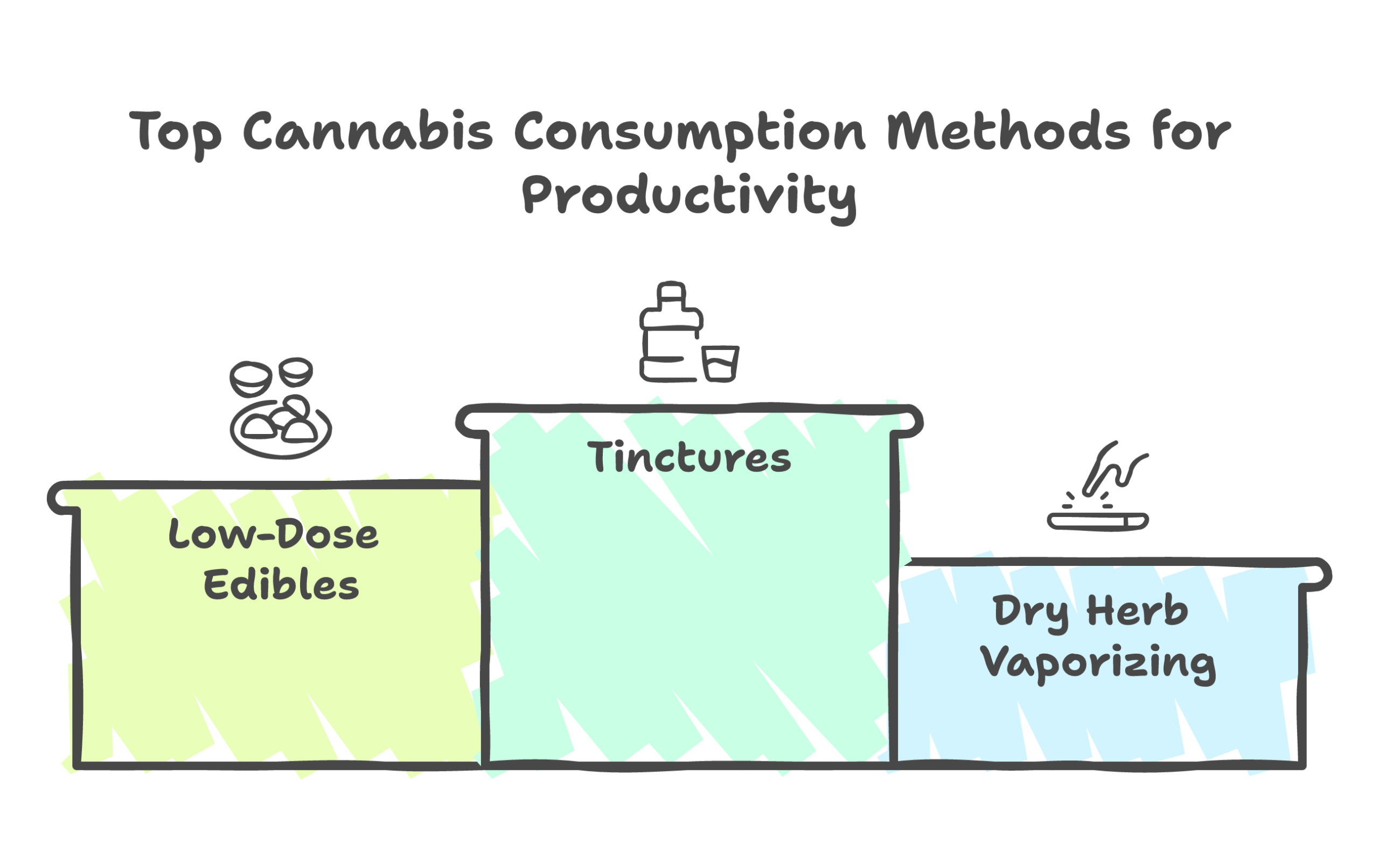
Consumption Methods Ranked for Productivity
How you consume cannabis matters as much as what you consume. Each method has different onset times, durations, and consistency profiles that affect how well you can work.
Tinctures (best for work): Sublingual absorption takes 15-30 minutes, lasts 4-6 hours, and allows precise dosing. You can measure exact milligrams and adjust in small increments. Our tinctures guide covers the basics.
Low-dose edibles (good for sustained work): Slower onset (60-90 minutes) but longest duration (6-8 hours). Ideal for long work sessions once you know your dose. The Harvard Health Blog recommends starting with 2.5mg for new users.
Dry herb vaporizing (moderate for work): Fast onset (5-10 minutes) and easier to microdose than smoking, though less precise than edibles. Quality vaporizers with temperature control let you target specific terpenes.
Smoking (least ideal for work): Difficult to microdose, harsh on the lungs, and the effects can be more variable. If you prefer smoking, use a one-hitter pipe for smaller doses, but be aware that the sharp onset curve makes it harder to hit the productivity sweet spot.
Real Risks You Should Know About
Let’s be straightforward about this. Cannabis is not a productivity supplement. It is a psychoactive substance with real tradeoffs, and pretending otherwise does nobody any favors.
The National Institute on Drug Abuse (NIDA) reports that regular cannabis use is associated with decreased motivation in some users, a phenomenon researchers call “amotivational syndrome.” While the evidence for this as a distinct condition is debated, the pattern is real: daily heavy use can reduce drive over time.
Memory impairment is another genuine concern. Even microdoses of THC affect short-term memory to some degree. If your work requires memorizing information, recalling specific details, or learning new systems, cannabis will likely slow you down. The American Psychological Association notes that these cognitive effects can persist for 24-48 hours after use, even when you no longer feel high.
Dependency is the elephant in the room. The Substance Abuse and Mental Health Services Administration (SAMHSA) estimates that about 9% of cannabis users develop dependence, rising to 17% for those who start in adolescence. If you find yourself unable to work without cannabis, or if your use is escalating to maintain the same effects, those are warning signs worth taking seriously.
Practical Tips From People Who Make It Work
After talking to dozens of professionals who use cannabis regularly while maintaining high performance, a few patterns emerge:
Set your intention before consuming. Decide what you are going to work on before you dose, not after. Cannabis tends to amplify whatever direction your mind is already heading. If you sit down unfocused and then consume, you will likely stay unfocused.
Prepare your workspace first. Open the files you need, close unnecessary tabs, put your phone in another room. Removing friction before the cannabis kicks in means you are more likely to channel the shifted mental state into actual work.
Use the Pomodoro technique. Set a 25-minute timer and commit to focused work until it rings. Cannabis can make time feel elastic, and external timers keep you grounded in actual output rather than perceived productivity.
Track your output honestly. Keep a simple log: what you consumed, how much, what you worked on, and how productive you actually were. After two weeks, the data will tell you whether cannabis is genuinely helping your work or just making the process feel more enjoyable.
Schedule regular tolerance breaks. One to two days per week without cannabis keeps your baseline tolerance low, your microdoses effective, and your sober work capacity intact. Think of it like intermittent fasting for your endocannabinoid system.
Frequently Asked Questions
Can cannabis make you more productive?
It depends on the task, the dose, and the person. Low doses (2.5-5mg THC) can improve focus on creative and repetitive tasks for some people. High doses almost universally decrease productivity. CBD without THC can reduce anxiety-related productivity barriers without cognitive impairment.
What is the best cannabis strain for working?
Sativa-dominant strains with high THCV content work best for most people. Durban Poison, Jack Herer, and Green Crack are popular choices. Strains high in limonene and pinene terpenes tend to promote alertness. Start with small amounts regardless of strain choice.
How much cannabis should I take for productivity?
Most people find their sweet spot between 2.5mg and 5mg of THC, or 15-25mg of CBD. Start at the lower end and increase gradually. The goal is to feel slightly different from normal, not visibly impaired. Edibles and tinctures offer the most precise dosing.
Does CBD help with focus at work?
CBD can improve focus indirectly by reducing anxiety and stress that otherwise distract from work. It does not produce the enhanced creativity that low-dose THC can provide, but it also carries no risk of impairment. Full spectrum CBD products tend to be more effective than isolates.
Will daily cannabis use hurt my long-term productivity?
Daily heavy use is associated with reduced motivation and baseline dopamine levels over time. However, daily low-dose use with regular tolerance breaks has not shown the same negative patterns in studies. The key variables are dose, frequency, and whether you maintain cannabis-free days each week.
Is it legal to use cannabis while working?
Legality varies by jurisdiction and employer policy. Even in places where cannabis is legal, most employers can prohibit use during work hours. Remote workers and self-employed individuals have more flexibility, but should be aware of impairment laws that may apply. Always check local regulations before combining cannabis with work.
⚠️ Disclaimer
This article is for informational purposes only and does not constitute medical advice. The information provided is current as of April 2026 but may change. Always consult with qualified healthcare professionals before using cannabis for any purpose. Cannabis affects individuals differently, and what works for one person may not work for another. For our full disclaimer, visit cannastoreams.gr/disclaimer.
