
Cannabis for Nausea: Treatment Options That Actually Work
Discover how cannabis relieves nausea from chemotherapy, gastroparesis, and more. Learn the best strains, dosing tips, and delivery methods for effective relief.

📺 Video Guide
Why Cannabis Works Against Nausea
Cannabis for nausea isn’t some fringe wellness trend. Doctors have known about it since the 1970s, when oncologists started noticing that patients undergoing chemotherapy felt less sick after using marijuana. Decades later, the science has caught up with what patients were already reporting. The National Institutes of Health recognizes cannabinoids as effective antiemetic agents, and synthetic THC (dronabinol) has been FDA-approved for chemotherapy-induced nausea since 1985.
Your body’s endocannabinoid system plays a direct role in regulating nausea and vomiting. CB1 receptors in the brainstem and gut respond to cannabinoids like THC and CBD, dampening the signals that trigger that queasy, about-to-throw-up feeling. When you consume cannabis, these compounds bind to those receptors and essentially tell your brain to calm down. It’s a more targeted approach than many conventional anti-nausea drugs, which tend to come with their own unpleasant side effects like drowsiness and constipation.
What makes cannabis particularly interesting as a nausea treatment is its versatility. Different cannabinoids work through different mechanisms, and you can choose delivery methods based on how quickly you need relief. Someone dealing with sudden motion sickness needs a different approach than a cancer patient managing recurring chemotherapy side effects. We’ll break down exactly what works, how to dose it, and what to watch out for.
The Science Behind Cannabinoids and Nausea Relief
THC is the most studied cannabinoid for nausea. It works by activating CB1 receptors in the dorsal vagal complex, the part of your brainstem responsible for the vomiting reflex. A 2021 review in the British Journal of Pharmacology confirmed that THC reduces both nausea and vomiting through this pathway. The research is solid enough that the FDA has approved two synthetic THC medications specifically for this purpose: dronabinol (Marinol) and nabilone (Cesamet).
CBD takes a different route. Rather than binding directly to CB1 receptors, it interacts with serotonin 5-HT1A receptors. This matters because serotonin plays a big role in triggering nausea. According to research published in the European Journal of Pharmacology, CBD’s anti-nausea effect is particularly useful for anticipatory nausea, the kind you get just thinking about something that previously made you sick. Chemotherapy patients often deal with this before their sessions even start.
Then there’s CBDA, the raw, unheated form of CBD. Early animal studies from Guelph University suggest CBDA may be even more potent than CBD for nausea, possibly because it has a stronger affinity for those same serotonin receptors. The catch? CBDA breaks down when heated, so you’d need raw cannabis juice or specially formulated tinctures to get it.
✓ Cannabinoids That Fight Nausea
- ✓ THC activates CB1 receptors in the brainstem to suppress vomiting
- ✓ CBD targets serotonin receptors, effective for anticipatory nausea
- ✓ CBDA (raw CBD) shows even stronger anti-nausea potential in preclinical research
- ✓ CBG reduces inflammation in the gut, which can contribute to nausea
Medical Conditions Where Cannabis Helps with Nausea
Chemotherapy-induced nausea and vomiting (CINV) is where cannabis has the strongest evidence. A Phase II/III clinical trial called CannabisCINV found that patients taking oral THC/CBD extracts (2.5 mg of each) experienced significant improvement in nausea control when standard antiemetics had failed. The National Cancer Institute lists cannabinoids among recognized treatments for CINV.
Gastroparesis is a condition where the stomach empties too slowly, causing chronic nausea, bloating, and vomiting. Patients in clinical surveys have reported that cannabis not only reduces their nausea but also stimulates appetite, helping them maintain weight when eating feels impossible. This dual benefit is something most pharmaceutical anti-nausea drugs can’t match.
HIV/AIDS-related nausea was actually one of the earliest medical uses of cannabis to gain mainstream acceptance. The wasting syndrome associated with HIV causes severe nausea that makes eating difficult. Dronabinol received FDA approval for AIDS-related anorexia back in 1992, and whole-plant cannabis has shown similar or better results in patient reports documented by the CDC.
Morning sickness and pregnancy-related nausea is a more controversial area. While some pregnant women report using cannabis for severe morning sickness, the American College of Obstetricians and Gynecologists advises against cannabis use during pregnancy due to potential effects on fetal brain development. If you’re pregnant and dealing with extreme nausea, talk to your doctor about safer alternatives first.
Best Delivery Methods for Nausea Relief
When you’re actively nauseous, swallowing a capsule or eating an edible can feel like the last thing you want to do. That’s why delivery method matters as much as the cannabinoid itself.
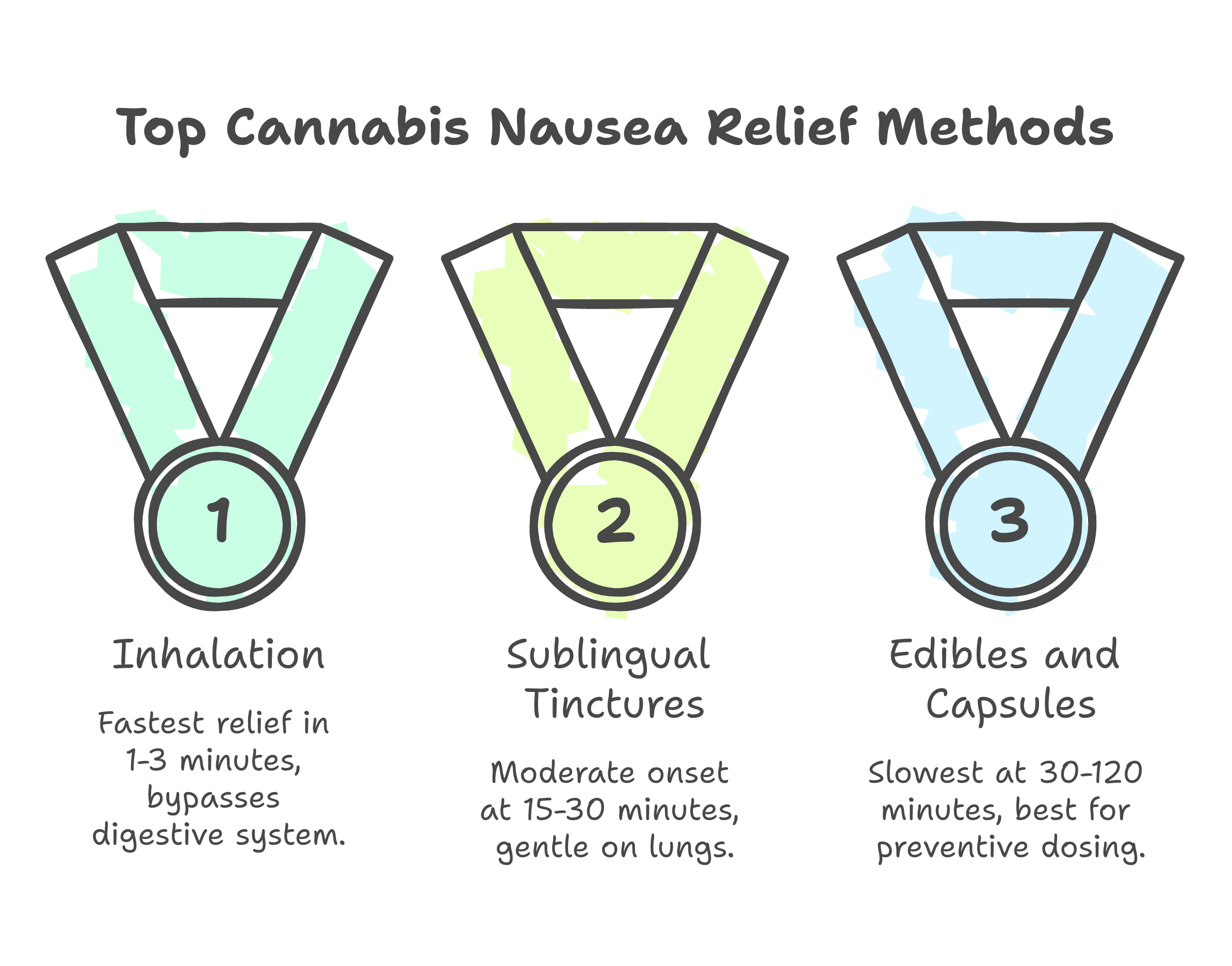
Inhalation (vaping or smoking) gives the fastest relief, usually within 1 to 3 minutes. The cannabinoids go straight from your lungs into your bloodstream, bypassing the digestive system entirely. For acute nausea episodes, this speed can make a real difference. Vaping is generally preferred over smoking because it produces fewer irritants. Check our guide to the best cannabis vaporizers in 2026 if you’re considering this route.
Sublingual tinctures and oils are a good middle ground. You place drops under your tongue and hold them for 30 to 60 seconds. Absorption starts within 15 to 30 minutes. This avoids the digestive system while being gentler on your lungs. A 1:1 THC:CBD ratio works well for most people starting out. Our cannabis tinctures guide covers the basics of selecting and using these products.
Edibles and capsules take 30 minutes to 2 hours to kick in, which makes them less ideal for sudden nausea. But they’re useful for ongoing management. If you know you’re going to feel sick later (like before a chemotherapy session), taking an edible an hour beforehand can provide sustained relief. Just keep in mind that absorption is unpredictable when your stomach isn’t working normally. For dosing advice, see our edibles dosing guide for beginners.
Topicals and suppositories are less common but worth mentioning. Cannabis suppositories bypass the stomach entirely and can provide localized relief for gut-related nausea. They’re available at some dispensaries and can be particularly helpful for patients who can’t keep anything down.
💡 Quick relief tip
If you’re too nauseous to inhale deeply, try holding a vape pen loosely and taking small, gentle puffs rather than deep draws. Even shallow inhalation can deliver enough THC to settle your stomach within minutes.
Dosing Cannabis for Nausea: Start Low, Go Slow
Getting the dose right is critical. Too little and you won’t feel relief. Too much and you might actually make the nausea worse, especially with THC. Here’s a practical starting framework based on clinical research and patient experience.
For THC, start at 2.5 mg and wait at least two hours before taking more (if using edibles or tinctures). The CannabisCINV trial used a 1:1 THC:CBD ratio at 2.5 mg each, and patients self-titrated upward over six days. Most people find their sweet spot between 5 and 15 mg of THC for nausea management.
For CBD-only products, doses tend to be higher because CBD doesn’t produce the same intensity of effect. Starting at 10 to 25 mg per dose is reasonable, with some patients going up to 50 mg or more. The advantage of CBD is that it won’t get you high, which matters if you need to function during the day. You can learn more about selecting the right strength in our CBD oil strength guide.
The ratio between THC and CBD also matters. A 1:1 ratio provides balanced relief with moderate psychoactive effects. If you want to minimize the high, go for a higher CBD ratio like 4:1 or even 10:1 CBD:THC. For patients dealing with severe CINV, a THC-dominant product may be necessary because CBD alone sometimes isn’t strong enough. Understanding the differences between full spectrum, broad spectrum, and isolate CBD can help you pick the right product for your situation.
Best Cannabis Strains for Nausea
Not every strain works equally well for nausea. Terpene profiles play a significant role alongside cannabinoid content. Here’s what to look for.
OG Kush is widely recommended for nausea because of its high myrcene content. Myrcene has its own anti-nausea properties and works synergistically with THC. OG Kush also tends to relax the stomach muscles, which helps reduce the cramping that often accompanies nausea.
Blue Dream is a hybrid that provides relief without completely knocking you out. It has a balanced terpene profile with both myrcene and pinene, giving you nausea relief while keeping you functional enough to go about your day. If daytime nausea management is your priority, this is a solid option.
Northern Lights is an indica that hits hard and fast. It’s better suited for evening use when you can afford to relax. The high THC content combined with caryophyllene (an anti-inflammatory terpene) makes it effective for nausea that comes with stomach inflammation or IBS flare-ups.
ACDC is a CBD-dominant strain with a typical ratio around 20:1 CBD:THC. If you want nausea relief without any psychoactive effects, ACDC is your best bet. It’s particularly popular among patients who need to stay clear-headed while managing their symptoms throughout the day.
Lemon Haze contains high levels of limonene, a terpene with its own anti-nausea properties. The citrus terpene profile can actually help settle your stomach before the cannabinoids even fully kick in. Some patients report that even just smelling a limonene-rich strain helps reduce the urge to vomit.
Cannabinoid Hyperemesis Syndrome: The Paradox You Need to Know About
Here’s the uncomfortable truth: cannabis can also cause nausea in some cases. Cannabinoid Hyperemesis Syndrome (CHS) is a condition that affects heavy, long-term cannabis users and causes cyclic episodes of severe nausea, vomiting, and abdominal pain. According to a study published in Current Drug Abuse Reviews, CHS is becoming more common as cannabis legalization spreads and daily use increases.
The mechanism isn’t fully understood. One theory is that chronic CB1 receptor stimulation eventually disrupts the gut-brain signaling pathway, essentially causing the opposite of the anti-nausea effect. CHS patients often report that hot showers or baths temporarily relieve symptoms, which is actually a diagnostic clue that doctors use to identify the condition.
Treatment for CHS is straightforward but not what most cannabis users want to hear: stop using cannabis. Symptoms typically resolve within one to two weeks of cessation. In acute episodes, capsaicin cream applied to the abdomen and medications like haloperidol can help. If you’re using cannabis for nausea and it seems to be getting worse rather than better, CHS might be the reason.
📝 When to suspect CHS
If you use cannabis daily and experience recurring episodes of severe nausea and vomiting that improve with hot showers, talk to your doctor about CHS. This condition resolves with cessation but can lead to serious dehydration if ignored.
Combining Cannabis with Other Anti-Nausea Approaches
Cannabis doesn’t have to be your only tool. In fact, combining it with other approaches can improve results significantly. Ginger is one of the best-studied natural anti-nausea remedies. Research from the Journal of the American Board of Family Medicine shows that ginger reduces nausea through a completely different pathway than cannabinoids, making them complementary rather than redundant.
Acupressure at the P6 (Nei Guan) point on the inner wrist has decent evidence behind it for motion sickness and post-operative nausea. Using a pressure band while also taking a low dose of CBD can cover multiple nausea triggers simultaneously. Peppermint aromatherapy is another low-risk addition, as studies from the Journal of Holistic Nursing show it can reduce nausea intensity on its own.
If you’re on prescription anti-nausea medications like ondansetron (Zofran), cannabis can often be used alongside them. However, check with your pharmacist about potential interactions, particularly with sedating medications. The combination of THC and prescription sedatives can cause excessive drowsiness. A drug interaction checker is useful if your medical team isn’t familiar with cannabis pharmacology.
Practical Tips for Using Cannabis When You Feel Sick
Timing matters. If you know nausea is coming (like before chemotherapy), take your cannabis 30 to 60 minutes before the anticipated onset. Preventive dosing is more effective than trying to stop nausea once it’s already in full swing.
Keep your environment cool and well-ventilated. Heat and strong smells can worsen nausea regardless of what medications you’re taking. If you’re vaping cannabis, do it in a well-aired room and consider a strain with mild, pleasant terpenes rather than something pungent.
Stay hydrated. Nausea and vomiting deplete fluids fast, and dehydration makes everything worse. Sip small amounts of water or electrolyte drinks between cannabis doses. Avoid carbonated beverages and anything acidic until your stomach settles.
Keep a log. Track which strains, doses, and delivery methods work best for your specific type of nausea. What works for chemotherapy-induced nausea might not be ideal for gastroparesis or motion sickness. Over time, you’ll build a personal playbook that takes the guesswork out of relief. If you want to get systematic about it, our guide to cannabis for chronic pain includes a similar tracking approach that can be adapted for nausea management.
💡 Emergency nausea kit
Keep a small kit ready: a vape pen with a 1:1 THC:CBD cartridge, ginger candies, a pressure band, and peppermint oil. Having everything within arm’s reach means you can act fast when nausea hits instead of scrambling.
Legal Considerations for Medical Cannabis and Nausea
In many jurisdictions, nausea is a qualifying condition for medical cannabis programs. The DEA still classifies cannabis as a Schedule I substance federally in the United States, but 38 states have medical cannabis programs that list nausea (particularly CINV) as a qualifying condition. In Europe, medical cannabis access varies by country, with Germany, Italy, and the Netherlands having the most developed programs according to the European Monitoring Centre for Drugs and Drug Addiction.
Greece legalized medical cannabis in 2017, though access has been limited by regulatory hurdles. Patients with qualifying conditions can get a prescription from authorized physicians. Persistent nausea from medical conditions like cancer or HIV qualifies in most medical cannabis frameworks. If you’re in Greece and interested in exploring medical cannabis for nausea, consult with a healthcare provider who specializes in cannabinoid medicine.
CBD products with less than 0.2% THC (0.3% in the US) are widely available without a prescription. For mild to moderate nausea, these may provide enough relief without requiring a medical cannabis card. However, for severe conditions like CINV, you’ll likely need products with meaningful THC content, which means going through the medical system.
Frequently Asked Questions
How fast does cannabis work for nausea?
Inhaled cannabis (vaping or smoking) provides relief within 1 to 3 minutes. Sublingual tinctures take 15 to 30 minutes. Edibles and capsules need 30 minutes to 2 hours, depending on your metabolism and stomach contents.
Can I use CBD alone for nausea, or do I need THC?
CBD alone can help with mild to moderate nausea, especially anticipatory nausea. For severe nausea from chemotherapy or gastroparesis, THC is generally more effective. A combination of both cannabinoids (1:1 ratio) tends to provide the best results based on clinical evidence.
What dose of cannabis should I take for nausea?
Start with 2.5 mg THC (or 2.5 mg THC + 2.5 mg CBD for a balanced approach). Wait at least 2 hours before increasing the dose if using edibles. For CBD-only products, start at 10 to 25 mg. Most people find effective nausea relief between 5 and 15 mg of THC.
Is cannabis safe to use for nausea during pregnancy?
Medical organizations including the American College of Obstetricians and Gynecologists recommend against cannabis use during pregnancy. While some women use it for morning sickness, THC can cross the placental barrier and may affect fetal brain development. Discuss safer alternatives with your OB-GYN.
What is Cannabinoid Hyperemesis Syndrome?
CHS is a paradoxical condition where chronic heavy cannabis use causes cyclic severe nausea, vomiting, and abdominal pain. It’s more common in daily users and resolves after stopping cannabis. Hot showers temporarily relieve symptoms. If your nausea worsens with continued cannabis use, see a doctor to rule out CHS.
Can I combine cannabis with prescription anti-nausea medication?
In many cases, yes. Cannabis and ondansetron (Zofran) work through different mechanisms and can complement each other. However, combining THC with sedating medications can cause excessive drowsiness. Always consult your pharmacist or doctor about potential interactions with your specific medications.
⚠️ Disclaimer
This article is for informational purposes only and does not constitute medical advice. The information provided about cannabis for nausea is current as of March 2026 but may change. Always consult with qualified healthcare professionals for medical advice and treatment options. Decisions about medical cannabis should be made in consultation with authorized healthcare providers who understand your specific medical history and conditions. For our full disclaimer, visit cannastoreams.gr/disclaimer.
