
Cannabis and Appetite: How THC Triggers Hunger
Learn how cannabis and appetite are linked, why THC can trigger hunger, what science says, and how to manage the munchies more responsibly.

Cannabis and appetite are tightly linked, and most regular consumers already know the effect by feel. You eat, feel full, then THC kicks in and suddenly snacks sound like a serious plan. That reaction is not random. Researchers have spent years studying how THC interacts with the endocannabinoid system, appetite hormones, reward pathways, and the senses that make food smell and taste better. The short version is simple: THC can push the brain toward hunger by activating CB1 receptors, changing hormone signaling, and making food more rewarding. The more useful question is what that means in real life, especially if you want to use cannabis intentionally instead of drifting into a late-night fridge raid.
Current research from the National Institute on Drug Abuse, clinical summaries in PubMed, and full-text papers on PubMed Central shows that cannabinoids can influence ghrelin, GLP-1, leptin, and other signals involved in hunger and satiety. That helps explain why some people use cannabis to support appetite during illness, while others try to avoid overeating by choosing different products, doses, or routines. If you have already read our guides on THC vs CBD and cannabis potency, this article connects those basics to one of the most familiar effects of THC.
📺 Video Guide
What actually causes the munchies
THC mainly works by binding to CB1 receptors, which are found throughout the brain and nervous system. Appetite control is one of the systems those receptors influence. A review indexed on PubMed explains that endocannabinoid signaling helps regulate food intake and energy balance, especially through the hypothalamus and reward circuits. When THC activates that network, hunger can feel stronger even if your stomach was not empty a few minutes earlier.
There is also a hormone angle. A controlled study published in PMC found that cannabis administration increased ghrelin and leptin while lowering PYY compared with placebo. Another human lab study in Translational Psychiatry reported higher total ghrelin during oral cannabis sessions and lower GLP-1 under cannabis than placebo. Those are not tiny details for researchers only. They help explain why THC can make you feel ready to eat, keep eating, and enjoy food more intensely than usual.
Smell and taste matter too. Animal and human research summarized by the National Academies and discussed in neuroscientific papers on PMC suggests that cannabinoids can increase the reward value of food, especially sweet or high-fat foods. That is why the munchies rarely send people toward plain lettuce. THC tends to make highly palatable food feel even more rewarding.
✓ Quick summary
- ✓ THC activates CB1 receptors linked to hunger and reward.
- ✓ Appetite hormones like ghrelin and GLP-1 can shift after cannabis use.
- ✓ Food smells better, tastes stronger, and becomes harder to ignore.
The appetite cycle, step by step
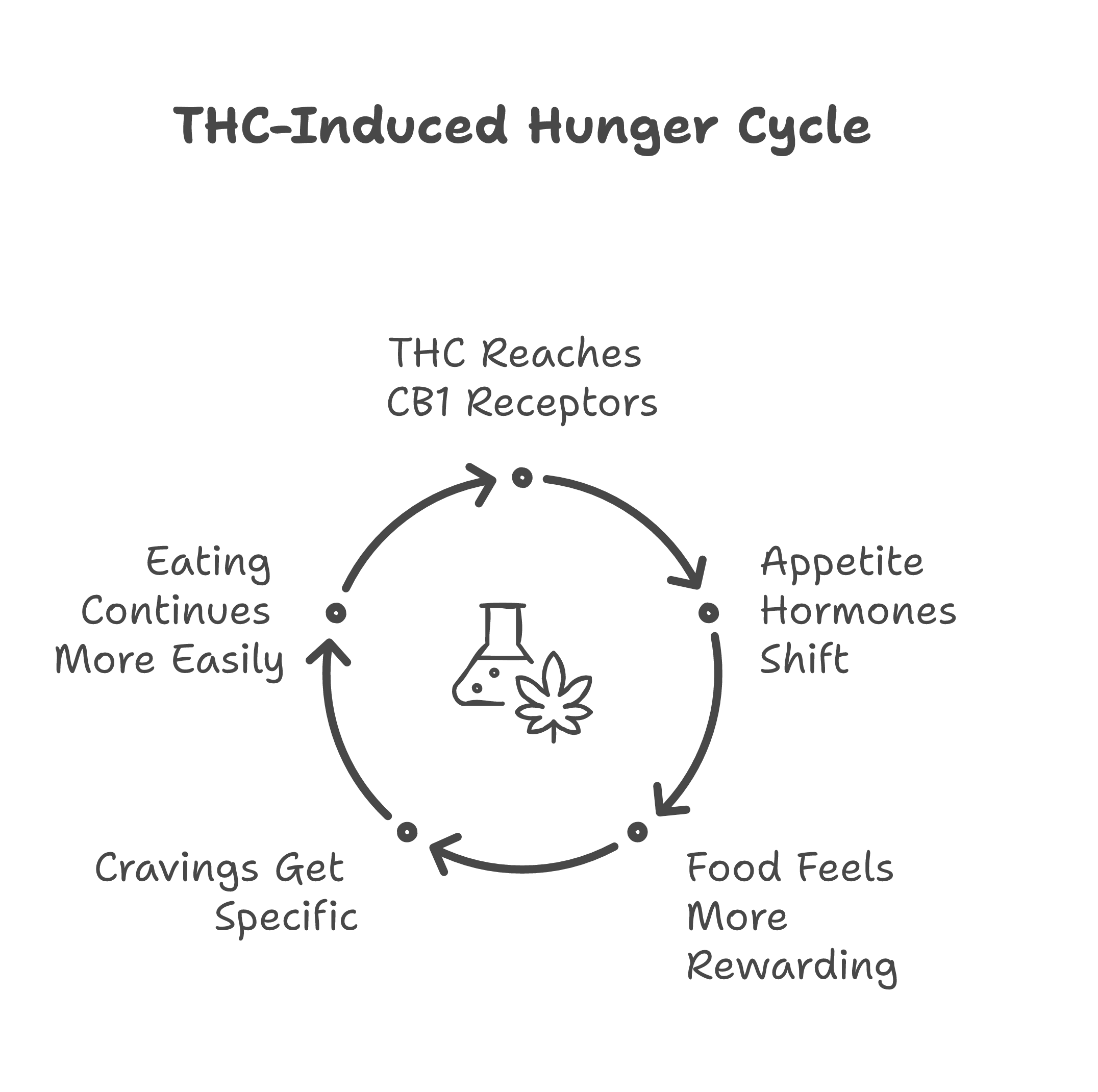
For most adults, the appetite effect follows a pretty predictable sequence. You consume THC, the onset begins, sensory awareness gets sharper, and food moves from background thought to main character. Then comes the part that catches people off guard: fullness signals can feel weaker while the reward of eating feels stronger. If you want to manage cannabis and appetite well, it helps to see the chain clearly rather than treating the munchies like magic.
Here is the practical version of that cycle:
- THC enters the system. Inhaled products usually hit faster than edibles, which is one reason edible dosing matters so much.
- CB1 receptors activate. Brain regions involved in hunger, reward, and sensory processing respond.
- Hormones shift. Ghrelin may rise while some satiety signals become less dominant.
- Food feels more tempting. Aroma, texture, sweetness, and saltiness all land harder.
- Eating becomes easier to continue. This is where dose, strain profile, setting, and snack choices make a real difference.
💡 Pro tip
If appetite support is your goal, inhaled THC often gives faster feedback. If you are trying to avoid overeating, edibles can be trickier because the delayed onset makes it easier to take too much before the hunger wave arrives.
Why some products make hunger stronger than others
Not every product drives the same appetite response. THC content is the biggest variable, but it is not the only one. Dose, route of administration, terpene mix, and the presence of cannabinoids like CBD or THCV can all shape the outcome. The NIDA overview makes the basic point clearly: cannabis products vary widely in composition, strength, and effects. That matters because people often compare one edible experience to one vape experience and assume they learned a universal rule. They did not.
High-THC products tend to produce the strongest classic munchies effect, especially when the dose rises quickly. That is one reason it is smart to understand lab results and product labels before buying. If you prefer something lighter, a balanced formula may feel more manageable. Some shoppers look at tinctures such as CBD Oil 10 10ml or Anti Stress 20 Broad Spectrum CBD Oil because they want a calmer routine without a strong THC push toward snacking.
Vapes and inhaled flower usually come on fast, which makes them easier for some users to dose in small steps. Edibles often last longer and can create a bigger mismatch between how hungry you expected to feel and how hungry you suddenly are. If you are shopping in that category, products like Delta 9 gummies deserve extra respect for dosing. A small amount can be enough. More is not automatically better unless your actual goal is appetite stimulation under medical guidance.
📝 Important note
If you are new to cannabis, start low. A dose that feels mild to an experienced user can feel very different to a beginner, especially with edibles or concentrates.
When increased appetite can actually be useful
The munchies get joked about constantly, but appetite stimulation can matter for people dealing with nausea, low appetite, treatment side effects, or unintentional weight loss. The evidence base is mixed depending on condition and product, yet appetite support remains one of the most familiar therapeutic reasons cannabinoids stay part of the medical conversation. The National Academies report and clinical papers indexed on PubMed both reflect ongoing interest in cannabinoids for appetite-related outcomes.
That does not mean self-prescribing is a smart move. It means cannabis and appetite deserve a more serious conversation than lazy stoner stereotypes. Some adults use cannabis because eating feels difficult without it. Others need to protect appetite during rough periods. In those contexts, the question is not whether hunger increases. The question is whether the effect is reliable, safe, and appropriate for that person. If you are dealing with chronic symptoms, it is worth reading broader research like our article on cannabis for nausea and then discussing options with a qualified clinician.
The FDA is far more cautious than internet wellness culture on this topic. Its consumer guidance on products containing cannabis or cannabis-derived compounds focuses on safety, product quality, and unapproved claims. That is a useful reminder. Cannabis can change appetite, but that does not give every product a free pass to pretend it is medicine.
How to manage the munchies without killing the experience
If you like cannabis but hate mindless overeating, the fix is usually behavioral, not heroic. Set up food before you consume. Drink water first. Choose products with a manageable THC level. Avoid dosing when you are already exhausted and standing two feet from a delivery app. This is one of those areas where being slightly boring upfront saves you from being ridiculous later.
Good appetite management usually comes down to planning:
- Eat a balanced meal before consuming if your goal is relaxation, not hunger.
- Keep portioned snacks ready so the first decision is not made while high.
- Pick lower doses and wait before redosing, especially with edibles.
- Track patterns in a simple note so you learn which products trigger the strongest appetite.
- Choose slower, intentional formats like tinctures when you want more control.
There is also a product-education layer here. People who understand labels, potencies, and cannabinoid ratios usually manage cannabis and appetite better than people who buy on vibes alone. If you want a refresher, our pieces on CBD gummies vs oil and cannabis tinctures are useful follow-ups.
💡 Pro tip
Protein, fiber, fruit, yogurt, popcorn, and nuts hold up better than ultra-processed snacks if you know appetite tends to spike. You still get the pleasure, just with less regret.
What the science still does not fully answer
Research on cannabis and appetite is real, but it is not complete. Human studies are still relatively small, product types vary a lot, and older cannabis research often does not reflect the strength or formulation of current commercial products. Reviews on PubMed and mechanistic work in PNAS show how fast the biology is moving. The practical takeaway is that we understand the general pathway well enough to explain the munchies, but not well enough to predict every person’s response with precision.
That is also why broad claims like “CBD always stops appetite” or “sativa makes you snack less” should raise an eyebrow. Sometimes those claims are based on a grain of truth. Sometimes they are just store talk wearing a lab coat. Your route of use, body weight, tolerance, sleep, recent meals, and setting can all shift the result.
So yes, cannabis and appetite are linked by real biology. But the cleanest way to use that knowledge is practical: understand the mechanism, buy smarter, dose with intent, and notice your own patterns. That approach beats guessing every time.
⚠️ Disclaimer
This article is for informational purposes only and does not constitute medical advice. Information about cannabis products and research is current as of April 2026 and may change. Always consult a qualified healthcare professional before using cannabis for appetite loss, nausea, or any medical condition. For our full disclaimer, visit cannastoreams.gr/disclaimer.
Frequently asked questions
Why does cannabis make food taste better?
THC can increase the reward value of food and sharpen sensory response, especially smell and taste. That makes familiar foods feel more appealing than usual.
Do all cannabis products increase appetite?
No. THC-rich products are most likely to increase appetite, while lower-THC or CBD-heavy products may feel different. Dose and route matter a lot.
Can cannabis help people who struggle to eat enough?
It can support appetite in some cases, but that should be treated as a medical conversation, not a casual assumption. Safety, product quality, and personal health history matter.
How can I avoid overeating after using THC?
Eat beforehand, keep portions ready, start with a lower dose, and avoid impulse buying food while high. Planning solves more of this problem than willpower does.
Is the appetite effect stronger with edibles or smoking?
Smoking or vaping usually starts faster, while edibles often last longer and can feel stronger if the dose is high. Many people find edibles harder to control.
