Greece’s Proposed Cannabis Law 2026: What Articles 40-49 Mean for CBD, Hemp Flower, and Retail
Greece cannabis law 2026 could ban retail hemp flower while licensing cannabis-product shops. See what Articles 40-49 mean for CBD and business.

Greece cannabis law 2026 is suddenly a topic that matters far beyond Greece. A draft Ministry of Health bill published for public consultation on OpenGov Greece on April 11, 2026 would redraw the line between what hemp and CBD businesses may sell to consumers, what must stay in the industrial supply chain, and how retail cannabis products would be licensed and supervised. For international readers, the headline is simple: the proposal would ban retail dried hemp flower for consumers in Greece, while at the same time formally defining cannabis products, creating licensed cannabis-product retail stores, and raising the industrial hemp THC threshold from 0.2% to 0.3%.
That combination makes this proposal more nuanced than a simple crackdown. It narrows one category very sharply, but it also creates a more explicit framework for compliant CBD and low-THC commerce. If you are a consumer, retailer, importer, processor, manufacturer, investor, or policy watcher, Articles 40 to 49 are the part worth reading closely. The consultation page itself sits on the Greek government’s public consultation portal, opengov.gr, and it specifically amends Law 4139/2013, the main Greek narcotics framework, plus related medical cannabis provisions.
What the draft law is trying to do
The proposed chapter covers tobacco products, medical cannabis, and cannabis products in one legislative package. The cannabis-specific changes do three things at once. First, they update technical definitions in Greek law, including the THC threshold for industrial hemp. Second, they separate consumer retail from industrial processing by saying dried flower up to 0.3% THC cannot be sold to the public in Greece. Third, they create a dedicated retail model for lawful cannabis products, backed by licensing, registration, inspections, and penalties.
This structure looks less like full liberalization and more like market channeling. Greece appears to be saying: compliant cannabis-derived products can exist, but retail must be controlled, flower for consumers is out, and the state wants traceable businesses with clear enforcement tools. That approach lines up with the broader compliance-heavy style seen in official Greek health regulation and with the role of the National Organization for Medicines (EOF) in product oversight.
✓ Key takeaway
- ✓ Retail hemp flower would be banned for consumers in Greece
- ✓ The industrial hemp THC ceiling would move from 0.2% to 0.3%
- ✓ CBD and other lawful cannabis products would enter a more formal retail regime
- ✓ Retailers would need dedicated stores, licensing, registry entry, and strict compliance
Article 41 is the pivot point: dried flower is the main loser
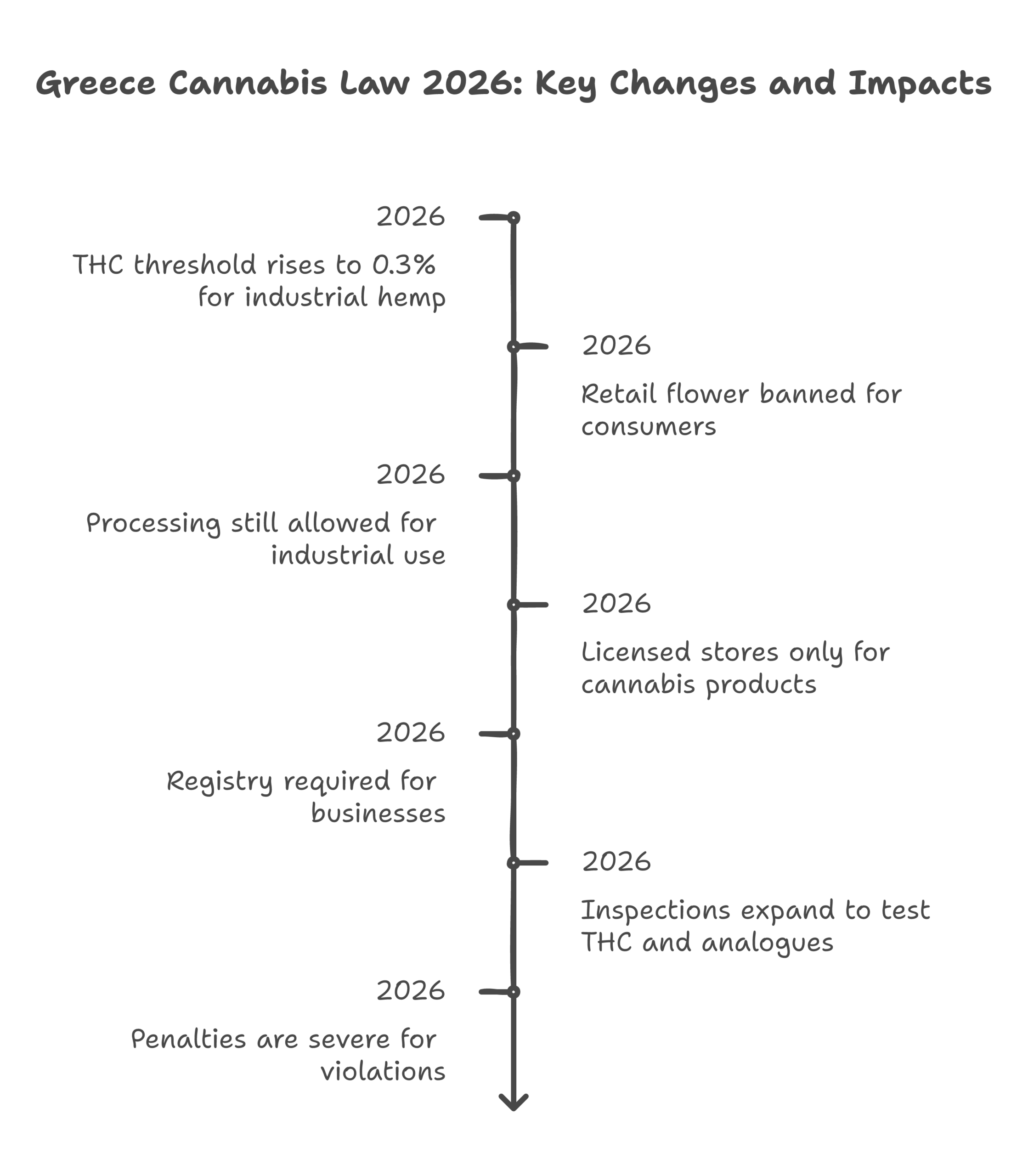
If you remember only one article, remember Article 41. The draft raises the THC threshold for industrial hemp in Greek law from 0.2% to 0.3%, which matters because it brings the domestic rule closer to the threshold many businesses already use as a benchmark in European trade discussions. But the same article then draws a hard distinction: dried flower derived from Cannabis sativa L. with THC up to 0.3% would no longer be treated as a raw harvested agricultural product when it is intended for retail sale to consumers.
The draft wording is unusually direct. It says dried flower intended for retail sale, circulation, and availability to the consumer public is not protected by the exemption for harvested raw products. It then imposes a blanket ban on retail sale, distribution to consumers, purchase, and use by consumers inside Greece, whether the flower is processed or unprocessed. That is why businesses selling smokable or vapable hemp flower in the Greek consumer market should treat this proposal as a material legal threat, not a minor labeling update.
This matters especially because hemp flower has often occupied a grey or contested space in Europe. In Greece, prior discussion around CBD, hemp, and semi-synthetic cannabinoids has already been tense, as reflected in earlier coverage such as Greece Bans THCP: New Cannabis Regulations Explained, Future of Hemp Regulations in Greece: What to Expect, and Hemp vs Cannabis CBD: Greek Consumer Guide 2025.
📝 Important Note
The draft does not ban all movement of dried flower. It specifically carves out import, storage, wholesale distribution, and transport of dried flower that is intended exclusively for industrial processing, such as cosmetics, foods, or food supplements.
What remains allowed under the proposal
The easiest mistake is to read Article 41 and assume Greece is trying to eliminate the legal cannabis-products market. That is not what the draft says. Article 44 creates a formal definition of “cannabis products,” covering products with THC up to 0.3% derived from Cannabis sativa L. or products containing CBD. That means Greece is not closing the entire category. It is redefining which product formats belong in lawful retail and which do not.
So what appears to remain allowed, if the draft passes and if the products also satisfy the rest of Greek and EU product rules? CBD oils, cosmetics, supplements, some ingestibles where authorized, and other compliant low-THC or CBD formats would still have a route to market. The draft also preserves business-to-business handling of dried flower when the end use is industrial transformation rather than consumer sale. That distinction is crucial for manufacturers sourcing biomass or flower for extraction, ingredients, or downstream product manufacturing.
For consumers trying to understand the practical line, think of it this way: Greece seems prepared to allow regulated products, but not loose dried flower sold as a retail wellness or smoking item. That is a major shift for businesses built around CBD flower jars, pre-roll style retail, or flower-focused tourism assumptions. It also means products like CBD Oil 20 Full Spectrum 10ml, Anti Stress 20 Broad Spectrum CBD Oil, or a lawful vaporizer device such as Herb Vaporizer fit the new structure far better than retail hemp flower does.
💡 Pro Tip
If you import into Greece, split your risk map into two channels immediately: consumer retail SKUs and industrial-processing inputs. The draft treats them very differently.
Articles 45 to 47 create a new retail model, not a free-for-all
Article 45 introduces “cannabis product enterprises” as dedicated retail businesses for lawful cannabis products. This is important because it suggests Greece does not want these products sold casually through any outlet that feels like stocking them. The stores must be independent, specially configured premises, and they must be at least 500 meters away from preschool, primary, and secondary school facilities. That distance rule will matter a lot in dense urban areas where viable storefronts can vanish fast.
These licensed stores may also sell certified medical cannabis vaporization devices that have been notified to EOF. That is a small line in the text, but commercially it matters. It suggests the Greek state is comfortable with a controlled overlap between wellness retail and the infrastructure around legal medical cannabis consumption devices, provided the products are certified and properly notified.
Article 46 then sets the licensing route through the competent Regional Authority. Applicants must provide corporate documents, a recent representation certificate, solvency documentation, tax and social security clearance, identity documents, criminal-record extracts, and a formal declaration that the products do not contain psychoactive analogues of Δ9-THC or CBD. That analogue language matters because Greece has already moved against certain synthetic or semi-synthetic cannabinoids, and the text explicitly connects retail authorization to that risk control logic. You can compare this compliance emphasis with public-facing frameworks hosted on gov.gr and with the consultation system itself, which shows the government is trying to push oversight into auditable digital channels.
The 60-day licensing deadline is not as friendly as it sounds
On paper, Article 46 gives the Regional Authority 60 working days to grant the operating licence. In practice, the more important line is the one after that: if the deadline passes without a decision, the result is a deemed refusal, not an automatic approval. That means silence works against the applicant. Businesses planning to enter the Greek market should budget for active follow-up, document quality, and possible delay rather than assuming the clock alone protects them.
That “silent refusal” model is especially relevant for foreign operators used to more permissive administrative systems. If your business model depends on fast storefront activation, this proposal raises execution risk. It also increases the value of local legal and compliance support, because a weak file or incomplete declaration could easily turn a two-month process into a dead end.
✓ What retailers should prepare now
- ✓ Reclassify flower-based SKUs as high-risk for Greek consumer retail
- ✓ Review store locations against the 500-meter school buffer
- ✓ Confirm tax, insurance, and solvency documents are current
- ✓ Audit formulas for psychoactive analogues or questionable derivatives
- ✓ Prepare for registry publication and inspection visibility
Digital registry, public visibility, and enforcement get much stronger
Article 47 establishes a Digital Registry of Cannabis Product Enterprises under the Ministry of Health, accessible through gov.gr. Registration is mandatory. Businesses that are not registered may not sell these products, and the draft allows registry information to be published publicly for transparency and public information. In plain English, Greece is building a visible compliance perimeter. If you are in, you are documented. If you are out, your legal footing collapses fast.
Article 48 adds inspection authority for EOF, the police, and mixed enforcement teams. The law expressly allows testing of product composition for THC levels and for psychoactive analogue molecules. That is a big signal to importers and white-label brands. It is no longer enough to rely on supplier assurances or generic certificates from another market. Documentation, batch testing, and Greek-specific compliance files become central survival tools.
Article 49 turns non-compliance into a serious business risk
The penalty section is brutal enough that no serious operator should treat it as background noise. Violating the licence terms or operating conditions can trigger a €100,000 fine and a six-month licence suspension. Selling unauthorized cannabis products can trigger a €100,000 fine and imprisonment of up to five years. That is not a symbolic compliance regime. It is a market-shaping deterrent.
For investors and partners, Article 49 changes diligence. Anyone looking at Greek cannabis retail now needs to ask not just whether demand exists, but whether the operator can survive documentary scrutiny, inspection, and product testing. Businesses selling borderline formulas, imported flower, or products that lean on legal ambiguity are exactly the ones this framework seems designed to squeeze out.
📝 Important Note
The draft is still under consultation until April 27, 2026. Businesses should not assume every clause will survive unchanged, but they should absolutely plan as if regulators are signaling their intended direction.
Medical cannabis becomes administratively easier
Articles 42 and 43 matter less for general retail, but they matter a lot for manufacturers and medical cannabis operators. The proposal cuts EOF fees for amending or renewing medical cannabis authorizations, including export-only production licences, from €2,500 per dossier to €500, plus €50 per additional form or strength. That is a substantial reduction in administrative friction.
Seen together with the retail provisions, the message is interesting. Greece is tightening control over low-THC consumer flower, while making the medical cannabis industrial pathway cheaper to maintain. That does not mean Greece is suddenly opening the market wide, but it does suggest policymakers see regulated medical production and export as legitimate economic activity worth supporting. For background on Greece’s medical framework, official context is available through the EOF, while broader market commentary has been covered by Business of Cannabis, Prohibition Partners, and prior local analysis such as Medical Cannabis Greece: Laws, Prescriptions & Access.
For businesses comparing channels, that means the medical route and the consumer wellness route may diverge even more sharply. One becomes more formalized and potentially more investable, while the other becomes more selective and less tolerant of flower-based loopholes.
What this means for different market participants
For consumers: the biggest impact is straightforward. If the law passes as drafted, buying low-THC hemp flower for personal use in Greece would no longer be lawful, even when the flower stays at or under 0.3% THC. Consumers would need to look to other lawful product categories and should be wary of any seller claiming the draft changes nothing.
For retailers: a compliant future likely means dedicated stores, documented supply chains, analogue-free product ranges, and strong recordkeeping. Generalist shops and flower-first operators are the most exposed. Retailers may want to pivot toward oils, topicals, accessories, and device categories already supported by educational content such as Cannabis Tinctures Guide, How to Read Cannabis Lab Reports, and Cannabis Vape Safety Guide 2025.
For importers and wholesalers: the carve-out for industrial processing is the most important operational detail. Imports of dried flower intended exclusively for processing into lawful end products appear to remain possible, but retail leakage becomes far more dangerous. Chain-of-custody controls, processing documentation, and customer classification will matter much more.
For processors and manufacturers: the proposal may actually create opportunity. If consumer flower exits the retail stage while extraction and transformation remain lawful, processors capable of converting raw material into compliant cosmetics, supplements, and other authorized products may gain relative advantage. Businesses that can prove formulation quality through testing standards aligned with public scientific sources such as PubMed, NCBI, and product-safety guidance from authorities like the U.S. FDA will be better placed to withstand scrutiny.
International context matters, but Greece is making its own choice
It is tempting to compare this proposal with broader European conversations around hemp thresholds, CBD trade, and novel products. Some European industry groups, such as the European Industrial Hemp Association, have advocated for more flexible hemp rules, and EU institutions continue to shape the treatment of foods, cosmetics, and health claims through frameworks like the General Food Law Regulation and the EU Novel Food Catalogue. But Greece is not simply copying a pan-European template here.
The proposal is distinctly Greek in its structure: specific retail geography limits, a gov.gr registry, EOF-linked oversight, and a sharp line between consumer flower and industrial input. That means foreign operators should resist lazy assumptions based on another country. What works in Germany, Switzerland, Malta, or a U.S. hemp market does not automatically work in Greece. Local law wins.
In that sense, the best comparison is not ideological but operational. Greece seems to be designing a system that is legible to health authorities, easy to inspect, and hard to game with borderline flower products or psychoactive analogue innovation.
Bottom line for 2026
Greece cannabis law 2026, if enacted in its current form, would do something many markets struggle to do cleanly: it would tell businesses exactly which side of the line they sit on. Consumer hemp flower loses. Licensed cannabis-product retail gains structure. Medical cannabis administration gets cheaper. Industrial processing remains alive. Enforcement becomes much sharper.
For international audiences, that makes Greece worth watching. It is not moving toward an anything-goes hemp market. It is moving toward a narrower, more supervised, and more document-heavy system. Some businesses will hate that. Others will quietly realize it creates a more stable playing field for compliant operators.
Until the consultation closes and final text appears, caution is the smart posture. But if you sell dried hemp flower into Greece’s consumer channel, the writing is already on the wall.
⚠️ Disclaimer
This article is for informational purposes only and reflects a draft law under public consultation as of April 2026. It is not legal or medical advice. Final wording, enforcement practice, and secondary rules may change. Always consult qualified Greek legal, tax, regulatory, and healthcare professionals before making commercial or personal decisions.
Frequently Asked Questions
Does the draft ban all CBD products in Greece?
No. The proposal defines cannabis products to include lawful low-THC products up to 0.3% THC and products containing CBD. The main target is dried flower sold to consumers, not every CBD format.
Would hemp flower still be allowed for industrial processing?
Yes, according to the draft. Import, storage, wholesale distribution, and transport of dried flower remain allowed when the flower is intended exclusively for industrial processing into products like cosmetics, foods, or supplements.
What kind of shops could legally sell cannabis products if the law passes?
Dedicated licensed cannabis-product enterprises. They would need to operate from independent stores, keep a 500-meter distance from schools, obtain a Regional Authority licence, and register in the Ministry of Health digital registry.
How severe are the penalties for breaking the proposed rules?
Very severe. The draft sets a €100,000 fine and six-month licence suspension for certain violations, and unauthorized cannabis-product sales can also trigger imprisonment of up to five years.
Is the law already in force?
No. As of April 2026, this is draft legislation published for public consultation. Businesses should monitor the consultation outcome, any revisions, and the final enacted text before treating any rule as settled law.
