
How to Make Cannabis Butter at Home
Learn how to make cannabis butter at home with safe decarbing, dosing tips, storage advice, and a beginner-friendly step-by-step method.

Making cannabis butter at home sounds simple, but the difference between a clean, reliable batch and a bitter, unpredictable one comes down to a few small details. You need the right heat, enough patience, and a realistic idea of potency. If you rush the process or guess on dosing, the final butter can be far stronger than expected. That is why it helps to combine practical kitchen technique with the safety guidance published by the FDA, the delayed-effect warnings described by the National Institute on Drug Abuse, and the basic public-health advice collected by the CDC.
This guide walks through a beginner-friendly stovetop method, explains why decarboxylation matters, shows how to estimate strength without pretending home dosing is laboratory precise, and covers storage, serving size, and common mistakes. If you are completely new to infused foods, read this alongside our Cannabis Edibles Dosing Guide for Beginners before you cook.
📺 Video Guide
What cannabis butter actually is
Cannabis butter, often called cannabutter, is regular butter infused with cannabinoids and aromatic compounds from cannabis flower. People use it as a base for brownies, cookies, sauces, toast, or any recipe that already contains fat. Butter works because cannabinoids are fat-soluble, which means they bind far more effectively to fat than to water. Practical recipe guides from Leafly, Weedmaps, and Cannigma all describe the same core workflow: decarboxylate the flower, infuse it gently in butter, then strain.
The part that catches beginners off guard is that homemade butter is never perfectly standardized. Even if a product label looks clear, small differences in flower potency, oven accuracy, grind size, infusion time, and straining can shift the final result. That is why homemade edibles should be treated with more caution than smoked or vaped cannabis. Effects take longer to show up, and people often make the classic mistake of eating more before the first portion has fully kicked in.
✓ Key benefits of doing it properly
- ✓ Better flavor because low heat reduces burnt or grassy notes
- ✓ More consistent cannabis butter strength from batch to batch
- ✓ Safer edible use because you can portion and label servings clearly
Decarboxylation is the step you should not skip
Before cannabis can meaningfully infuse butter for most psychoactive edibles, the flower usually needs to be heated first. This process, called decarboxylation, converts THCA into THC. That is the chemistry behind why raw flower in butter is not the same as properly activated flower in butter. A detailed open-access review at PMC and a cannabinoid stability paper from the National Research Council Canada both show that heat, time, and storage conditions matter a lot for cannabinoid conversion and degradation.
In plain English, too little heat can leave your batch weak, while too much heat can degrade cannabinoids and flatten flavor. For a home oven, a practical range is around 220 to 245°F for roughly 30 to 40 minutes, with light stirring once or twice for even exposure. Some cooks go a little lower and slower. The exact sweet spot varies by material and equipment, so think of these numbers as a workable home range rather than a universal law.
If you already read our guide to cannabis lab results, the logic is similar: you want to respect the numbers, but you also want to respect the limits of real-world kitchen conditions.
💡 Pro tip
Use an oven thermometer if you have one. Home ovens drift more than people think, and that alone can explain why one batch of cannabis butter feels far stronger or weaker than the last.
What you need before you start
A beginner batch of cannabis butter does not require fancy equipment. You need cannabis flower, unsalted butter, water, a baking tray, parchment paper, a saucepan or double boiler, a wooden spoon, a fine mesh strainer or cheesecloth, and a glass jar or container for storage. If you hate guesswork, add a kitchen scale and a thermometer.
For a simple first run, start with 7 to 10 grams of flower and 1 cup of unsalted butter. That is enough to learn the workflow without making a huge batch you might regret. If you want a more controlled edible experience, you may decide that store-bought, measured alternatives such as CBD oil 10%, delta-9 gummies, or THC-P strips fit you better than homemade edibles. That is a perfectly reasonable call.
If you do want to cook, keep the rest of the recipe plain on your first attempt. Do not stack cannabis butter into a dessert loaded with alcohol, extra concentrates, or mystery serving sizes. Simple is smarter here.
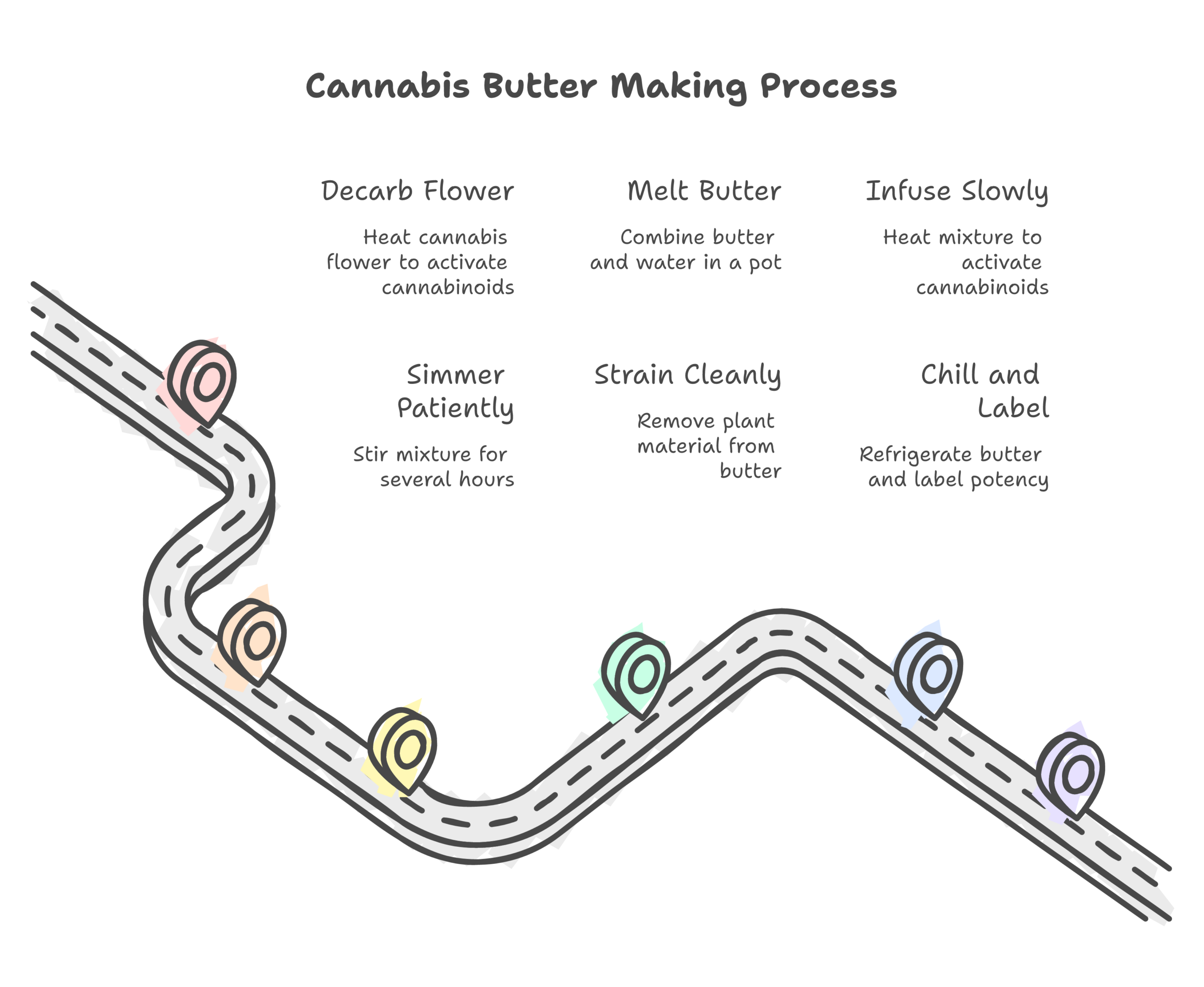
How to make cannabis butter step by step
Step 1: Break up the flower. Use your fingers or a grinder to break the cannabis into small, even pieces. Do not powder it into dust. A medium grind gives you enough surface area without making straining a nightmare.
Step 2: Decarboxylate. Spread the flower on parchment paper and bake it at roughly 230 to 240°F for about 35 minutes. Stir once halfway through. You want dry, lightly toasted flower, not charred bits. Practical decarb explainers from Cannigma and recipe walkthroughs from Leafly align on the bigger point: steady heat matters more than kitchen bravado.
Step 3: Melt the butter with water. Add 1 cup of unsalted butter and 1 cup of water to a saucepan on very low heat. The water helps buffer the temperature and reduces the chance of scorching the milk solids in the butter.
Step 4: Add the decarboxylated cannabis. Stir the flower into the melted butter and keep the mixture between roughly 160 and 180°F if you can. A gentle simmer is fine. A hard boil is not.
Step 5: Infuse slowly. Let it cook for 2 to 3 hours, stirring occasionally. This is where people get impatient. Do not. Low heat and time are doing the work for you.
Step 6: Strain. Pour the mixture through cheesecloth or a fine mesh strainer into a heat-safe container. Press gently if you want, but squeezing too aggressively can push bitter plant material into the butter.
Step 7: Chill and separate. Refrigerate the container until the butter firms up. If water pooled underneath, drain it off once the butter solidifies. Label the jar clearly so nobody mistakes it for ordinary butter.
📝 Important note
If your kitchen smells strong, your batch is not automatically ruined. Smell tells you aromatic compounds are moving around. Burnt smells, dark brown butter, or visible boiling are the real signs that your heat is too high.
How to estimate strength without fooling yourself
Here is the rough math. If you use 7 grams of flower at 20% THC, that is 1,400 milligrams of THC in theory before losses. Real extraction is never perfect, so the usable amount in your cannabis butter will be lower. Divide the estimated total by the number of tablespoons in your final batch, and you get a rough milligrams-per-tablespoon figure. Rough is the key word. It is an estimate, not a lab certificate.
That uncertainty is exactly why beginner edible dosing should stay conservative. NIDA notes that edible effects can arrive later than inhaled cannabis, and public-health agencies keep repeating that people often overconsume because they think the first dose did nothing. If you want a fuller primer, our guide to cannabis and appetite explains why ingesting THC can feel different from smoking it, especially once the effect curve stretches out over time.
A sensible first serving is a very small amount of cannabis butter in food, followed by a long wait. Think in fractions of a teaspoon if you do not know your potency. That sounds annoyingly cautious. It is still the right move.
Common mistakes that ruin cannabis butter
The first big mistake is skipping decarboxylation. The second is overheating the infusion. The third is treating homemade edibles like ordinary baking ingredients and forgetting they may hit much later and much harder than expected. The FDA has repeatedly warned about accidental ingestion and mislabeled cannabis food products, especially products that look like regular snacks. Their alert on THC foods that children may mistake for normal treats is worth reading before you leave infused butter in a shared fridge.
Another common mistake is poor storage. Butter picks up odors and degrades faster when it is loosely wrapped or forgotten at the back of a warm kitchen. If you already have flower at home, our guide on how to store cannabis properly gives you the same broader lesson: cool, dark, sealed, and labeled beats casual every time.
One more thing: do not hand homemade cannabis butter to friends and casually say, “just try some.” If you made it, you are responsible for explaining what is in it, how strong it may be, and why the effects could take a while.
Storage, labeling, and legal caution
Store cannabis butter in an airtight container in the fridge for short-term use or freeze portions for longer storage. Label the container with the preparation date, the strain or product used if known, and a clear warning that it contains cannabis. If there are children or guests in the home, locked storage is the grown-up move. Pediatric exposure data discussed in this review on cannabis edible toxicity show why public-health people keep hammering this point.
For emergency guidance, keep the Poison Help resource handy. Even experienced consumers can underestimate homemade edible strength. If someone has severe confusion, repeated vomiting, chest pain, trouble breathing, or cannot be woken normally, do not try to play hero in the kitchen. Get medical help.
Legality matters too. Rules around cannabis products, THC limits, and home preparation differ by country and region. For Greece-specific context and broader compliance thinking, keep an eye on the legal framing across our site and do not assume that because a method is common online it is automatically risk-free where you live.
⚠️ Disclaimer
This article is for informational purposes only and does not constitute medical or legal advice. Information is current as of April 2026, but product rules, THC limits, and local enforcement can change. Always check local law, keep cannabis butter away from children and pets, and speak with a qualified healthcare professional if you have questions about drug interactions, pregnancy, underlying health conditions, or safe edible use. For our full disclaimer, visit cannastoreams.gr/disclaimer.
When homemade butter is not the best choice
Sometimes the smartest answer is not another DIY project. If you want easier dosing, lower smell, less prep, or less variability, homemade cannabis butter might not be for you. Ready-made products, clearly labeled oils, or even taking a break from edibles altogether may fit better. That is not boring. That is just honest.
This is also a good moment to check your own pattern. If your tolerance is climbing and every recipe becomes an excuse to chase a heavier effect, read our guide on managing cannabis tolerance. Better technique in the kitchen will not solve every relationship you have with cannabis.
Still, if you approach it with patience, labeling, and conservative dosing, cannabis butter can be a useful base for homemade edibles and savory recipes. Just do not confuse “homemade” with “easy to dose perfectly.” That is where people get humbled.
Frequently Asked Questions
How long does cannabis butter stay good in the fridge?
A tightly sealed batch of cannabis butter usually keeps for a few weeks in the fridge. For longer storage, freeze portions and label them clearly.
Can I make cannabis butter without decarboxylation?
You can infuse raw flower into butter, but the result will usually be much less effective for THC-focused edibles because decarboxylation activates the cannabinoids first.
Why did my cannabis butter turn out weak?
The most common reasons are weak starting material, under-decarboxylation, short infusion time, or overestimating how much THC actually moved into the butter.
How much cannabis butter should a beginner eat?
Very little at first. If potency is unknown, start with a fraction of a teaspoon in food and wait long enough before taking more.
Can I use cannabis butter in savory food instead of desserts?
Yes. Cannabis butter can go into sauces, pasta, mashed potatoes, or toast. Savory recipes are often easier for portion control because you are not tempted to treat them like candy.
