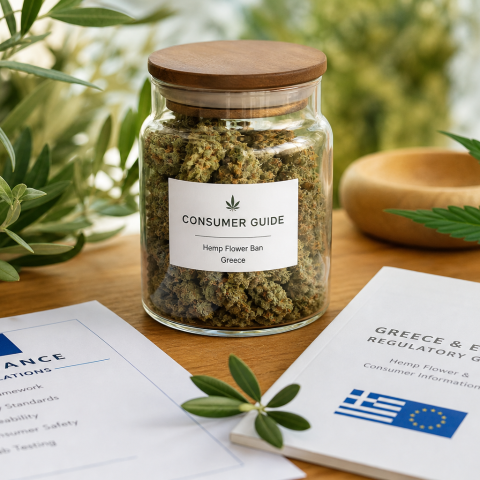
The hemp flower ban Greece debate is not a simple story about cannabis becoming stricter or looser. It is a more awkward regulatory split: Greece appears to be aligning industrial hemp with the European Union’s 0.3% THC threshold while also trying to remove consumer-facing dried hemp flower from ordinary retail shelves. For adults who buy CBD flower, CBD oil, legal hemp products, or wellness accessories in Athens, that distinction matters because a product can be low-THC and still face a specific retail restriction.
The practical question is not whether every hemp product disappears. It is which product formats remain available, who is allowed to sell them, what documentation shoppers should expect, and how EU law might shape the final result. This guide gives a consumer-friendly explanation of the proposed Greek rule, how it fits with the European Commission’s hemp framework, and what responsible buyers should check before purchasing any cannabis wellness product in June 2026.
⚠️ Disclaimer
This article is for informational purposes only and does not constitute legal or medical advice. The information about hemp flower and medical cannabis in Greece is current as of June 2026 but may change as legislation, ministerial guidance, and EU case law develop. Always consult qualified legal, medical, or regulatory professionals for advice about your situation. For our full disclaimer, visit cannastoreams.gr/disclaimer.
Hemp Flower Ban Greece: What Is Being Proposed?
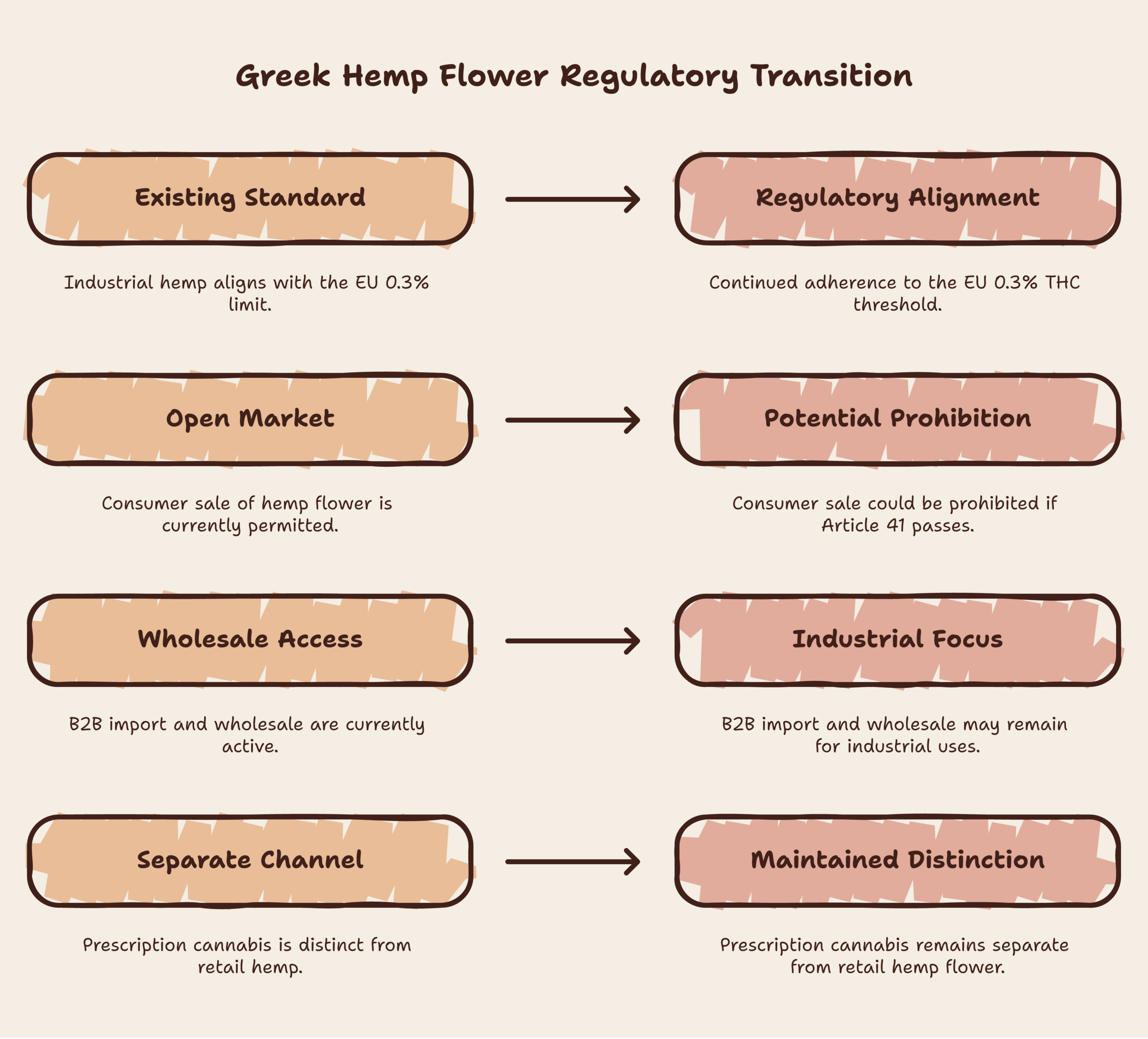
The key development is Article 41 of a Greek health bill reported in May 2026. According to specialist coverage by Business of Cannabis, the proposal would raise the industrial hemp THC threshold from 0.2% to 0.3%, but it would also redefine dried hemp flower intended for retail sale so that it no longer qualifies as a normal raw harvested hemp product. That is the regulatory twist. The THC number moves closer to Europe, while the flower format becomes more restricted for consumers.
If adopted as described, retail sale, distribution, purchase, and consumer use of dried hemp flower in Greece could be prohibited even when the flower comes from Cannabis sativa L. and stays at or below the 0.3% THC limit. Import, storage, or wholesale activity may still be possible when the flower is destined for industrial processing into other formats. In plain English: a processor may still handle compliant hemp as raw material, but a shop may not be allowed to sell dried CBD flower directly to an adult consumer.
That matters for people who have followed older consumer guides on hemp flower in Greece, CBD hash in Greece, or medical cannabis access. The same plant family can fall into different legal channels depending on THC level, intended use, product format, medical status, and supply chain documentation.
💡 Pro Tip
Do not judge a product only by the phrase “under 0.3% THC.” In Greece, the product category, seller licence, lab report, and intended use may matter as much as the THC percentage.
Why the 0.3% THC Limit Matters
The 0.3% threshold is not random. Under the reformed Common Agricultural Policy, EU hemp farmers can receive support only when cultivating certified varieties with THC below 0.3%, as explained by the European Commission. This replaced the older 0.2% reference point for CAP-eligible hemp varieties from 2023 onward. It is an agricultural threshold, not a universal permission slip for every finished consumer product.
That distinction is where many shoppers get confused. A farmer may grow a compliant hemp variety. A laboratory may show that a raw flower sample sits below the EU threshold. A processor may use hemp biomass in cosmetics or another regulated product. None of that automatically proves that dried flower can be sold loose to consumers in every EU country. National product rules, narcotics laws, food rules, cosmetics rules, and public health restrictions still have to be considered.
For Greek consumers, the safest reading is this: the 0.3% alignment is helpful for industrial hemp cultivation and cross-border consistency, but the proposed retail flower restriction is a separate policy choice. Anyone comparing flower, oil, gummies, vapes, or topical products should treat each format as its own compliance question. If you use CBD oils, start with transparent products such as CBD Oil 10 10ml or compare formats through our CBD edibles vs oil guide before assuming flower rules apply the same way.
What Changes for Consumers and Retailers
If the Greek proposal becomes law without meaningful amendments, the most direct impact would fall on retailers that sell CBD flower as a finished consumer product. Shops would need to check whether dried flower can be displayed, marketed, supplied, or sold at all. Consumers would need to avoid assuming that a familiar product remains lawful simply because it was available before the legislative change.
Other hemp-derived formats may remain more viable, but they are not unregulated. CBD extracts intended for food or supplements are shaped by the EU Novel Food framework. The European Commission’s Novel Food status catalogue treats cannabinoids such as CBD as novel in many food contexts, while the European Food Safety Authority has said CBD safety evaluations remain on hold because of data gaps. Cosmetics, topicals, and non-ingestible wellness products follow different rules again.
Retailers also face a trust problem. When rules change, low-quality sellers often try to blur categories: “aromatic use only,” “souvenir,” “not for consumption,” or vague lab claims. Responsible shops should do the opposite. They should provide clear certificates of analysis, explain product type honestly, avoid medical promises, and direct customers toward safer alternatives where appropriate. Consumers interested in non-flower formats can compare options like Anti Stress 20 Broad Spectrum CBD Oil while also reviewing our COA guide.
✓ Consumer Checklist
- ✓ Confirm whether the product is flower, oil, edible, topical, vape, or medical cannabis.
- ✓ Ask for a recent certificate of analysis from an independent lab.
- ✓ Check THC percentage and cannabinoid profile, not just marketing claims.
- ✓ Avoid sellers making disease-treatment promises.
- ✓ Follow Greek legal updates before buying flower products.
The EU Law Tension Behind the Debate
The most interesting part of the hemp flower ban Greece debate is that it may collide with EU internal market principles. In the 2020 Kanavape judgment, the Court of Justice of the European Union held that CBD extracted from the Cannabis sativa plant was not a narcotic drug under EU law and that a member state could not simply prohibit marketing of lawfully produced CBD from another member state without a proportionate public health justification. The Court’s own press release is available from CURIA, and the European drug agency summarized the decision by stating that CBD is not considered a narcotic drug under European law.
This does not mean every CBD product is automatically legal. The same EU framework allows restrictions when they are necessary, consistent, evidence-based, and proportionate. Public health can justify limits. Poorly labelled products can be removed. Products with unsafe contaminants can be blocked. But a total retail ban on a compliant category is a heavier measure, so policymakers need a stronger justification than general discomfort with hemp flower.
That is why Greece’s own advisory context matters. Reporting on the proposal says the Economic and Social Council warned that the measure could over-restrict economic activity and conflict with the free movement of goods. Similar arguments have appeared in other European hemp disputes, including Italy’s attempts to restrict hemp inflorescences. The legal direction is still unsettled, so consumers should treat the 2026 picture as active, not finished.
How This Differs From Medical Cannabis
Retail hemp flower and prescription medical cannabis are not the same channel. Greece has allowed medical cannabis in a controlled framework since reforms beginning in 2017, while production, prescription, dispensing, and pharmacy access are handled separately from wellness retail. Patients should not treat a CBD shop purchase as a substitute for medical advice, and retailers should not imply that a wellness product replaces prescription treatment.
For health claims, official and clinical caution is essential. The U.S. FDA warns consumers that CBD can carry risks, including drug interactions and liver-related concerns in some contexts. The CDC also explains that cannabis effects vary by product, dose, frequency, and person. Research databases such as PubMed include studies on CBD interactions, but those studies do not turn every retail product into a medicine.
This is why Puff ‘n Pass takes a careful education-first stance. If you are exploring CBD for wellness, read broadly, start low where appropriate, avoid combining products with medication without professional guidance, and prioritize lab-tested formats with transparent labels. For wider context, compare our CBD beginner guide, CBD sleep guide, and CBD for office stress guide.
📝 Important Note
If you use prescription medication, are pregnant, have liver concerns, or manage a chronic condition, speak with a qualified clinician before using CBD or cannabis-derived wellness products.
What Responsible Buyers Should Do Now
First, separate legal questions from wellness questions. A product can be legal but unsuitable for you. A product can feel helpful but still be restricted. A product can be low-THC but poorly labelled. The mature consumer mindset is to ask several questions at once: What exactly is this product? Who made it? What does the lab report show? Is the seller allowed to sell this format? Does it make health claims? Does Greek or EU guidance currently affect it?
Second, follow official and high-quality regulatory updates. EU hemp policy sits across agriculture, public health, customs, food safety, and internal market law. The European Commission’s mutual recognition information helps explain why goods lawfully marketed in one member state can raise free movement questions elsewhere. The World Health Organization has also discussed CBD’s risk profile at a high level, though national rules still decide market access.
Third, expect the market to shift toward documentation and safer formats. Whether or not the flower ban survives legal scrutiny, consumers are already asking for better certificates, clearer labels, and products that do not rely on loophole language. A responsible retailer should welcome that. The future of cannabis wellness in Greece is not “anything goes.” It is likely to be more structured, more documented, and more focused on quality control.
Bottom Line for Greek Consumers
The hemp flower ban Greece proposal should be read as a targeted restriction on consumer-facing dried flower, not as a complete end to hemp or CBD wellness products. Greece may be aligning with the EU 0.3% THC threshold for industrial hemp while simultaneously trying to narrow how dried flower reaches consumers. That creates legal tension, practical confusion, and likely further debate.
For now, the smart move is caution without panic. Follow the final law, not just headlines. Buy only from transparent retailers. Ask for lab reports. Avoid products that make medical promises. Treat prescription medical cannabis as a separate healthcare route. And remember that the best cannabis wellness market is not the loosest one. It is the one where adults can understand what they are buying, why it is compliant, and how to use it responsibly.
Frequently Asked Questions
Is hemp flower already banned in Greece?
As of June 2026, the key issue is a proposed restriction reported in a Greek health bill. Consumers should follow the final enacted law and current enforcement guidance before buying dried hemp flower.
Does 0.3% THC make every hemp product legal?
No. The 0.3% threshold is important for industrial hemp alignment with EU rules, but product format, intended use, seller licence, medical status, and national rules still matter.
Are CBD oils affected the same way as dried hemp flower?
Not necessarily. CBD oils, foods, supplements, cosmetics, vapes, and topicals can fall under different rules. Each format needs its own compliance check.
Why does EU law matter for a Greek hemp rule?
Greece is an EU member state, so free movement of goods, proportionality, and CJEU case law can affect how far Greece can go when restricting lawfully produced hemp-derived products.
What should I ask before buying a CBD product in Greece?
Ask for a recent lab report, confirm THC level, check the product category, avoid medical claims, and buy only from retailers who explain legal and safety limits clearly.