
CBD Sleep Routine: Timing, Safety and Better Nights
Build a safer CBD sleep routine with timing, dose, product quality, interactions and travel tips for calmer nights in 2026.

A smart CBD sleep routine is not about chasing a stronger product or copying someone else’s dose. It is about building a calm, repeatable evening ritual around quality, timing, realistic expectations and safety. That matters because CBD is marketed everywhere as a sleep shortcut, while the actual evidence is more careful: it may support relaxation for some adults, especially when stress or discomfort keeps the mind active, but it is not a guaranteed insomnia treatment and it is not risk-free.
For adults in Greece who already use wellness products, the best approach is simple: choose lab-tested CBD, start low, track the next morning, avoid risky combinations and treat driving, travel and medication interactions seriously. This guide explains how to structure an evening routine that feels practical, responsible and grounded in current research rather than hype.
📺 Video Guide
CBD Sleep Routine Basics
A good routine starts before the bottle is opened. CBD, or cannabidiol, is a non-intoxicating cannabinoid found in cannabis and hemp. The FDA explains that CBD products can carry safety concerns, including liver effects and medication interactions, so the responsible wellness position is to be calm but not casual. Think of CBD as one possible support inside a wider sleep plan, not the plan itself.
The research picture is mixed. A 2024 review of randomized trials on CBD and anxiety found promising but varied evidence, while insomnia-specific results remain less consistent. One controlled trial published on PubMed Central reported that 150 mg nightly CBD was similar to placebo for many primary insomnia outcomes. That does not mean CBD has no value. It means expectations should be realistic: many people use it as part of a wind-down routine, but severe insomnia, sleep apnea, restless legs or persistent night waking deserve medical evaluation.
If you are new to CBD, read our practical CBD dosage calculator guide before choosing a serving size, then use this article to shape the timing and safety side of the routine.
✓ Key Benefits of a Structured Routine
- ✓ Easier to notice what actually helps your sleep
- ✓ Lower chance of taking too much too soon
- ✓ Better awareness of next-day grogginess or side effects
- ✓ Cleaner separation between CBD, alcohol, THC and sleep medicines
What the Evidence Says About CBD and Sleep
CBD may help some adults relax, but the sleep claim needs nuance. A systematic review on cannabinoid treatments noted that CBD often shows stronger anxiety-related effects than direct sleep-promoting effects. Another review indexed by PubMed found that studies of CBD for insomnia were promising but heterogeneous, with different products, doses and participant groups. In plain English: if stress is keeping you alert, CBD may fit into a relaxation stack. If the problem is a clinical sleep disorder, CBD alone is unlikely to be the whole answer.
This is why the strongest wellness routine combines several boring but effective habits: dim lights, a cool room, reduced screens, a regular bedtime, lighter evening meals and a consistent wake time. The Sleep Foundation’s sleep hygiene guidance supports these foundations, and CBD should sit on top of them, not replace them.
For shoppers comparing formats, our CBD edibles vs oil guide is useful because onset and duration change the entire bedtime plan. Oils usually fit better when you want flexible timing. Gummies and capsules are easier to repeat but can take longer to feel because digestion slows absorption.
Timing: When to Take CBD Before Bed
Timing depends on the format. Sublingual oils are commonly taken 30 to 60 minutes before bed, while edibles and capsules often need 60 to 90 minutes because they pass through digestion first. Vapes act faster, but they are usually a poor sleep routine choice because effects may fade quickly and inhalation adds respiratory considerations. If you use a product such as CBD Oil 10 10ml, keep timing consistent for several nights before judging the effect.
A simple schedule looks like this: finish caffeine by mid-afternoon, eat dinner early enough to avoid heavy digestion at bedtime, reduce bright screens one hour before sleep, take CBD at the same point in the routine, then read, stretch or drink a non-caffeinated herbal tea. If you prefer a calming drink ritual, a product like Haze Cannabis Chill Out Tea can fit the behavioral side of winding down, but read the label and avoid stacking too many sedating products at once.
💡 Pro Tip
Do not change dose, timing and product format on the same night. Change one variable at a time, then track sleep quality and next-day alertness.
How to Choose a Safer CBD Product
Product quality matters more than branding. Look for a recent certificate of analysis, often called a COA, that confirms cannabinoid content and screens for contaminants such as pesticides, heavy metals, residual solvents and microbes. The National Academies report on cannabis and cannabinoids highlights why product consistency and evidence quality matter across cannabis categories. If a CBD product cannot show testing, it should not be part of a nightly routine.
Also check the THC statement. Greece has had changing hemp and CBD rules, and consumer sources sometimes cite different THC thresholds. Our current practical advice is conservative: choose sealed, labeled CBD oils, capsules or topicals from established retailers, avoid loose flower if legal certainty matters, and review our CBD in Greece legal buying guide for local context. When traveling, keep products in original packaging and do not assume airport staff will interpret every cannabis-looking product the same way.
For sleep support, broad-spectrum or isolate-style CBD products are often easier for cautious users because they reduce THC exposure. Full-spectrum products may include trace THC, so they require more attention to lab reports, local rules and driving plans.
Step-by-Step CBD Sleep Routine
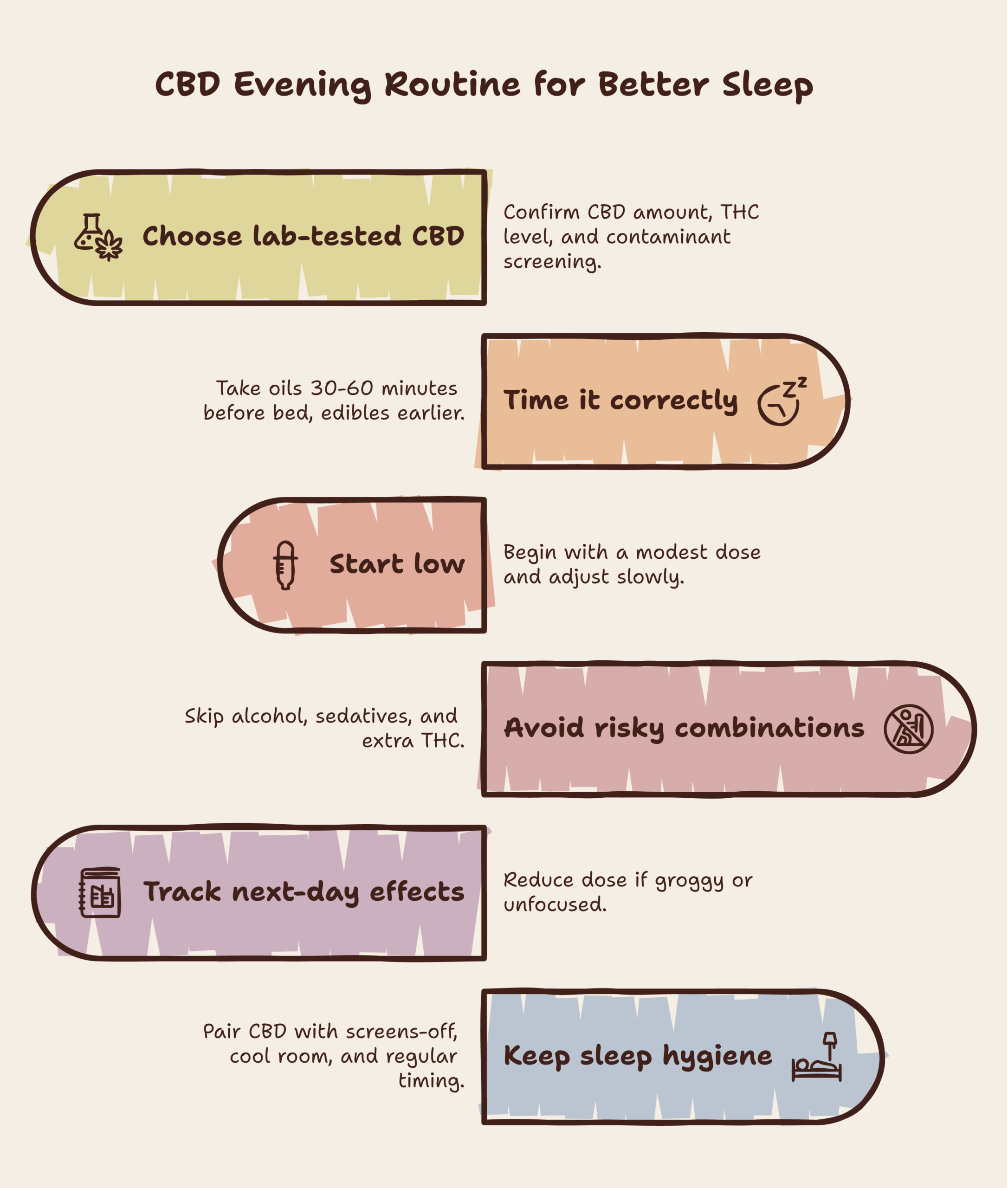
Use this six-step CBD sleep routine for two weeks before deciding whether it works. First, choose one lab-tested CBD product and keep it unchanged. Second, pick a modest starting serving that matches the product label and your own tolerance. Third, take it at the same time each evening. Fourth, remove alcohol and extra THC from the experiment, because otherwise you will not know what caused the sleep change. Fifth, write down sleep onset, night waking, dreams, morning energy and any side effects. Sixth, adjust only after several nights, not after one impatient evening.
This system is intentionally boring. Boring is good. It protects you from the most common mistakes: increasing too fast, switching products constantly, mixing CBD with wine or sedatives, and calling a single good night proof. If the goal is better sleep, the routine must be repeatable on a Tuesday, not just impressive on a weekend.
Medication Interactions and Liver Safety
The biggest safety issue with CBD is not intoxication. It is interaction. CBD can affect liver enzymes involved in processing many medications, including some seizure medicines, blood thinners, antidepressants, antipsychotics, heart medications and sedatives. The prescription CBD medicine Epidiolex carries detailed safety information, and the FDA label notes risks including liver enzyme elevations and drug interactions. That does not mean every low-dose CBD user will have a problem, but it does mean regular use should be discussed with a clinician if you take prescription medication.
A recent review in PubMed Central discusses CBD-associated liver injury concerns, especially at higher doses and with interacting drugs. Watch for unusual fatigue, nausea, abdominal pain, dark urine or yellowing of the skin or eyes, and stop using the product while seeking medical advice if concerning symptoms appear.
📝 Important Note
If you use sleep medication, benzodiazepines, alcohol, antihistamines, opioids or other sedating products, do not casually add CBD at night. Combined sedation can be stronger than expected.
Driving, Travel and Next-Day Alertness
CBD should not make you feel high, but any nighttime routine can affect morning alertness. If you wake up heavy, unfocused or unusually slow, reduce the serving, take it earlier or stop. If a product contains THC, driving risk changes significantly. The CDC warns that cannabis can slow reaction time, impair coordination and distort perception. For products with THC, never drive while impaired, and be extra cautious the morning after edibles or strong nighttime products.
Travel adds another layer. U.S. TSA rules, for example, distinguish hemp-derived products with no more than 0.3% THC from marijuana products, and the official TSA medical marijuana and CBD page still warns that products outside the rule can be referred to law enforcement. International travel is stricter and less predictable. For Greece and the EU, keep wellness products sealed, labeled and documented, and avoid transporting flower-like material if you do not want legal ambiguity.
Who Should Avoid CBD Before Bed
CBD is not suitable for everyone. Pregnant or breastfeeding people, children, people trying to conceive, anyone with liver disease, and anyone taking complex medication should avoid self-directed CBD use unless a qualified clinician says otherwise. The World Health Organization’s cannabis public health review places cannabinoid use inside a broader risk discussion, and that framing is useful: adults should make informed decisions, not emotional ones.
If your sleep problem is severe, sudden, linked to chest pain, breathing pauses, panic attacks, depression or intense daytime sleepiness, skip the supplement experiment and get medical support. CBD can be part of a wellness conversation, but it should never delay care for a real sleep disorder or mental health issue.
⚠️ Disclaimer
This article is for informational purposes only and does not constitute medical advice. Information about CBD and cannabis wellness in Greece is current as of July 2026 but may change. Always consult qualified healthcare professionals for medical advice and treatment options. For our full disclaimer, visit cannastoreams.gr/disclaimer.
Frequently Asked Questions
Is CBD proven to treat insomnia?
No. Research is promising for some sleep-related outcomes, but clinical insomnia evidence remains mixed. CBD may help some adults relax, especially when stress contributes to poor sleep, but it is not a proven cure for insomnia.
How long before bed should I take CBD oil?
Many adults take CBD oil 30 to 60 minutes before bed. Edibles and capsules often need more time, usually 60 to 90 minutes, because digestion slows onset.
Can I mix CBD with alcohol or sleep medication?
Do not mix CBD with alcohol, sedatives or sleep medication without medical guidance. The combination may increase drowsiness, impair coordination or change how medications affect you.
Will CBD make me feel high?
CBD itself is non-intoxicating. However, full-spectrum products may contain trace THC, and poorly labeled products can be stronger than expected. Always check lab reports.
What should I track during a CBD sleep routine?
Track dose, timing, product format, sleep onset, night waking, dreams, morning energy, grogginess and any side effects. This makes your routine measurable instead of random.
