
CBD Dosage for Beginners: Safe Start Guide
Learn CBD dosage for beginners with a safe start-low approach, timing tips, side effects, and Greek buying reminders.

⚠️ Disclaimer
This CBD dosage for beginners guide is educational only and is not medical advice. CBD can interact with medicines, may not be suitable during pregnancy or breastfeeding, and legal rules can change. Information is current as of August 2026. Speak with a qualified healthcare professional before using CBD for a health condition.
CBD dosage for beginners should feel simple, calm, and measurable. The smartest first step is not chasing the strongest bottle or copying someone else’s routine. It is choosing a quality product, understanding the label, starting with a conservative amount, and giving your body enough time to respond before changing anything.
CBD, short for cannabidiol, is a non-intoxicating cannabinoid found in cannabis and hemp. The FDA explains that cannabis-derived products can carry real safety questions, especially around labeling, contaminants, liver effects, and drug interactions. That does not mean beginners should panic. It means CBD works best when treated like a wellness product that deserves structure.
This guide gives you a practical beginner framework: how to read milligrams, how to calculate a starting amount, how long to wait, when to adjust, and when to stop and ask a professional. If you already read our CBD in Greece legal buying guide, use this as the next step: a personal use plan focused on comfort, safety, and consistency.
CBD Dosage for Beginners Starts With the Label
The most common beginner mistake is looking at the front of the bottle and assuming “10% CBD” or “1,000 mg CBD” tells the whole story. It does not. A useful dose is measured in milligrams per serving. To find that, look for the total CBD in the bottle, the bottle size, and the suggested serving size. A 10 ml bottle with 1,000 mg total CBD is much stronger per drop than a 30 ml bottle with the same total amount.
For oils, labels may show total CBD per bottle and sometimes CBD per drop. If the product does not clearly show serving strength, be cautious. The FDA’s dietary supplement guidance is a useful reminder that labels and marketing claims deserve careful reading, even when a product looks professional.
Beginners should also distinguish between full spectrum, broad spectrum, and isolate products. Full spectrum CBD may contain trace cannabinoids and terpenes. Broad spectrum usually keeps multiple hemp compounds but removes detectable THC. CBD isolate is cannabidiol alone. For a deeper comparison, our CBD edibles vs oil guide explains why format changes both timing and expectations.
✓ Beginner Label Checklist
- ✓ Total CBD in the bottle, shown in milligrams
- ✓ CBD per drop, capsule, gummy, puff, or serving
- ✓ Third-party lab report or certificate of analysis
- ✓ Clear ingredient list and product format
- ✓ THC status and local legal suitability
A Safe Starting Range for First-Time Users
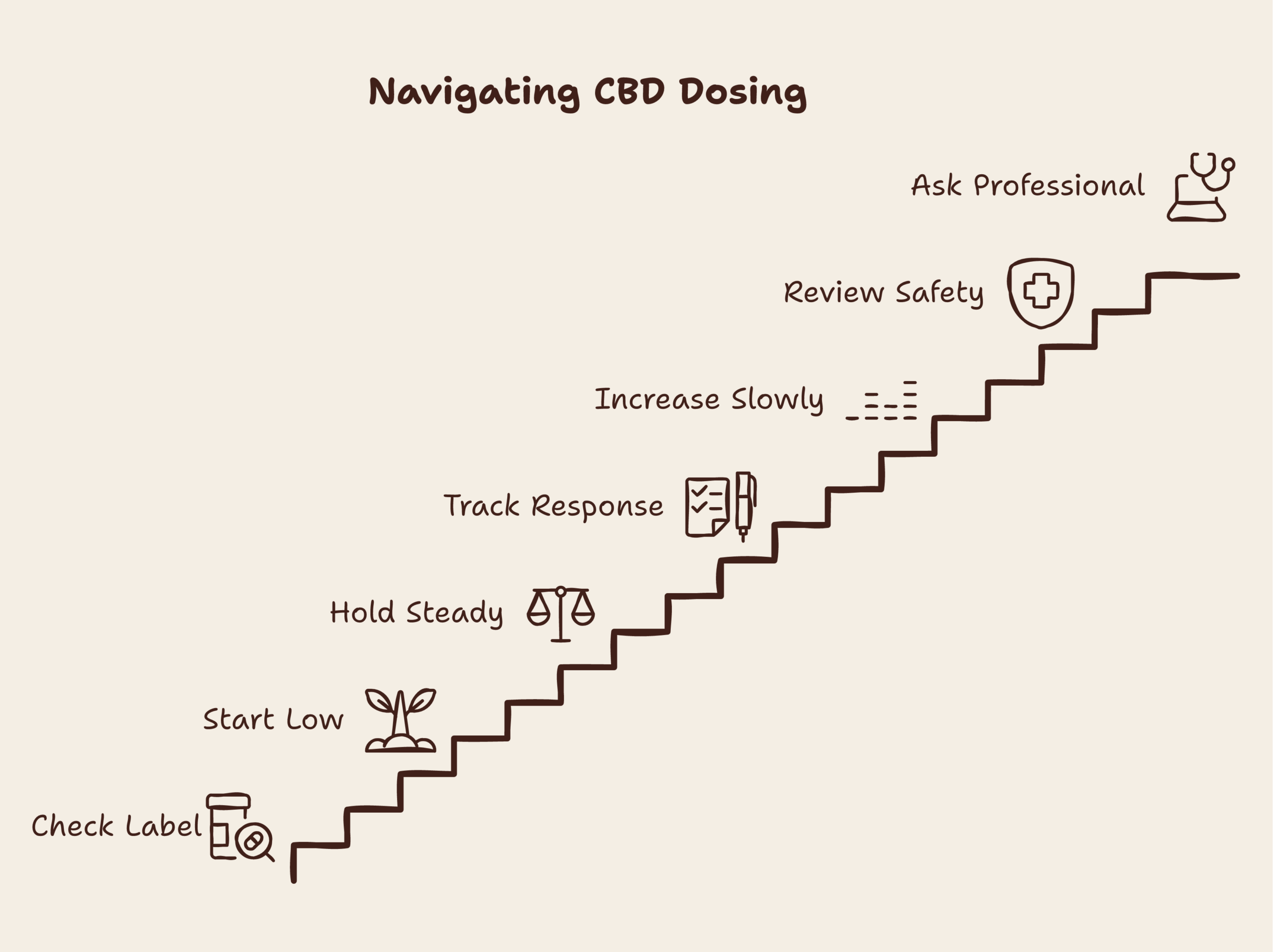
A conservative beginner approach is to start with a low daily amount, often around 5–10 mg of CBD, then hold that amount steady for several days before increasing. Public guidance varies because CBD is not a one-size-fits-all substance. Body weight, metabolism, product type, reason for use, sleep, food intake, and medication history can all change the experience.
The important principle is “start low and go slow.” The NIH National Center for Complementary and Integrative Health notes that cannabis and cannabinoids are being studied for several conditions, but evidence and product quality vary. That is exactly why a beginner dose should be treated as a personal observation process, not a race.
Keep the first test boring. Take the same amount at the same time of day, preferably when you do not need to drive, operate equipment, drink alcohol, or make important decisions. If you feel unusually sleepy, lightheaded, nauseous, or mentally foggy, do not increase. If you feel nothing after several consistent days, increase only slightly and repeat the tracking period.
💡 Pro Tip
Use a notes app for the first two weeks. Track dose, time, product type, food, sleep quality, mood, discomfort, and any side effects. Pattern beats guesswork.
How Long CBD Takes to Work
Timing depends heavily on the delivery method. Sublingual CBD oil is usually held under the tongue before swallowing, which may feel faster than a gummy because some absorption happens through the mouth. Edibles and capsules pass through digestion, so they usually take longer. Inhaled products can feel faster, but they are not the right fit for everyone, especially people with respiratory sensitivity.
Research on cannabinoids often separates oral, inhaled, and mucosal routes because absorption differs. A review in the National Library of Medicine discusses how cannabinoid pharmacokinetics change by route, formulation, and metabolism. In plain English: when you take CBD matters, but how you take it matters just as much.
For beginners, the safest timing habit is to wait long enough before taking more. If you use oil, wait at least a full observation window before adjusting. If you use edibles, be even more patient. Taking more too soon is one of the easiest ways to overshoot your comfort zone, especially with products that combine CBD with other cannabinoids.
Safety, Side Effects, and Medication Interactions
CBD is widely marketed as gentle, but “gentle” is not the same as risk-free. The FDA has highlighted potential CBD harms, including possible liver effects, drowsiness, digestive issues, and drug interactions. Prescription cannabidiol is monitored differently from ordinary retail CBD products, so do not use medical research as a free pass for every bottle on a shelf.
Medication interaction is the biggest reason to involve a healthcare professional. CBD can affect enzymes involved in drug metabolism, similar to why grapefruit warnings appear on some medicines. If you take blood thinners, anti-seizure medication, sedatives, antidepressants, blood pressure medicine, or multiple prescriptions, get medical guidance first. The FDA-approved Epidiolex label is not a consumer CBD label, but it clearly shows why cannabidiol interactions and liver monitoring matter in clinical contexts.
Side effects can include sleepiness, diarrhea, appetite changes, dry mouth, lightheadedness, or changes in alertness. If that happens, reduce the amount or stop. If symptoms feel strong, persistent, or unusual, seek professional advice. For wellness routines, comfort is the point. Pushing through side effects to “make CBD work” is bad logic with nice branding.
📝 Important Note
Avoid combining a first CBD dose with alcohol, sedatives, or a new medication. Test one variable at a time so you know what caused the effect.
Choosing the Right CBD Format
CBD oil is the most flexible beginner format because you can adjust gradually. Gummies and capsules are convenient but less flexible because each serving is fixed. Topicals are different: they are applied to the skin and are usually chosen for localized comfort rather than whole-body effects. Our CBD topicals for muscle recovery guide covers that category separately.
If your goal is a calm evening routine, an oil or low-strength edible may be easier to track. If your goal is post-workout body comfort, a topical may make more sense. If your goal is anxiety support, be extra careful with timing and expectations. Our CBD for anxiety guide explains why evidence, dose, and context matter.
Product quality matters as much as format. Look for batch testing, clear ingredients, realistic claims, and responsible sellers. You can browse examples such as CBD Oil 10 10ml, CBD Oil 20 Full Spectrum 10ml, and Anti Stress 20 Broad Spectrum CBD Oil, but always match strength to your experience level rather than choosing the strongest option by default.
Legal and Quality Checks in Greece
In Greece, consumers should be careful with CBD legality, THC limits, product category, and dried flower rules. Legal interpretations can shift, and different sources sometimes summarize rules differently. When in doubt, choose products with transparent lab reports and avoid assumptions about raw flower, intoxicating cannabinoids, or imported products with unclear documentation.
For broader context, the European Union Drugs Agency cannabis policy overview shows how cannabis regulation differs across Europe. The World Health Organization CBD Q&A also notes that pure CBD has not shown the same abuse potential as THC, while still leaving regulation to national authorities.
Quality checks are practical, not theoretical. Ask whether the product has a certificate of analysis, whether the batch number matches the bottle, whether ingredients are clear, whether the seller avoids disease-cure claims, and whether the strength suits a beginner. For legal detail, revisit our CBD legality Greece 2026 guide before buying unfamiliar formats.
A Simple Two-Week CBD Starter Plan
Week one is for observation. Choose one product, one time of day, and one low amount. Do not stack CBD with several other supplements and then try to guess what worked. If you are using oil, keep the routine consistent. If you are using gummies, avoid taking another serving too soon just because the first one feels subtle.
Week two is for adjustment. If the first week felt comfortable but too subtle, increase slightly and track again. If the first week felt useful, stay there. The best CBD dosage for beginners is not the highest dose. It is the lowest amount that gives the desired support without unwanted effects. The PubMed-indexed review literature on cannabidiol reinforces that CBD research covers many doses and contexts, which is why personal retail use should stay cautious and individualized.
At the end of two weeks, decide honestly: better, neutral, or worse. If better, continue your lowest effective routine. If neutral, review product quality, timing, and expectations before increasing. If worse, stop. Wellness is supposed to reduce friction in your life, not add a spreadsheet of side effects and wishful thinking.
✓ Quick Takeaways
- ✓ Start with a low, measurable amount and hold steady
- ✓ Adjust only after several consistent days
- ✓ Check medication interactions before using CBD
- ✓ Prefer lab-tested products with clear milligram labels
- ✓ Stop if side effects outweigh benefits
⚠️ Disclaimer
This article is for informational purposes only and does not constitute medical advice. The information provided about cannabis and CBD in Greece is current as of August 2026 but may change. Always consult qualified healthcare professionals for medical advice and treatment options. For our full disclaimer, visit cannastoreams.gr/disclaimer.
Frequently Asked Questions
What is the best CBD dosage for beginners?
A conservative beginner routine often starts around 5–10 mg per day, then adjusts slowly after several consistent days. The right amount depends on product strength, body response, goal, and medication status.
Can I take more CBD if I do not feel anything immediately?
Do not rush. Oils, capsules, and edibles can take different amounts of time to feel noticeable. Wait through a full observation window before changing your amount.
Is CBD safe with prescription medication?
Not always. CBD can interact with medicines, especially drugs affected by liver enzymes. Ask a qualified healthcare professional before combining CBD with prescriptions.
Should beginners choose CBD oil, gummies, or topicals?
CBD oil is usually the most flexible for gradual adjustment. Gummies are convenient but fixed-dose. Topicals are best considered separately because they are applied to a specific area.
Is stronger CBD better?
No. Stronger products can be useful for experienced users, but beginners usually benefit from lower strength, clearer measurement, and slower adjustment.
