
CBD Joint Pain Guide: Evidence and Safe Use
CBD joint pain guide for adults: evidence, product formats, Greece safety checks, medication cautions, and responsible use tips.

CBD joint pain is one of the most common wellness questions adults ask when they are looking for a calmer, non-intoxicating option to support sore knees, hands, shoulders, or post-workout stiffness. The honest answer is promising but measured: CBD may be useful for some people as part of a wider comfort routine, especially in topical formats, but the clinical evidence for arthritis and chronic joint pain is still developing. This guide explains what current research suggests, how to compare oils and topicals, what safety checks matter, and how to use CBD responsibly in Greece in August 2026.
Video Guide
CBD Joint Pain Evidence in Plain English
CBD, short for cannabidiol, is a cannabinoid found in hemp and cannabis. Unlike THC, CBD is not used for a euphoric high, which is why many adults explore it for daily wellness routines. The World Health Organization has described pure CBD as generally well tolerated, but that does not mean every CBD product is automatically effective, legal, or appropriate for every person.
For joint discomfort, the strongest practical distinction is between topical CBD and oral CBD. Topicals are applied to a specific area, so people often choose them for knees, wrists, fingers, or shoulders. Oils, capsules, and gummies are swallowed, absorbed systemically, and may be more relevant when someone is also looking at sleep, stress, or whole-body recovery. The Arthritis Foundation says evidence remains limited and recommends a cautious, low-dose approach for adults who still choose to try CBD.
Research is mixed. A recent PubMed-indexed osteoarthritis review found that CBD and cannabis-based products may help some symptoms, but current studies vary too much in dose, format, and comparison methods to justify routine clinical use for osteoarthritis. A 2025 knee osteoarthritis trial in Frontiers in Pharmacology reported that CBD-rich oil was well tolerated but was not superior to placebo. A randomized trial discussed in The Lancet Regional Health Europe also found no added pain benefit from high-dose oral CBD for painful knee osteoarthritis.
That sounds less exciting than many marketing claims, but it is actually useful. It tells us CBD should be treated as a supportive wellness tool, not a guaranteed arthritis treatment. For broader background on pain research, the NCBI Bookshelf living review on cannabis and chronic pain is a good reminder that cannabinoid evidence depends heavily on product type, dose, condition, and study quality.
✓ Key Benefits
- ✓ Non-intoxicating when properly formulated from compliant hemp
- ✓ Available in localized topical and whole-body oral formats
- ✓ May fit evening recovery routines when paired with rest and mobility work
- ✓ Can be selected without smoke or combustion
How CBD May Support Joint Comfort
CBD interacts with the body through several pathways connected to the endocannabinoid system, inflammatory signaling, and pain perception. That biology is one reason researchers keep studying cannabinoids for pain and inflammation. Preclinical evidence is interesting, but adults should be careful about jumping from laboratory findings to personal results. A mechanism is not the same as a proven outcome.
In real life, joint discomfort usually has more than one driver. Age, repetitive movement, sports load, old injuries, inflammation, sleep quality, body weight, footwear, and work posture can all matter. CBD may help some people feel more comfortable, but it should sit alongside the basics: medical assessment when pain is persistent, gentle movement, strength work, hydration, sleep, and a realistic review of daily strain.
For product education, the easiest starting point is understanding route of use. A topical CBD cream, balm, or gel is chosen for one area. A CBD oil is swallowed or held under the tongue and can affect the whole body. An edible has a slower onset and longer duration. If you are comparing formats, our CBD edibles vs oil guide explains why timing and duration are not interchangeable.
Product quality matters as much as format. Look for transparent cannabinoid content, batch information, sensible ingredient lists, and clear usage guidance. For people who want a simple oral format, a moderate-strength product such as CBD Oil 10 10ml may be easier to approach than jumping straight to stronger products. For adults already experienced with CBD, higher-strength options such as CBD Oil 20 Full Spectrum 10ml require more care around dosing and drug interactions.
A Safe CBD Joint Pain Routine
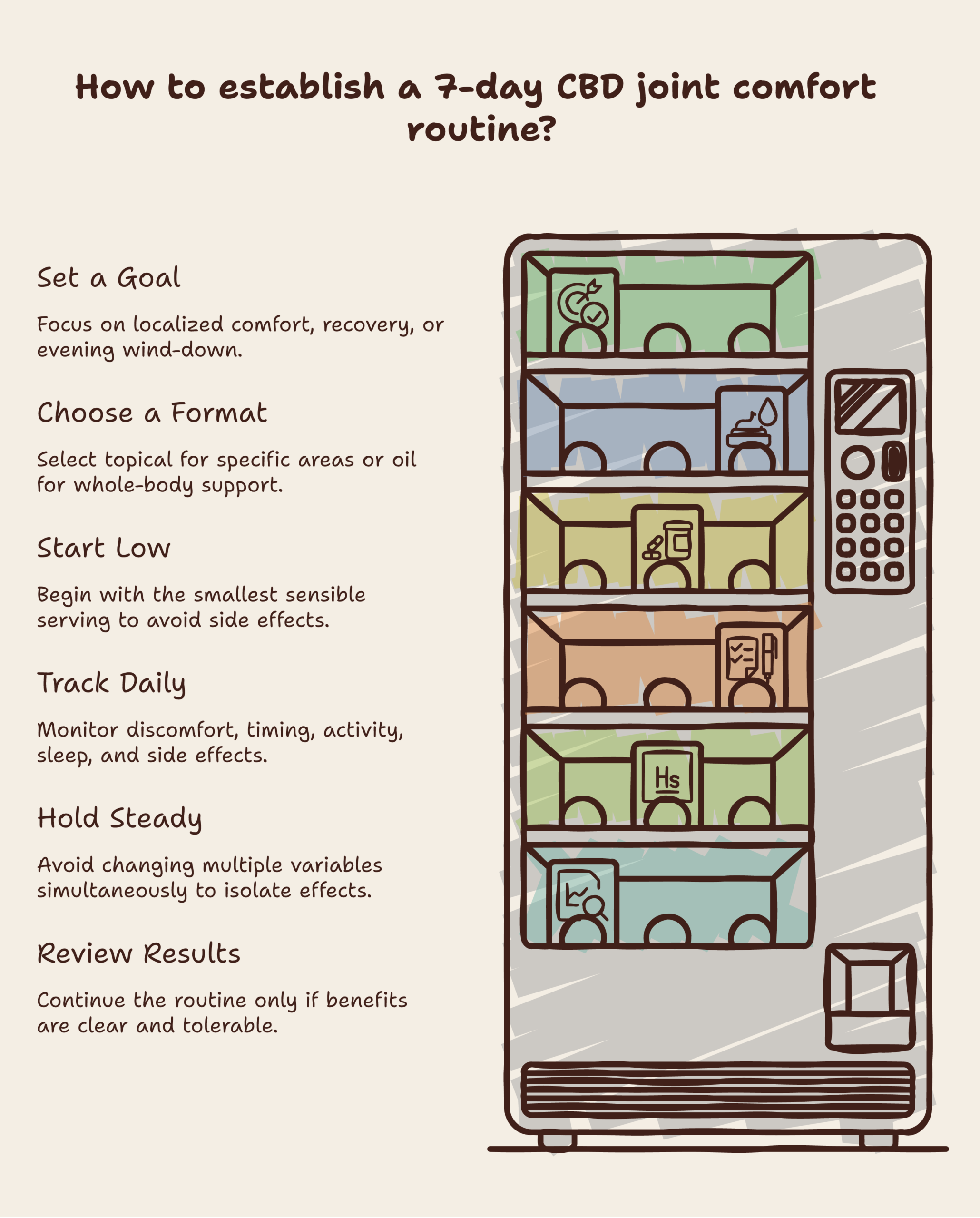
A good CBD joint pain routine starts with a clear goal. Do you want localized comfort after walking? Evening support after training? Help winding down when soreness makes sleep harder? That goal determines whether a topical, oil, edible, or combined routine makes sense. It also prevents the common mistake of taking more product without knowing what improvement you are measuring.
Use a simple seven-day tracking method. Record the joint area, baseline discomfort from 1 to 10, product type, amount used, time of day, activity level, sleep quality, and any side effects. Keep other variables steady where possible. If everything changes at once, you will not know whether CBD, rest, stretching, heat, or reduced activity made the difference.
For oral CBD, many adult guidance documents use a low-and-slow principle. The Arthritis Foundation has suggested starting around 5 to 10 mg twice daily and increasing gradually if needed, but it also stresses that CBD is not a substitute for disease-modifying treatment in inflammatory arthritis. For topicals, follow the product label and avoid broken skin, eyes, and mucous membranes.
If soreness is linked to exercise, our CBD workout recovery guide is a useful companion because recovery is not only about pain. Sleep, training load, nutrition, and consistency all change how joints feel. Adults who prefer localized support can also compare approaches in our CBD topicals for muscle recovery guide.
💡 Pro Tip
Track one joint, one product, and one timing window for a full week before changing dose or format.
Safety, Side Effects, and Medication Checks
CBD is widely used, but it is still biologically active. The U.S. Food and Drug Administration warns that CBD can interact with other medicines and that other medicines can change how safe a CBD dose may be. This matters most for people taking blood thinners, anti-seizure medicines, sedatives, antidepressants, liver-metabolized drugs, or multiple prescriptions.
Liver safety deserves respect. FDA researchers reported liver enzyme elevations in a randomized trial of consumer-relevant CBD doses, and the approved CBD medicine Epidiolex includes liver monitoring information. The Epidiolex prescribing context is not the same as over-the-counter wellness use, but it shows why people with liver disease or complex medication lists should speak with a clinician first.
Common CBD side effects can include sleepiness, dry mouth, stomach upset, appetite changes, lightheadedness, or changes in alertness. The CDC cannabis health effects materials also remind consumers that cannabis products can affect coordination, judgment, and mental state, especially when THC is present. Even when a product is marketed as CBD, trace THC or mislabeled potency can change the experience.
Athletes need an extra layer of caution. The World Anti-Doping Agency permits CBD as an exception, but THC remains prohibited in competition. That means a CBD product contaminated with THC can still create risk. Anyone subject to testing should use only carefully documented products and should understand that product labels are not a legal defense in anti-doping cases.
📝 Important Note
If joint pain is new, severe, swollen, hot, linked to fever, or limiting normal movement, get medical advice instead of self-managing with CBD.
CBD Products in Greece: What Adults Should Check
In Greece, consumer CBD rules can be confusing because hemp, CBD wellness products, medical cannabis, and high-THC cannabis are treated differently. The cautious consumer approach in 2026 is to buy only from transparent retailers, avoid products that make disease-treatment promises, check THC information, and stay away from anything presented as a legal loophole. Our CBD legality Greece 2026 guide covers this in more detail.
European hemp rules and national interpretation do not always feel simple at retail level. The European Commission hemp page explains the agricultural hemp framework, while Greek consumer decisions still depend on product category, labeling, and current enforcement practice. If a product contains THC above the applicable threshold or is marketed for intoxication, treat it as a different legal category.
Product labels should be plain and specific. You want the CBD amount per bottle and per serving, the extract type, ingredients, suggested use, warnings, and batch or lab information where available. If the product is vague, the brand is anonymous, or the claims sound medical without a prescription context, walk away. A clean label is not glamorous, but it is often the best sign that a company takes adult consumers seriously.
Some adults prefer broad-spectrum CBD to avoid THC, while others choose full-spectrum hemp products because they want multiple hemp compounds together. If you are sensitive to THC, tested at work or in sport, or anxious about impairment, broad-spectrum or isolate-style products may be the more conservative choice. Our CBD oil Greece guide explains why many consumers are moving toward oils when they want cleaner dosing and less ambiguity.
Choosing Between Topicals, Oils, and Edibles
Choose a topical when the discomfort is specific and near the surface: fingers after typing, knees after stairs, shoulders after carrying, or calves after training. Topicals are also practical for adults who do not want to swallow CBD or who are already taking medicines that make oral CBD less appealing. The tradeoff is that topical effects are harder to compare across people because skin, formulation, massage, and the underlying cause of soreness all matter.
Choose an oil when you want adjustable dosing and a whole-body format. Oils are easier to titrate than edibles because you can change the amount more precisely. Start small, keep notes, and avoid combining CBD with alcohol or sedating products until you know how your body responds. If daytime calm is part of the goal, our CBD oil for daytime stress guide explains why timing matters.
Choose edibles when convenience and longer duration matter, but respect the delayed onset. Edibles can take longer to feel noticeable, which leads some people to take more too soon. That is a bad pattern with any cannabinoid product. Keep the serving modest, wait long enough, and avoid driving or operating equipment if there is any chance of drowsiness or impairment.
For adults building a home wellness shelf, CBD oil, a topical product, and basic recovery habits often cover more needs than chasing extreme potency. If sleep is part of the joint pain picture, compare our CBD for sleep guide before mixing CBD with melatonin, sedatives, or alcohol.
⚠️ Disclaimer
This article is for informational purposes only and does not constitute medical advice. Information about CBD and medical cannabis in Greece is current as of August 2026 but may change. Always consult qualified healthcare professionals for medical advice and treatment options. Decisions about CBD or medical cannabis should be made with authorized healthcare providers who understand your specific medical history and conditions. For our full disclaimer, visit cannastoreams.gr/disclaimer.
Frequently Asked Questions
Does CBD cure arthritis or joint pain?
No. CBD should not be described as a cure. Current evidence is mixed, and major arthritis guidance treats CBD as an optional supportive product, not a proven disease treatment.
Is topical CBD better than CBD oil for sore joints?
Topical CBD may make more sense for localized soreness, while CBD oil is a whole-body format. The better choice depends on the goal, medicines, sensitivity, and whether you need localized or general support.
Can I use CBD with pain medication?
Ask a doctor or pharmacist first, especially if you use prescription medicines, blood thinners, sedatives, anti-seizure medicines, liver-metabolized drugs, or multiple medications.
Will CBD make me high?
Properly formulated CBD is non-intoxicating. THC, mislabeled products, or contaminated products can create a different effect, so source and lab transparency matter.
Is CBD legal in Greece in 2026?
Hemp-derived CBD products may be available when they comply with the applicable Greek and EU rules, but product category, THC content, labeling, and current enforcement matter. Buy only from transparent adult-focused retailers.
