
CBD for Energy and Alertness: 2026 Guide
CBD for energy may support calm focus when used thoughtfully. Learn dosing, timing, product tips, and safety considerations for 2026.

CBD for energy is one of the most misunderstood ideas in modern cannabis wellness. People hear “CBD” and often think only of relaxation, sleep, or winding down, yet many adults use carefully chosen CBD products as part of a daytime routine built around calm focus, steady mood, and less friction during busy hours. The key is not expecting CBD to behave like caffeine. CBD is not a stimulant in the classic sense, and it should not be sold as a magic productivity hack. A better way to understand it is as a wellness tool that may help some adults feel more balanced, which can indirectly support energy and alertness when stress, discomfort, or poor recovery are what make the day feel heavy.
This guide explains what CBD can and cannot do for daytime wellness in 2026, how timing and dose change the experience, what product formats make sense for morning or afternoon use, and how to stay realistic about safety. The regulatory backdrop matters too: the FDA cannabis and CBD guidance is clear that CBD is not approved as a dietary supplement in the United States, while European medical approvals such as the European Medicines Agency Epidyolex assessment relate to specific prescription use, not general wellness claims. For everyday consumers, the smart approach is simple: choose quality products, start low, track your response, and avoid mixing CBD casually with medications or alcohol.
📺 Video Guide
CBD for Energy: What It Really Means
When someone says they use CBD for energy, they usually mean something more subtle than a quick buzz. They may mean they feel less tense before work, less distracted by physical discomfort, or less likely to crash emotionally after a stressful morning. The NCCIH overview of cannabis and cannabinoids notes that cannabis and cannabinoids are being studied for several potential effects, but it also emphasizes that evidence varies by condition and product type. That caution is important. CBD is not a shortcut for sleep debt, poor nutrition, dehydration, or burnout. It works best, when it works, as one layer in a broader daytime routine.
CBD interacts with the endocannabinoid system, a network involved in mood, pain perception, sleep, appetite, and stress regulation. Unlike THC, CBD does not produce a classic intoxicating high. The World Health Organization cannabidiol report concluded that pure CBD does not appear to have abuse potential in humans, but that does not mean every commercial CBD product is risk-free. Formulas can vary widely, labels can be inaccurate, and full-spectrum products may contain small amounts of THC or other cannabinoids. If your goal is alertness, that distinction matters.
A practical way to frame the question is this: what is draining your energy? If your low energy comes from anxiety, muscle tension, or poor recovery, CBD may be worth exploring with realistic expectations. If it comes from anemia, thyroid issues, depression, sleep apnea, or a medication side effect, CBD is not the answer. The CDC cannabis health effects reminds consumers that cannabis products can affect coordination, judgment, and mental state, especially when THC is involved, so daytime use should always be approached carefully.
✓ Key Benefits People Look For
- ✓ A calmer start to the day without feeling intoxicated
- ✓ Less distraction from minor tension or discomfort
- ✓ Support for consistent routines around work, movement, and recovery
- ✓ A gentler alternative to stacking more caffeine
How CBD May Support Alertness Without Acting Like Caffeine
Caffeine pushes the nervous system toward stimulation. CBD is different. For some adults, the daytime benefit feels more like removing static from the signal. If stress is taking up mental bandwidth, a calm baseline can feel like better energy. Research into CBD and anxiety is still developing, but a review on cannabidiol and anxiety found promising preclinical and early clinical signals for anxiety-related conditions. That does not prove CBD will make every person more focused, but it explains why some people report clearer work sessions when they use modest daytime doses.
Sleep is another piece of the puzzle. A product that makes you feel relaxed at night may indirectly support tomorrow’s energy if it improves your evening wind-down routine. At the same time, daytime overuse can backfire. A review of cannabis, cannabinoids, and sleep highlights the complex relationship between cannabinoids and sleep, and consumers should not assume that more CBD always means better performance. Dose, timing, product composition, and individual biology all matter.
This is why Puff ‘n Pass usually recommends thinking in routines rather than miracles. A morning CBD oil paired with water, breakfast, and a short walk is a different experience from taking a random gummy after three coffees and four hours of sleep. If you already use CBD oil, compare product formats in our cannabis tinctures guide before assuming that gummies, vapes, oils, and capsules will feel the same.
Choosing the Right Daytime CBD Format
The best format depends on how fast you want the effect, how long you want it to last, and how discreet your routine needs to be. Oils and tinctures are flexible because you can adjust serving size gradually. Capsules and softgels are convenient, but they are slower and less adjustable. Gummies are easy, though they can be tempting to overuse because they feel like sweets. Vape products act faster, but quality and safety standards matter heavily, especially after widespread concerns about contaminated or poorly made vapor products. If you use vapor products, revisit our cannabis vape safety guide before choosing a device.
For CBD for energy routines, many adults prefer low-to-moderate CBD oil servings in the morning or early afternoon. Puff ‘n Pass carries options such as CBD Oil 10 10ml and Anti Stress 20 Broad Spectrum CBD Oil for adults who want a measured, non-smoking format. Product choice should follow your tolerance, schedule, and desired intensity. If you are sensitive to cannabinoids, start with a smaller amount than you think you need.
Full-spectrum, broad-spectrum, and isolate products also feel different. Full-spectrum formulas may contain trace THC and a wider cannabinoid profile. Broad-spectrum products aim to preserve multiple hemp compounds while removing THC. Isolate products focus on CBD only. If your job requires drug testing or strict clarity, THC-free options deserve extra attention, but labels and lab reports should still be checked. Our guide to reading cannabis lab reports explains how to review certificates of analysis before trusting marketing language.
💡 Pro Tip
For daytime use, test CBD on a low-pressure day first. Do not try a new product for the first time before driving, a difficult meeting, or a long shift.
A Simple CBD Daytime Routine
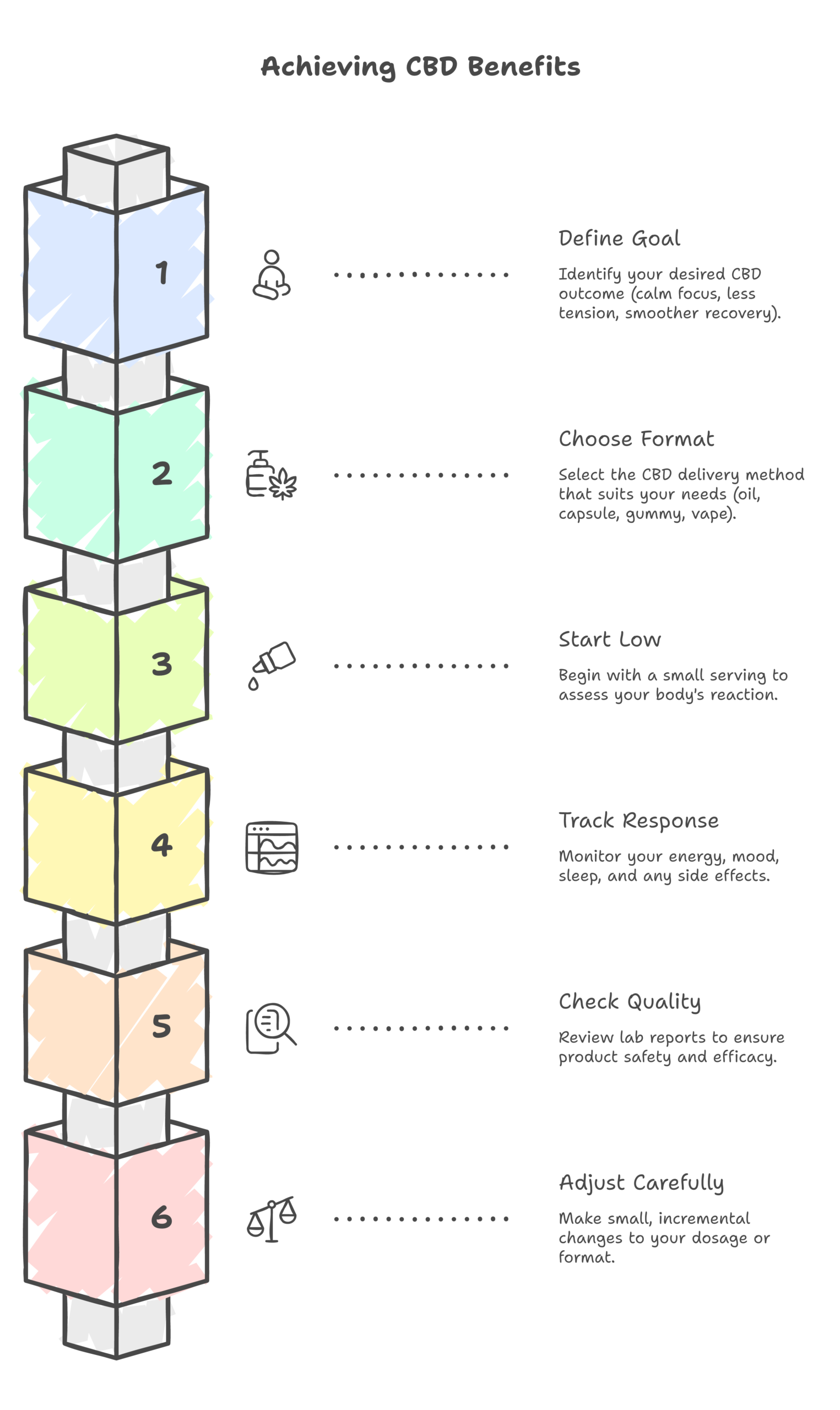
The most reliable way to judge CBD is to build a simple routine and track it for at least one week. Random use produces random conclusions. Start with a clear goal such as calmer focus, less afternoon tension, or smoother recovery after exercise. Then keep the product, serving size, timing, caffeine intake, and sleep schedule as consistent as possible.
Begin with a low morning serving, especially if you are new to CBD. Wait long enough to judge the effect before taking more. Oils may be felt sooner than edible products, while capsules and gummies can take longer because they pass through digestion. If your first trial makes you sleepy, lower the serving or move it later in the day. If you feel nothing, do not immediately double the amount. Increase gradually and keep notes.
Pair CBD with behaviors that actually produce energy. Hydration, protein at breakfast, sunlight exposure, movement, and focused work blocks will do more than CBD alone. CBD may support the routine, but it should not be asked to replace it. If you are exploring daytime cannabinoids because of stress, our guide to CBD for office stress gives a practical workplace-focused framework.
✓ Daytime CBD Checklist
- ✓ Choose oil, capsule, gummy, or vape based on timing needs
- ✓ Start low and keep the same serving for several days
- ✓ Track energy, focus, mood, sleep, caffeine, and side effects
- ✓ Check lab reports and avoid vague “energy blend” claims
- ✓ Stop or adjust if CBD causes drowsiness or brain fog
Safety, Interactions, and Who Should Be Careful
CBD can interact with medications. This is not a minor footnote. Cannabidiol is metabolized through liver enzyme pathways that also process many prescription drugs, and a CBD drug-interaction review discusses clinically relevant interaction concerns. The NIH LiverTox cannabidiol monograph also documents liver-related safety considerations, especially at higher doses used in prescription contexts. If you take blood thinners, seizure medication, antidepressants, sedatives, heart medication, or anything with a grapefruit warning, speak with a qualified healthcare professional before using CBD.
CBD can also cause side effects such as sleepiness, digestive discomfort, appetite changes, dry mouth, or changes in alertness. A clinical review of CBD safety and interactions reinforces the need to think about dose and drug metabolism rather than assuming hemp-derived means harmless. Pregnant or breastfeeding people should avoid CBD unless specifically advised by a clinician. Adults with liver disease, complex medication routines, or a history of sensitivity to cannabinoids should be especially cautious.
Product quality is part of safety. Look for current batch lab reports, clear cannabinoid levels, contaminant testing, and realistic language. Be skeptical of products promising instant energy, guaranteed focus, or medical outcomes. The Harvard Health CBD summary offers a balanced reminder: CBD may have useful applications, but many commercial claims run ahead of evidence. That is exactly why responsible consumers should treat CBD as a tool, not a cure.
📝 Important Note
Do not combine CBD with alcohol, sedatives, or new medications without professional advice. If a product makes you drowsy, do not drive or operate equipment.
CBD for Energy vs THC for Mood
Many adults confuse “energizing cannabis” with high-THC products that feel uplifting. That difference matters. THC can change perception, reaction time, coordination, and judgment. Some people feel more social or creative with THC, while others feel anxious, unfocused, or tired. If your goal is a normal workday, CBD-forward products are usually easier to fit into a responsible routine than intoxicating products.
The National Cancer Institute cannabis PDQ summarizes cannabinoids in a medical context and shows how different compounds can have different effects. CBD and THC are not interchangeable. For beginners, our THC vs CBD guide is a useful starting point before choosing a product. If you want alertness, clarity, and control, prioritize transparent CBD products, modest servings, and timing that matches your actual day.
What to Buy for a Daytime CBD Routine
For most adults, the best starting point is a measured CBD oil with clear labeling. If you want a simple low-strength product, CBD Oil 5 10ml may suit cautious beginners. If you already know CBD works for you, a stronger oil can be more efficient, but stronger does not automatically mean better. Daytime CBD should leave you functional, not flattened.
If your goal is a calm morning routine, choose a product you can measure accurately and repeat consistently. If your goal is fast relief during a stressful afternoon, a different format may make sense, but be careful with vape products and check quality first. For cannabis wellness generally, the safest buying rule is boring but powerful: choose transparent products from a retailer willing to explain ingredients, potency, and realistic expectations.
Final Thoughts on CBD for Energy and Alertness
CBD for energy is best understood as calm support, not stimulation. It may help some adults feel more centered, less tense, and more able to follow through on healthy routines. It may do nothing for others, and it may cause drowsiness in people who are sensitive or who take too much. That is not a failure of CBD; it is a reminder that cannabinoids are personal.
If you want to experiment, start with a low serving, choose a high-quality product, avoid risky combinations, and track your response. The winning formula is not “more CBD.” It is the right CBD product, at the right time, for the right reason, inside a routine that already respects sleep, food, movement, and stress management.
⚠️ Disclaimer
This article is for informational purposes only and does not constitute medical advice. The information provided about cannabis and CBD wellness is current as of May 2026 but may change. Always consult qualified healthcare professionals for medical advice, especially if you take medication, are pregnant or breastfeeding, have liver concerns, or have a medical condition. For our full disclaimer, visit cannastoreams.gr/disclaimer.
Frequently Asked Questions
Does CBD give you energy?
CBD does not act like caffeine. Some adults feel more energetic because they feel calmer, less tense, or better recovered, but others may feel no change or even mild drowsiness.
What is the best time to take CBD for energy?
Morning or early afternoon is usually the best test window. Try it first on a low-pressure day so you can see whether your chosen product supports alertness or makes you relaxed.
Can I take CBD with coffee?
Many adults combine CBD and coffee, but start carefully. Caffeine can mask how CBD feels, and too much caffeine can create the anxiety or tension you are trying to reduce.
Will CBD make me sleepy during the day?
It can. Drowsiness is possible, especially with higher servings, sensitive users, or products that contain other relaxing cannabinoids or terpenes. Lower the serving or change timing if that happens.
Is CBD safe with medications?
CBD can interact with medications through liver enzyme pathways. Ask a healthcare professional first if you use prescription medicine, especially products with grapefruit warnings.
