
CBD Capsules vs Softgels: Which Is Better?
CBD capsules vs softgels explained: compare absorption, dosing, ingredients, safety checks, and who each format suits best.

CBD capsules vs softgels is one of the most practical comparisons for adults who want a simple, discreet, pre-measured CBD routine without the taste of hemp oil. Both formats are swallowed, both move through digestion, and both can fit into a wellness routine, but they are not identical. The shell, ingredient form, absorption pattern, allergen profile, and label transparency can all change the better choice for your body and schedule.
This guide breaks down the real differences in plain English. It also shows how to read labels responsibly, what safety checks matter, and when a bottle of CBD oil, a topical, or another format may make more sense. As always, cannabis wellness products should be used legally, carefully, and with respect for personal tolerance, medication interactions, and local rules.
CBD Capsules vs Softgels: The Core Difference
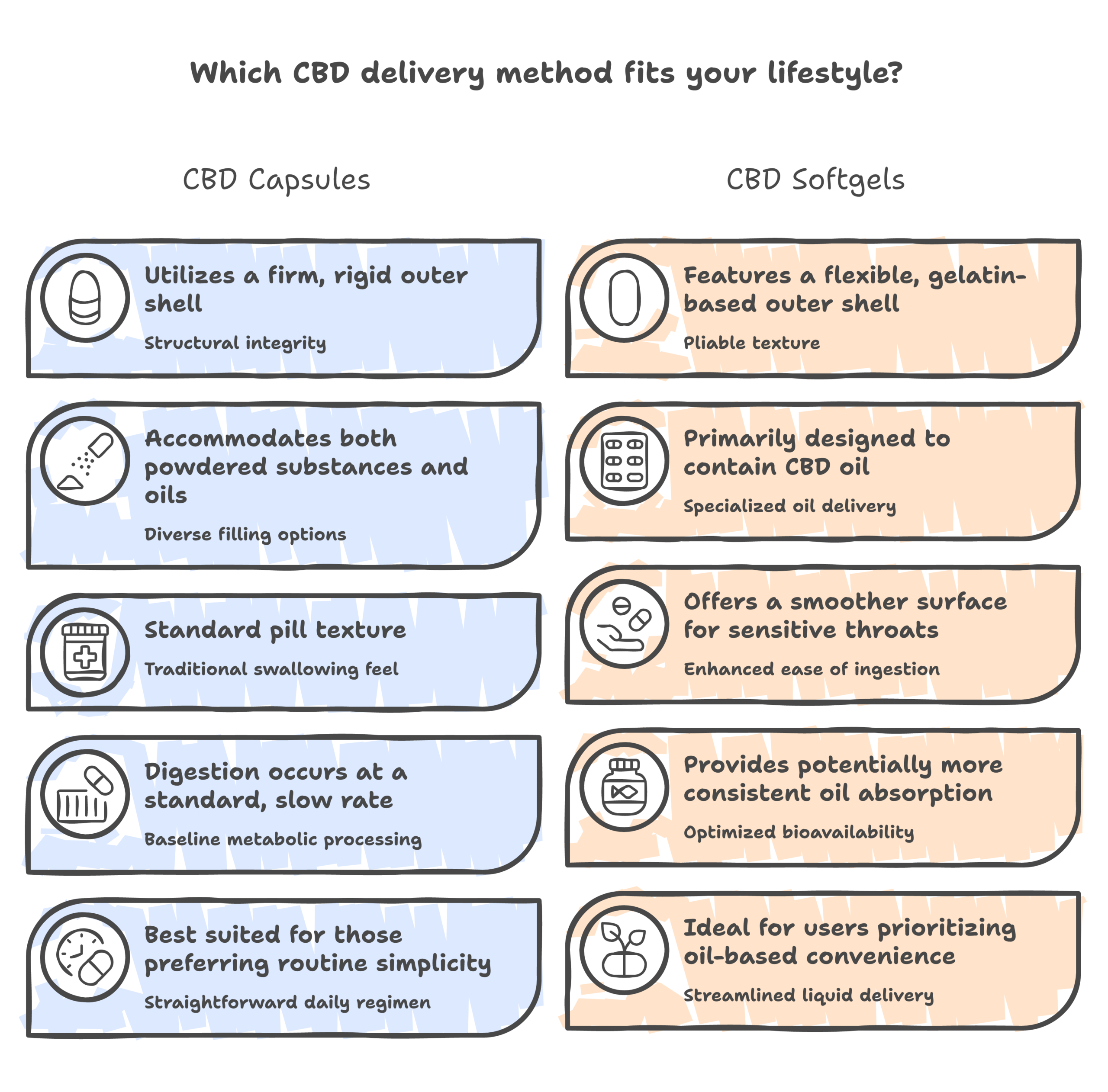
A CBD capsule usually has a firm outer shell. Depending on the brand, that shell may contain powdered hemp extract, granules, or CBD oil combined with carrier ingredients. A CBD softgel is technically also a capsule, but it has a softer, flexible shell that usually holds liquid CBD oil. That small design difference affects swallowability, ingredient lists, and sometimes consistency from one serving to the next.
From a consumer safety perspective, the bigger issue is not whether the product is called a capsule or a softgel. It is whether the brand clearly states the CBD milligrams per serving, the cannabinoid spectrum, batch testing, contaminants screening, and recommended use. The U.S. Food and Drug Administration has repeatedly warned that CBD products need careful evaluation because quality, labeling, and safety claims can vary widely.
✓ Quick Takeaway
- ✓ Capsules are often firm-shell and may contain powder or oil.
- ✓ Softgels are flexible and usually contain CBD oil.
- ✓ Both are discreet, tasteless, and easy to dose.
- ✓ Lab testing matters more than the format name.
How Each Format Works in the Body
Because both capsules and softgels are swallowed, they pass through the digestive system before CBD reaches the bloodstream. This is different from holding an oil under the tongue or using a vape product. Digestion is slower, but it can feel steadier for people who prefer a routine serving at the same time every day. The NCBI Bookshelf overview of cannabidiol notes that CBD is processed through several body systems, which is one reason medication interactions and liver metabolism deserve attention.
Softgels often contain CBD already dissolved in a carrier oil such as MCT oil, hemp seed oil, or olive oil. That may support more even distribution inside the serving. Capsules can also be oil-filled, but many are powder-based. In practice, onset varies by meal timing, individual digestion, body weight, product formulation, and dose. The National Center for Biotechnology Information has published research on CBD pharmacology showing that formulation and route of administration influence how CBD behaves in the body.
For most adults, this means patience matters. A swallowed CBD product is not designed for instant results. Many people evaluate it over several days or weeks while keeping serving size consistent. If you need precise starter guidance, our CBD dosage calculator explains why starting low and adjusting slowly is the smarter approach.
CBD Capsules: Strengths and Tradeoffs
CBD capsules are excellent for people who want simplicity. You do not need to measure drops, count gummies, or handle oil. Each capsule has a stated serving size, making it easy to build a consistent morning or evening routine. Capsules also travel well and are discreet in a supplement organizer, provided local laws allow possession and use.
The tradeoff is that capsule formulas vary. Some contain fillers, flow agents, plant cellulose, gelatin, or dry extract blends. That is not automatically a problem, but adults with dietary restrictions should read the full ingredient panel. The NIH Office of Dietary Supplements offers general guidance on evaluating supplement labels, which is useful even when the product category is cannabis wellness.
Capsules may suit people who dislike oily textures or want a shelf-stable, familiar format. They also work well for those comparing CBD with other wellness habits, such as sleep hygiene, stress routines, or mindful movement. If your main goal is calm without intoxication, our guide to THC-free CBD products is a useful next read.
CBD Softgels: Strengths and Tradeoffs
CBD softgels are popular because they feel smoother to swallow. The flexible shell can be easier for adults who struggle with hard capsules. Since many softgels contain CBD dissolved in oil, the serving can feel more similar to taking CBD oil without the taste or measuring step. This makes softgels attractive for people who want oil-based CBD but dislike droppers.
Softgels can, however, include gelatin, which may not be suitable for vegan consumers. Some brands use bovine or porcine gelatin, while others offer plant-based alternatives. Carrier oils can also matter. MCT oil, hemp seed oil, olive oil, and sunflower oil all have different allergen and digestion considerations. The European Food Safety Authority treats novel foods and ingredient safety as a serious review area, which is one reason European buyers should avoid vague or untested CBD labels.
If you like the logic of softgels but want more adjustable serving sizes, compare them with cannabis tinctures and CBD oils. Oils let you fine-tune servings more easily, while softgels win on convenience.
💡 Pro Tip
If you are comparing two products with the same CBD milligrams, choose the one with clearer batch testing, cleaner ingredients, and a serving format you will actually use consistently.
What to Check Before Buying
The best CBD capsules vs softgels decision starts with the certificate of analysis, often called a COA. A trustworthy COA should show cannabinoid levels, THC content, pesticides, heavy metals, solvents, and microbial testing. The FDA cannabis regulation page explains why cannabis-derived products are still under active oversight and why unsupported health claims are a red flag.
Check the spectrum type too. Full-spectrum CBD may contain trace THC and other cannabinoids. Broad-spectrum CBD aims to include multiple hemp compounds without detectable THC. Isolate is purified CBD. If workplace testing or THC sensitivity is a concern, this distinction matters. Our full spectrum vs broad spectrum vs isolate CBD guide explains the differences in more detail.
You should also look for realistic language. Be cautious with products promising to cure anxiety, pain, inflammation, Parkinson’s, insomnia, or other conditions. The Federal Trade Commission health claims guidance makes clear that health-related advertising should be truthful, substantiated, and not misleading. In cannabis wellness, that standard is not optional.
Safety, Interactions, and Responsible Use
CBD is often discussed as non-intoxicating, but non-intoxicating does not mean risk-free. It may interact with certain medications, especially those processed by liver enzymes. The National Center for Complementary and Integrative Health advises consumers to be cautious with cannabis and cannabinoid products, particularly when using them alongside medical treatment.
Possible side effects can include sleepiness, digestive changes, appetite changes, and interactions with alcohol or sedating medicines. The Mayo Clinic overview of CBD also notes concerns around side effects and medication interactions. If you are pregnant, breastfeeding, managing a liver condition, taking prescription medication, or using CBD for a diagnosed condition, speak with a qualified healthcare professional first.
Responsible use also means avoiding mixing products casually. If you combine CBD with alcohol, THC, sedatives, or other cannabinoids, effects may be less predictable. Read our guide on CBD and alcohol before experimenting with combinations.
📝 Important Note
Do not judge CBD only by milligrams. A 25 mg serving from a transparent, batch-tested product is a smarter choice than a higher-dose product with unclear ingredients or no recent lab report.
Who Should Choose Capsules?
Choose CBD capsules if you want a familiar supplement format, prefer a firm shell, or like products that can be sorted into a weekly organizer. Capsules may also suit people who dislike liquid textures and want something neutral, discreet, and simple. If the product is powder-based, check whether the formula includes extra botanical ingredients that could affect tolerance or medication interactions.
Capsules are especially practical for routine users. They remove the mental friction of measuring, which can improve consistency. That matters because swallowed CBD is usually evaluated over time, not judged by one isolated serving. The PubMed literature on cannabidiol safety and side effects highlights why dose, duration, and individual context matter when assessing CBD use.
Who Should Choose Softgels?
Choose CBD softgels if swallowing comfort matters, you prefer an oil-based serving, or you want the benefits of CBD oil without the taste. Softgels feel premium and convenient, which is why many adults stick with them. The main watchouts are gelatin source, carrier oil, storage instructions, and whether the product has been tested after manufacturing rather than only testing raw hemp extract.
Softgels may also be a good middle ground between oils and gummies. They are less playful than edibles but often cleaner and more adult-focused. If you are comparing edible-style formats, our CBD gummies vs oil guide can help you think about taste, timing, and dose control.
✓ Buying Checklist
- ✓ CBD milligrams per capsule or softgel are clearly stated.
- ✓ Recent third-party COA is easy to access.
- ✓ THC level and spectrum type are transparent.
- ✓ Ingredients match your diet and allergy needs.
- ✓ Claims are realistic, not miracle-cure marketing.
Final Verdict: Which Is Better?
There is no universal winner in the CBD capsules vs softgels debate. Capsules are better if you want a firm, familiar supplement format and do not mind a standard pill feel. Softgels are better if you want an oil-filled product that is often smoother to swallow. Both can be excellent if they are legal, accurately labeled, properly tested, and used responsibly.
For most adults, the smartest choice is the one that combines clean ingredients, transparent lab reports, a comfortable serving size, and a format you will use consistently. If you are new to CBD, start with a modest serving, keep your routine stable, and avoid stacking multiple cannabis products at once. Good wellness habits are built through consistency, not guesswork.
⚠️ Disclaimer
This article is for informational purposes only and does not constitute medical advice. The information provided about medical cannabis and CBD wellness products is current as of May 2026 but may change. Always consult qualified healthcare professionals for medical advice and treatment options. Decisions about medical cannabis should be made in consultation with authorized healthcare providers who understand your specific medical history and conditions. For our full disclaimer, visit cannastoreams.gr/disclaimer.
Frequently Asked Questions
Are CBD softgels stronger than capsules?
Not automatically. Strength depends on CBD milligrams per serving, formula quality, and how your body processes the product. Always compare the label and COA, not just the format name.
Do CBD capsules or softgels work faster?
Both are swallowed, so both usually have slower onset than sublingual oils. Oil-filled softgels may feel slightly more consistent for some users, but meal timing and digestion matter a lot.
Are CBD capsules or softgels better for beginners?
Both can work for beginners because they are pre-measured and discreet. Beginners should choose a modest serving, check testing, and avoid products with exaggerated health claims.
Can CBD capsules or softgels contain THC?
Yes, full-spectrum products may contain trace THC depending on local legal limits and product formulation. Broad-spectrum and isolate products are designed differently, but you should always confirm with a recent lab report.
Should I take CBD capsules or softgels with food?
Many people take swallowed CBD with food for comfort and consistency. Follow the product label and keep timing consistent when evaluating how a product feels.
