
CBD Topicals Guide: Creams, Balms & Lotions
CBD topicals guide to creams, balms, and lotions: how they work, how to choose quality formulas, and safer application tips.

CBD topicals are one of the most practical ways to bring hemp wellness into a daily routine because they stay focused on the skin instead of asking you to swallow, inhale, or wait for a full-body effect. Creams, balms, salves, lotions, gels, and roll-ons all sit in the same topical family, but they do not feel the same, absorb the same, or suit the same use case. If you have ever wondered whether a balm is better than a lotion, whether “full spectrum” matters on the skin, or how much CBD should be in a jar, this guide gives you the plain-English version without the hype.
📺 Video Guide
CBD Topicals Explained Simply
A topical is any product applied directly to the skin. In the cannabis wellness world, that usually means CBD infused into a cosmetic base such as shea butter, coconut oil, beeswax, aloe, menthol, essential oils, or a water-based lotion. The goal is local application: you use the product on a specific area, massage it in, and judge the result by how the skin and nearby tissues feel.
CBD, short for cannabidiol, is a non-intoxicating cannabinoid found in cannabis and hemp. The FDA explains CBD regulation as a still-evolving area, which is why responsible shops should avoid miracle claims and focus on transparent ingredients, lab testing, and realistic expectations. Unlike THC-rich inhalables, CBD topicals are not chosen for a “high.” They are chosen for texture, targeted use, skin feel, and routine consistency.
The science is still developing. Researchers continue to study cannabinoid receptors, skin biology, and inflammatory pathways, and resources like the National Academies cannabis evidence review and PubMed CBD topical research show why the topic is promising but not settled. That balance matters: topicals can be useful wellness products, but they should not be framed as cures.
✓ Key Benefits
- ✓ Local application without inhalation
- ✓ Easy to combine with stretching, massage, or recovery routines
- ✓ Available in light lotions, rich balms, gels, and roll-ons
- ✓ Non-intoxicating when formulated around CBD
Creams vs Balms vs Lotions: What Changes?
The product base is the biggest difference. CBD creams are usually emulsions, meaning oil and water are blended into a smooth texture. They feel familiar because most people already use hand cream or body cream. A cream is a good middle ground: richer than lotion, less greasy than balm, and easy to apply after a shower or before bed.
CBD balms and salves are thicker. They often use waxes and oils, which creates a protective layer on the skin and makes the product last longer. If you want something for a small, specific area, a balm is usually the better format. Many users pair balms with massage because the slower absorption gives enough slip to work the product in. If you already use cannabis topicals for athletic recovery, you will recognize this richer, recovery-focused feel.
CBD lotions are lighter and spread more easily over larger areas. They suit daily skin hydration, broad coverage, and people who dislike greasy residue. The tradeoff is that a lotion may feel less “intensive” than a balm. For face and body care, also compare this format with broader CBD skincare benefits, because skincare products care just as much about moisturizers, fragrance, and skin compatibility as they do about cannabinoid content.
How CBD Topicals Interact With Skin
Your skin is not just a covering; it is a complex organ with immune cells, nerve endings, oil glands, and barrier functions. The skin endocannabinoid system has been studied for its role in balance, signaling, and skin homeostasis. That does not mean every CBD cream will perform dramatically, but it explains why topical cannabinoids are such an active research area.
Most traditional CBD topicals are designed to work locally rather than enter the bloodstream in meaningful amounts. That is different from transdermal patches, which are built to move ingredients through the skin barrier over time. For everyday shoppers, this distinction is useful: a cream, balm, or lotion is usually a local-use wellness product, while a transdermal product is a more specialized delivery system.
Other ingredients matter. Menthol creates a cooling sensation. Camphor or eucalyptus may add a sharper aromatic feel. Arnica, aloe, magnesium, and botanical oils can change the user experience. The American Academy of Dermatology recommends paying attention to dry-skin ingredients and irritation triggers, which applies here too. A topical is only as good as its full formula, not just the CBD number on the label.
💡 Pro Tip
Judge a CBD topical by four things: CBD strength, full ingredient list, third-party testing, and how the texture fits the area where you plan to use it.
How to Choose the Right CBD Topical
Start with the use case. For hands, elbows, knees, shoulders, and post-workout massage, a cream or balm usually makes sense. For daily body hydration, a lotion may be easier. For travel or gym bags, a roll-on can be cleaner. If you are comparing topical formats with ingestible CBD, our CBD capsules vs softgels comparison can help you separate local application from full-body oral routines.
Next, look at CBD concentration. A 500 mg jar and a 2,000 mg jar do not mean the same thing if the jar sizes differ. Calculate milligrams per milliliter or milligrams per gram when possible. If the product does not make strength easy to understand, that is a yellow flag. The FDA dietary supplement Q&A is a reminder that labels and marketing claims deserve careful reading, even when a product looks polished.
Third-party lab testing is non-negotiable. A certificate of analysis should confirm cannabinoid content and screen for contaminants such as pesticides, heavy metals, or residual solvents. Guidance from organizations such as the American Herbal Products Association and state cannabis regulators like the California Department of Cannabis Control reinforces the same consumer principle: buy transparent products from accountable sellers.
Spectrum also matters, but it is not everything. Full-spectrum CBD contains multiple hemp compounds, including trace THC where legally allowed. Broad-spectrum CBD keeps multiple hemp compounds while aiming for THC-free formulas. CBD isolate is purified CBD without the wider plant profile. If you want a deeper breakdown, read our full spectrum vs broad spectrum vs isolate CBD guide.
Application Routine: Get Better Results From Less Product
Good application starts with clean, dry skin. Use a small amount first, then add more if needed. Massage the product in for 30 to 60 seconds instead of smearing it quickly and washing your hands immediately. This improves coverage, reduces waste, and helps you notice whether the texture suits your skin.
Avoid broken skin, eyes, mucous membranes, and irritated rashes unless a qualified healthcare professional tells you otherwise. The CDC cannabis health effects overview encourages careful use and awareness of individual responses, and that mindset applies even to non-intoxicating wellness products. If you have sensitive skin, patch test on a small area for 24 hours.
Timing depends on the product. Lotions may absorb quickly and suit daytime use. Balms may be better at night or after exercise because they are richer. If your routine includes stretching, sauna, yoga, or massage, apply the topical after your skin is clean and your body is settled. For people building a broader wellness stack, our cannabis and fitness guide explains why timing and intention matter.
Choosing CBD Topicals: Quick Checklist
Use this simple checklist before buying or using a new topical:
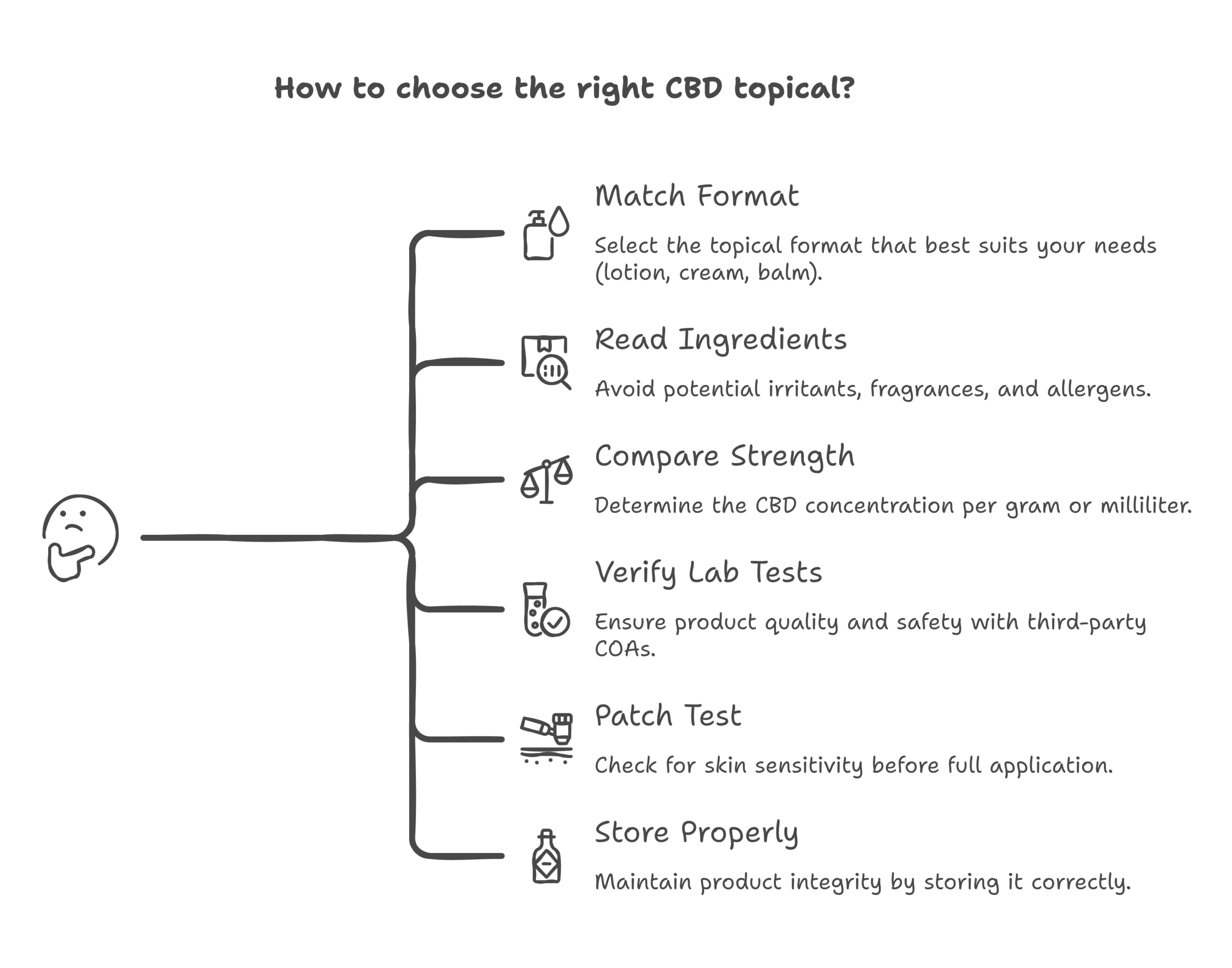
- Match the format to the area: lotion for broad coverage, cream for everyday comfort, balm for small targeted zones.
- Read the full ingredient list: avoid fragrances, essential oils, or botanicals that bother your skin.
- Check CBD strength clearly: compare milligrams to container size, not just the front-label number.
- Look for lab reports: choose products with recent third-party certificates of analysis.
- Patch test first: especially if you have sensitive skin or allergies.
- Store properly: keep jars closed, cool, and away from strong sunlight.
Safety, Interactions, and Realistic Expectations
CBD topicals are generally chosen because they feel approachable, but “natural” does not automatically mean risk-free. Fragrance, menthol, essential oils, preservatives, and carrier oils can irritate some users. Stop using a product if you notice burning, swelling, persistent redness, or a rash. For chronic skin conditions, pregnancy, breastfeeding, or complex medication use, speak with a clinician first.
Drug interactions are less likely with ordinary local-use topicals than with oral CBD, but caution is still smart if you use CBD in multiple formats. The FDA consumer update on cannabis-derived products highlights known concerns around CBD, especially ingestible products and medication interactions. Our own CBD drug interactions guide goes deeper for anyone using oils, capsules, or gummies alongside prescriptions.
Expectations should stay grounded. A topical can support a self-care routine, make massage more intentional, and help you care for specific areas. It is not a replacement for diagnosis, physiotherapy, dermatology care, or medical treatment. The best results usually come from combining a good product with smart habits: hydration, movement, rest, proper footwear, stretching, and professional care when symptoms persist.
📝 Important Note
If a CBD topical promises to cure arthritis, reverse nerve damage, or treat a disease, treat that as a red flag. Responsible brands explain ingredients, testing, and intended use without overpromising.
Where CBD Topicals Fit in a Wellness Routine
Topicals work best when they have a clear job. Keep a light lotion near your shower products if your goal is daily skin comfort. Keep a balm in your recovery kit if you want something richer after training or long workdays. Keep a roll-on in a bag if you need clean application while travelling. The product format should remove friction from your routine, not create another bottle you forget to use.
For shoppers who prefer local, non-intoxicating use, CBD topicals are an easy entry point into cannabis wellness. They pair naturally with massage, stretching, skincare, and evening wind-down routines. If you are already familiar with oils or capsules, topicals add a targeted option rather than replacing everything else. If you are completely new, they are one of the simplest ways to start because the experience is familiar: apply, massage, observe, adjust.
⚠️ Disclaimer
This article is for informational purposes only and does not constitute medical advice. The information provided about medical cannabis in Greece is current as of May 2026 but may change. Always consult with qualified healthcare professionals for medical advice and treatment options. Decisions about medical cannabis should be made in consultation with authorized healthcare providers who understand your specific medical history and conditions. For our full disclaimer, visit cannastoreams.gr/disclaimer.
Frequently Asked Questions
Do CBD topicals make you high?
CBD topicals formulated around cannabidiol are not chosen for intoxication. They are applied to the skin for local use. Always check whether a product contains THC and whether it fits local rules.
Is CBD cream better than CBD balm?
Neither is automatically better. Cream is more balanced and familiar for daily use. Balm is thicker and better for small targeted areas where you want a richer feel.
How often can I apply CBD lotion?
Follow the product label. Many lotions are used once or twice daily, but sensitive skin needs caution. Patch test first and stop if irritation appears.
Should I choose full-spectrum or THC-free CBD topicals?
Choose full-spectrum if you want a wider hemp profile and the product is legal and tested. Choose broad-spectrum or isolate if you prefer THC-free options.
Can I use CBD topicals with other CBD products?
Many people combine formats, but oral CBD raises more interaction questions than local topicals. If you use medication or have a medical condition, ask a healthcare professional.
