Hemp Flower Ban Greece: Consumer Guide 2026
Hemp flower ban Greece guide: what Article 41 means for CBD flower, legal products, retailers, and consumers in 2026.

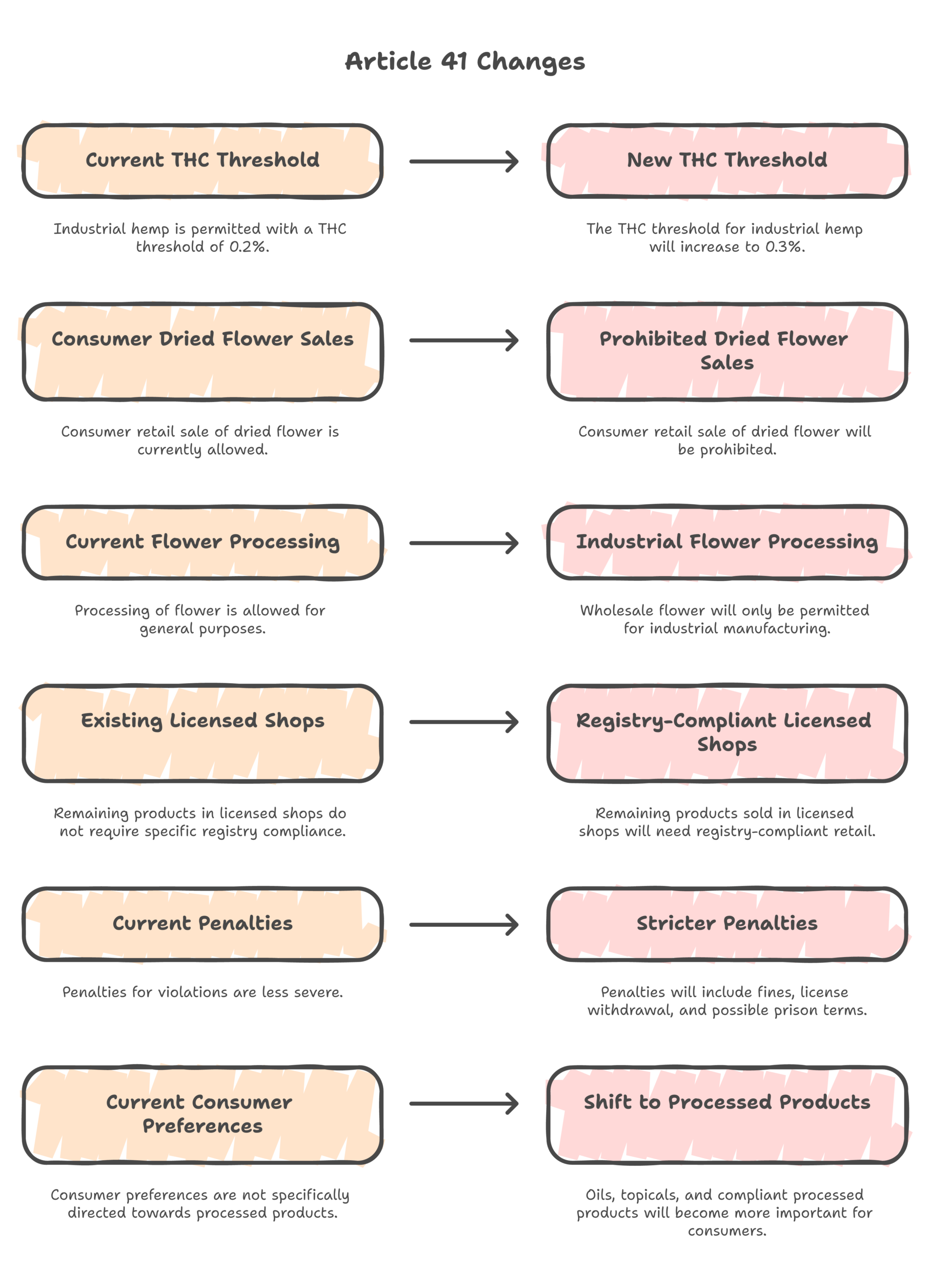
The hemp flower ban Greece discussion has become one of the most important consumer issues in the Greek CBD market in 2026. A new legislative package, widely discussed as Article 41, would change how low-THC hemp flower is treated: the THC threshold for industrial hemp may rise to 0.3%, but dried flower intended for retail consumers would be removed from the practical exemption that many shops relied on. In plain English, CBD flower could become unavailable for direct consumer sale, even when the THC level is within the new industrial hemp limit.
This guide explains what the proposal means for shoppers, CBD users, wellness consumers, and retailers in Greece. It does not replace legal advice, but it does give you the practical map: what appears to be changing, what products may remain available, why the distinction between flower and processed products matters, and how to shop responsibly while the law is moving.
⚠️ Disclaimer
This article is for informational purposes only and does not constitute legal, medical, or regulatory advice. The information about cannabis and hemp regulation in Greece is current as of June 2026 but may change. Always consult qualified legal professionals for compliance decisions and healthcare professionals for medical advice.
Hemp Flower Ban Greece: What Article 41 Means
The central issue is a legal split between industrial hemp as raw material and dried hemp flower sold to consumers. Reporting from Business of Cannabis describes a bill tabled in the Hellenic Parliament that would raise the hemp THC threshold to 0.3% while prohibiting dried flower for consumer retail. Hanf Magazin reported similar concerns, including warnings that the measure may clash with EU principles around lawful CBD products.
That difference matters because many consumers assume “0.3% THC” means everything under that level is automatically retail-legal. The proposal is more complicated. A hemp crop may qualify as industrial hemp, but the dried flower from that crop may still be prohibited for direct consumer sale if it is marketed as a smokable, vapable, or loose flower product. For shoppers, this means the label “CBD flower” is no longer enough. The format of the product may be just as important as the THC percentage.
✓ Key Takeaways
- ✓ Industrial hemp threshold may rise from 0.2% to 0.3% THC.
- ✓ Dried hemp flower for consumers may be banned regardless of low THC.
- ✓ Oils, cosmetics, foods, and supplements are treated differently from loose flower.
- ✓ Retailers may need licensing, registry compliance, and distance rules.
Why Low-THC Flower Is Being Treated Differently
Greek regulators appear to be separating hemp flower from processed wellness products because flower can look, smell, and be consumed similarly to high-THC cannabis. This creates enforcement problems for police, customs, and shop inspections. A dried CBD flower may be legal in chemical composition but visually difficult to distinguish from illegal cannabis without laboratory analysis. That problem has also appeared in other European markets, where regulators struggle to balance lawful hemp commerce with youth protection, synthetic cannabinoid risk, and anti-trafficking enforcement.
The broader Greek context is also important. Recreational cannabis remains illegal, while medical cannabis exists under a separate prescription framework. The Prohibition Partners medical cannabis map summarizes the medical channel, and our own Medical Cannabis Greece guide explains how prescriptions and access differ from over-the-counter CBD shopping. The proposed flower restrictions do not erase medical cannabis, but they may reshape the non-prescription wellness market.
What Consumers May Still Be Able to Buy
The proposal focuses on dried hemp flower for consumer retail, not necessarily every CBD product. That means processed formats may become the practical path for compliant consumers: CBD oils, topicals, cosmetics, certain supplements, and other products that meet category-specific THC rules. The distinction aligns with how many EU rules separate agricultural raw material from finished goods. The European Commission hemp overview explains industrial hemp in the EU agricultural context, while EUR-Lex is the place to track formal EU legal texts.
For practical shopping, consumers should shift attention from “flower strength” to product documentation. Look for batch information, clear ingredient lists, THC compliance, and a shop that can explain where the product fits legally. If you are choosing oils, start with transparent products such as CBD Oil 20 Full Spectrum 10ml or compare formats using our CBD capsules vs softgels comparison. If you prefer non-inhaled wellness formats, topicals and balms may be easier to understand under a processed-product framework.
💡 Pro Tip
Do not judge legality by cannabinoid percentage alone. Product format, intended use, documentation, and retail licensing may matter more under the new framework.
How This Affects CBD Flower Users
If you currently buy CBD flower for aroma, ritual, or relaxation, the hemp flower ban Greece proposal is a clear signal to reassess your routine. The safest approach is to avoid stocking up based on rumors and instead follow verified updates from reputable shops and official publications. Consumer confusion is predictable, especially because hemp flower has often been sold alongside oils, edibles, and accessories. But if direct sale and use of dried flower becomes prohibited, possession or purchase could carry risks that are not present with compliant processed products.
The health side also matters. Inhalation is not the only way to use cannabinoids, and it may not be the best fit for many wellness users. The CDC cannabis health effects page explains general risk considerations, while the FDA overview of cannabis-derived products is useful for understanding why regulators are cautious with CBD claims. For research context, PubMed cannabidiol studies show that CBD science is active but still nuanced.
Retailers, Licences, and the New Compliance Mindset
For businesses, the message is even stronger: informal CBD retail is becoming a compliance-heavy sector. The new framework discussed in reporting includes licensed cannabis product businesses, distance requirements from schools, registry obligations, and inspections. Greek Reporter covered the proposed stricter cannabis rules in the wider public-health package. Retailers should follow official Greek government publications, consult counsel, and avoid assuming that old interpretations will carry forward unchanged.
This is also why consumers should prefer established stores that communicate clearly. A serious retailer should be able to discuss compliance without making exaggerated health promises. Our COA lab report guide remains useful because paperwork, testing, and batch transparency are not optional details anymore. They are becoming the foundation of responsible cannabis retail.
EU Law Questions and Why the Debate Is Not Over
One reason this topic is so contested is that CBD and low-THC hemp sit inside a European legal conversation, not just a national one. The Court of Justice of the European Union has previously addressed CBD and free movement issues in the Kanavape case C-663/18, and many industry observers argue that blanket restrictions on lawful CBD products must be proportionate. That does not mean any challenge will automatically succeed. It means the debate is likely to continue, especially if Greek rules go further than neighboring EU approaches.
Consumers should avoid reading EU-law debate as permission to ignore Greek law. Courts and regulators move slowly, while shops and buyers operate in real time. The most practical path is to treat the rules as changing, follow reliable updates, and choose formats that are easier to document. For background on how Greek hemp rules have been evolving, read our future of hemp regulations in Greece article and our guide on Greece cannabis law 2026 and CBD flower retail.
📝 Important Note
A proposed or newly tabled law can change before final enforcement. Do not rely on social media summaries. Check official updates and ask the retailer for product-specific compliance information.
A Responsible Consumer Checklist
Before buying any hemp-derived product in 2026, ask five simple questions. First, is it dried flower or a processed product? Second, does the seller provide batch or lab documentation? Third, is the THC level clear and relevant to the product category? Fourth, does the shop explain whether the product is food, cosmetic, supplement, oil, topical, or another format? Fifth, is the seller operating through a credible retail channel?
If the answer is vague, wait. CBD wellness is supposed to reduce uncertainty, not create legal anxiety. For many consumers, processed formats such as Anti Stress 20 Broad Spectrum CBD Oil, Phyto Relax 10 Broad Spectrum CBD Oil, or carefully documented topicals will make more sense than loose flower during a legal transition. If you are interested in skin and topical formats, our CBD topicals guide is a better starting point than guessing.
The Bottom Line for 2026
The hemp flower ban Greece story is not simply “CBD is banned” or “0.3% THC is legal.” It is more specific: Greece is moving toward a framework where industrial hemp may have a higher THC ceiling, while dried hemp flower for consumer retail may be prohibited. Processed CBD products may remain available, but only when they fit their category rules and are sold through compliant channels.
For consumers, the smart move is to stop treating hemp products as interchangeable. Flower, oils, edibles, topicals, supplements, cosmetics, and medical cannabis are different legal and practical categories. Stay informed, choose transparent retailers, avoid exaggerated claims, and move toward documented products that match the new compliance environment. That is the responsible way to navigate cannabis wellness in Greece in 2026.
Frequently Asked Questions
Is all CBD banned in Greece under the new proposal?
No. The proposal focuses especially on dried hemp flower for consumer retail. Processed products such as oils, cosmetics, and certain compliant wellness products may remain available under separate product rules.
Why would hemp flower be banned if the THC limit rises to 0.3%?
Because the proposal treats industrial hemp raw material and dried flower for consumers differently. A crop may meet the industrial hemp limit, while retail flower from that crop may still be prohibited.
Can I still buy CBD oil in Greece?
CBD oil may remain available when it complies with applicable product rules, THC limits, labeling requirements, and retail licensing conditions. Always check documentation before buying.
Does this affect prescription medical cannabis?
Medical cannabis is separate and remains governed by prescription and pharmaceutical rules. The hemp flower retail debate mainly concerns non-prescription CBD and hemp wellness products.
What should consumers do now?
Follow official updates, avoid loose flower if the rules become restrictive, and choose documented products from credible retailers. When in doubt, ask for legal and product-specific clarification.
