
Cannabis Concentrates Explained: Wax, Shatter, Live Resin
Learn the differences between cannabis concentrates like wax, shatter, and live resin. Compare potency, flavor, cost, and find which type suits your needs.

If you’ve browsed a dispensary menu lately, you’ve probably noticed the concentrate section keeps growing. Wax, shatter, live resin, budder, sugar… the terminology alone can feel overwhelming. Cannabis concentrates are exactly what the name suggests: concentrated forms of the cannabinoids and terpenes found in the cannabis plant, stripped away from the plant material itself. They’re potent, flavorful, and increasingly popular among both recreational and medical users. This guide breaks down the main types, how they’re made, and which one might work best for you.
📺 Video Guide
What Are Cannabis Concentrates?
Cannabis concentrates are products made by extracting the most desirable compounds from the cannabis plant, primarily cannabinoids like THC and CBD along with terpenes, the aromatic compounds responsible for flavor and aroma. The extraction process removes excess plant material, leaving behind a product that packs significantly more potency per gram than traditional flower.
While cannabis flower typically contains 15-25% THC, concentrates can range from 60% to over 90% THC content. According to the U.S. Drug Enforcement Administration, this increased potency is what draws experienced consumers who want stronger effects from smaller amounts. The tradeoff is that dosing requires more care, particularly for newcomers.
There are two broad categories of extraction: solvent-based and solventless. Solvent-based methods use chemicals like butane, propane, or CO2 to dissolve trichomes from plant material. Solventless methods rely on heat, pressure, or ice water. The extraction method, combined with post-processing techniques, determines the final texture, flavor, and potency of each concentrate type.
Wax: The Versatile Everyday Concentrate
Wax is one of the most common cannabis concentrates you’ll find in dispensaries. It gets its name from its opaque, waxy texture that ranges from soft and pliable (sometimes called “budder”) to crumbly and dry (often called “crumble”). The color typically falls somewhere between light gold and deep amber, with lighter shades generally indicating higher purity.
Production starts with butane hash oil (BHO) extraction, where butane is passed through cannabis plant material to dissolve the trichomes. After extraction, the solution is purged of residual solvents under controlled heat and vacuum. The key difference between wax and other BHO products happens during this purging stage: the extract is whipped or agitated, which disrupts the molecular structure and creates that characteristic opaque, creamy consistency.
Wax tends to retain more terpenes than shatter because the agitation process happens at lower temperatures. This means better flavor, though the tradeoff is a slightly shorter shelf life since the looser molecular structure allows terpenes to evaporate more quickly. For daily users, wax offers a good balance of potency, flavor, and ease of handling. You can dab it, add it to joints, or use it with a portable vaporizer.
✓ Why People Choose Wax
- ✓ Easier to handle than sticky oils or runny sauces
- ✓ Strong terpene profile means better flavor than shatter
- ✓ Works with dab rigs, vape pens, and can top off flower bowls
- ✓ Widely available and usually mid-range in price
Shatter: The Glass-Like Powerhouse
Shatter is hard to miss. It looks like a sheet of amber glass or hard candy, and it actually shatters into pieces when you break it, hence the name. Among concentrates, shatter has been around the longest and was one of the first types to gain mainstream popularity in the cannabis community.
Like wax, shatter is produced through BHO extraction. The critical difference is in the post-processing: instead of whipping, the extract is left undisturbed while solvents are purged under heat and vacuum. This lack of agitation allows the molecules to settle into a tight, ordered structure, which creates the transparent, glass-like appearance. Think of it like the difference between whisking egg whites into foam versus letting them settle flat.
The ordered molecular structure gives shatter a longer shelf life compared to wax, since the tightly packed molecules are less prone to degradation. However, that same structure means fewer terpenes survive the extraction process, as the higher purging temperatures needed to achieve that clarity tend to cook off some of the more volatile aromatic compounds. If you’re chasing maximum potency over flavor, shatter delivers. THC levels in quality shatter typically range from 70-90%.
One practical note: shatter can be finicky to work with. In cold temperatures it’s brittle and tends to fly off in small pieces when you try to break it. In warm conditions, it gets sticky and stretchy. Many experienced users keep their shatter in a cool, dark place and use a dedicated dab tool to portion out servings.
Live Resin: The Flavor King
Live resin changed the concentrate game when it hit the market. Unlike wax and shatter, which use dried and cured cannabis, live resin starts with fresh-frozen plant material. Immediately after harvest, the cannabis is flash-frozen at extremely low temperatures, skipping the drying and curing process entirely. This preserves terpenes and cannabinoids that would otherwise degrade during the traditional curing period.
The result? A concentrate with a dramatically richer terpene profile compared to its dried-material counterparts. Where shatter might test at 1-2% total terpenes, live resin commonly hits 5-10% or higher. You can literally smell the difference. The aroma of quality live resin closely mirrors the scent of the living plant, which is something that dried-material extracts can’t replicate.
In terms of texture, live resin is usually a sticky, viscous substance with a golden to amber color. Some batches lean toward a “sugar” consistency with visible crystalline structures (THCA crystals) suspended in a terpy sauce. Others come out as a smoother “badder” or “batter.” The exact texture depends on the strain, extraction parameters, and how the final product is processed.
The higher terpene content in live resin contributes to what researchers call the entourage effect, where cannabinoids and terpenes work together to produce effects that differ from isolated THC alone. Many medical patients prefer live resin for this reason, reporting more nuanced and well-rounded effects compared to high-THC, low-terpene alternatives like distillate.
💡 Pro Tip
When shopping for live resin, check if the label says “live resin” versus “cured resin.” Cured resin uses dried material, which means fewer terpenes and a different flavor profile. True live resin will usually command a higher price, but the taste difference is noticeable.
Other Concentrate Types Worth Knowing
Beyond the big three, several other concentrate types are worth understanding, especially as the market continues to evolve.
Rosin is the go-to for people who want zero solvents involved. It’s made by applying heat and pressure to cannabis flower, hash, or kief, essentially squeezing out the oils. The appeal is simplicity and purity. You can even make rosin at home with a hair straightener and some parchment paper, though commercial presses produce far more consistent results. Potency typically falls between 60-80% THC, with solid terpene retention since no chemical solvents are used.
Diamonds (THCA crystals) are the most potent concentrate available, sometimes exceeding 99% purity. They look like small, clear crystals and are often sold in a pool of terpene-rich “sauce.” On their own, diamonds are almost flavorless since they’re nearly pure THCA. Combined with sauce, they deliver both maximum potency and full-spectrum flavor.
Hash and bubble hash are the oldest forms of cannabis concentrates, dating back centuries according to the Encyclopedia Britannica. Traditional hash is made by collecting and compressing trichomes (kief) into a solid block. Bubble hash uses ice water to separate trichomes from plant material, producing a cleaner product. Both are solventless and typically range from 30-60% THC.
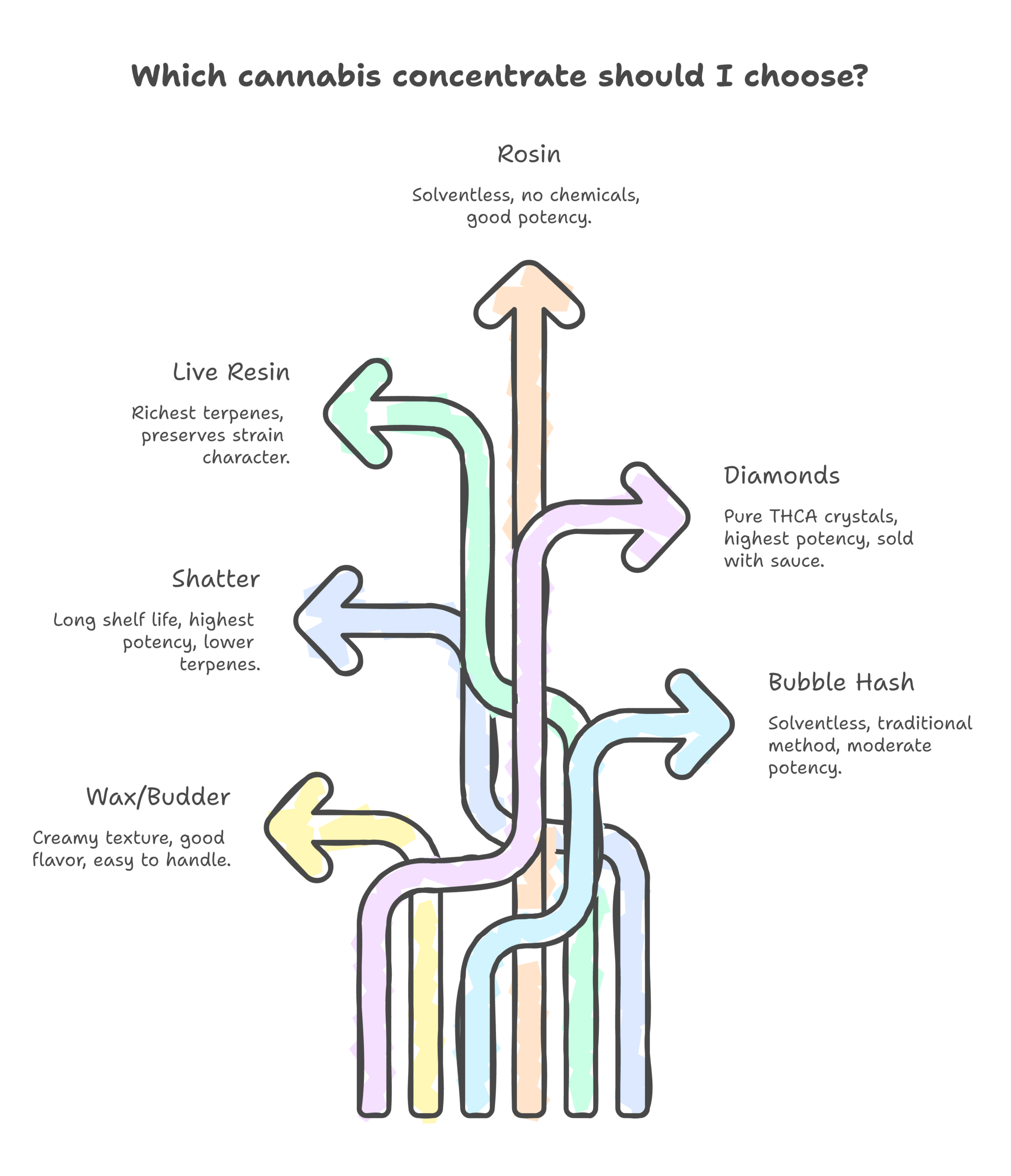
How to Choose the Right Concentrate
Your ideal concentrate depends on what you care about most. Here’s a practical breakdown to help narrow down the options:
Flavor is your priority? Go with live resin. The flash-frozen extraction preserves terpenes that other methods lose. If you want to truly taste the strain’s unique character, live resin is the way to go. Live rosin is another excellent choice if you prefer solventless products.
Maximum potency matters most? Shatter and diamonds are your best bet. Both deliver extremely high THC concentrations with minimal filler. Shatter is usually more affordable than diamonds and easier to find.
Convenience and versatility? Wax is probably your best all-rounder. It’s easy to dose, works with almost any consumption method, and hits a good middle ground between flavor and potency. Crumble, a drier variant of wax, is particularly easy to sprinkle onto flower in a joint or bowl.
Clean, solvent-free product? Rosin and bubble hash are your options. You’re paying a premium for the solventless extraction, but many consumers consider the peace of mind worth the extra cost. The FDA has noted the importance of understanding what goes into cannabis product manufacturing.
Consumption Methods for Concentrates
Dabbing remains the most popular way to consume concentrates. A dab rig works like a water pipe, but instead of a bowl, it uses a heated nail or banger (usually quartz, titanium, or ceramic). You heat the nail with a torch, let it cool slightly, then apply a small amount of concentrate. The concentrate vaporizes on contact and you inhale through the rig. Electronic nails (e-nails) take the guesswork out of temperature control. According to research published in ACS Omega, lower dab temperatures (around 315-450°F) preserve more terpenes and produce a smoother vapor.
Vape pens offer a portable, discreet option. Concentrate-compatible vape pens use a heated coil to vaporize the product. Some use pre-filled cartridges (usually with distillate or live resin), while others have a chamber where you load your own concentrate. The vape experience tends to be smoother and less intense than dabbing, making it more approachable for beginners.
Topping flower is the simplest approach. Sprinkle crumble over a packed bowl, or lay a thin line of wax inside a joint before rolling. This boosts the potency of your regular flower without requiring any specialized equipment. It’s a good way to experiment with concentrates before investing in a dab rig.
Nectar collectors (also called dab straws) are a middle ground between rigs and vape pens. You heat the tip and touch it directly to your concentrate while inhaling from the other end. They’re affordable, portable, and deliver potent hits without the complexity of a full rig setup.
Safety and Dosing Considerations
Concentrates demand more respect than flower when it comes to dosing. A single dab of 80% THC shatter delivers roughly four times the THC of a comparable-sized hit of 20% flower. The Centers for Disease Control and Prevention recommends that new users start with very small amounts and wait to feel the full effects before taking more.
For first-time concentrate users, start with a piece roughly the size of a grain of rice. Seriously, that small. The onset is rapid (usually within seconds when inhaled), and the effects are significantly stronger than what you’re used to from flower. You can always take more after 10-15 minutes, but you can’t take less once it’s in your system.
When purchasing concentrates, always check lab test results. Legitimate products should be tested for potency (THC/CBD percentages) and contaminants (residual solvents, pesticides, heavy metals, and microbials). Avoid products that don’t come with third-party lab results, as poorly purged BHO products can contain harmful levels of residual butane or propane.
📝 Important Note
Never attempt to make BHO (butane hash oil) at home. Butane is extremely flammable and has caused numerous explosions and serious injuries. Commercial extraction labs use closed-loop systems with proper ventilation and safety equipment. If you want to make concentrates at home, stick to solventless methods like rosin pressing.
Storage Tips for Cannabis Concentrates
Proper storage makes a real difference with concentrates. Heat, light, air, and humidity all degrade cannabinoids and terpenes over time. Here’s what actually works:
Keep concentrates in airtight silicone or glass containers. Glass is generally better for long-term storage since certain terpenes can interact with silicone over extended periods. Store in a cool, dark place. A drawer or cupboard works fine for short-term storage (a few weeks). For longer periods, some users refrigerate their concentrates, but let them come to room temperature before opening to prevent condensation.
Shatter is the most storage-friendly concentrate since its stable molecular structure resists degradation. Wax and live resin are more sensitive and should be consumed within a few weeks of purchase for the best flavor. If your shatter has started to “sugar up” (becoming opaque and grainy), it’s still safe to use, just losing some of its original consistency and terpene content. For a detailed guide on keeping all your cannabis products fresh, check our cannabis storage guide.
Frequently Asked Questions
What is the strongest type of cannabis concentrate?
THCA diamonds are the most potent, sometimes exceeding 99% purity. However, shatter and distillate also regularly test above 80-90% THC. For most practical purposes, the potency differences between high-quality shatter, wax, and live resin are relatively small compared to the flavor and terpene differences.
Are cannabis concentrates safe?
Lab-tested concentrates from licensed producers are generally considered safe for adult consumption. The main risks come from untested products that may contain residual solvents, pesticides, or other contaminants. Always buy from reputable sources and check for third-party lab results.
How much do cannabis concentrates cost?
Prices vary widely by market and product type. Generally, shatter and basic wax are the most affordable ($20-40/gram in mature markets), while live resin runs higher ($30-60/gram). Diamonds, live rosin, and other premium concentrates can cost $60-100+ per gram. On a per-dose basis though, concentrates are often comparable to or cheaper than flower due to the higher potency.
Can I eat cannabis concentrates directly?
Most concentrates contain THCA, which needs heat to convert into active THC (a process called decarboxylation). Eating raw shatter or wax won’t produce much effect. However, distillate is already decarboxylated, so it can be eaten directly or added to food. For other concentrates, you’d need to decarboxylate them first by applying gentle heat before incorporating them into edibles.
What equipment do I need to start dabbing?
At minimum, you need a dab rig (or a nectar collector for a simpler option), a torch, a dab tool for handling the concentrate, and the concentrate itself. E-nails or electronic dab rigs eliminate the need for a torch and offer precise temperature control. Vape pens designed for concentrates are the easiest entry point since they require zero setup.
⚠️ Disclaimer
This article is for informational purposes only and does not constitute medical advice. The information provided about cannabis concentrates is current as of March 2026 but may change. Always consult with qualified healthcare professionals for medical advice and treatment options. Cannabis laws vary by jurisdiction. For our full disclaimer, visit cannastoreams.gr/disclaimer.
